




Which of the following undergoes Ullmann reaction
(a)
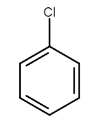
(b)
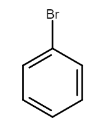
(C)
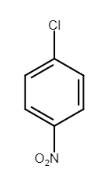
(d)
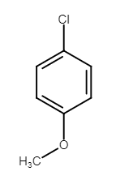
Answer
 Verified
605.7k+ views
Hint: Ullmann reaction also known as Ullmann coupling is an organic coupling reaction between aryl halides and yields bi-aryl as a product in the presence of copper and bronze $ ( $ Palladium and Nickel can also act as effective catalyst $ ) $ . So, we need to find the compound that will most easily form the product.
Complete step by step solution:
Ullmann reaction is an organic coupling reaction also known as Ullmann coupling after German chemist Fritz Ullmann in which two aryl halides react with one another in presence of copper and bronze as catalysts to yield bi-aryl as the product. The steps involved in the reaction are:
$ \bullet $ The first step involves the formation of an activated $ Cu\,\left( I \right) $ species, when aryl halide is introduced to an excess metallic copper under relatively high temperatures.
$ Ph - I\, + \,Cu\,\xrightarrow[{addition}]{{oxidative}}\,Ph - CuI\, \to \,Ph - Cu $ .
$ \bullet $ The activated $ Cu\,\left( I \right) $ species undergoes oxidative addition with another haloarene molecule linking the two molecules.
$ Ph - Cu\, + \,I - Ph\,\xrightarrow[{addition}]{{oxidative}}\,Ph - CuI - Ph $ .
$ \bullet $ Lastly, the compound formed undergoes reductive elimination resulting in the formation of a new carbon-carbon bond between the two aryl compounds giving us the final product.
$ Ph - CuI - Ph\,\xrightarrow[{e\lim ination}]{{reductive}}\,Ph - Ph\, + \,CuI $ .
The yield obtained in the Ullmann reaction is very low. So an electron withdrawing group is inserted in the aryl halide in order to increase the yield of the reaction.
An example of this reaction is:
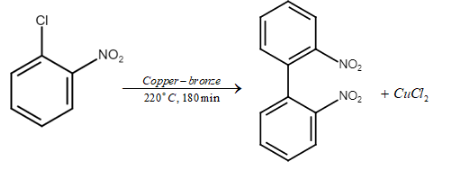
Since in $ Cl - {C_6}{H_4} - N{O_2} $ an electron withdrawing group $ - N{O_2} $ is present at the para position it undergoes Ullmann reaction to give better yield.
The equation involved is:
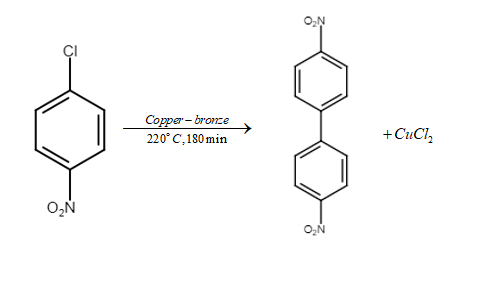
So the correct answer is (c).
Note:
As the yield obtained in the Ullmann reaction is low, modern variants of the Ullman reaction are used which uses palladium and nickel as catalysts. This renders the reaction condition to be mild but yields are generally still moderate. Ullmann synthesis of biaryl compounds can be used to generate chiral products from chiral reactants.
Complete step by step solution:
Ullmann reaction is an organic coupling reaction also known as Ullmann coupling after German chemist Fritz Ullmann in which two aryl halides react with one another in presence of copper and bronze as catalysts to yield bi-aryl as the product. The steps involved in the reaction are:
$ \bullet $ The first step involves the formation of an activated $ Cu\,\left( I \right) $ species, when aryl halide is introduced to an excess metallic copper under relatively high temperatures.
$ Ph - I\, + \,Cu\,\xrightarrow[{addition}]{{oxidative}}\,Ph - CuI\, \to \,Ph - Cu $ .
$ \bullet $ The activated $ Cu\,\left( I \right) $ species undergoes oxidative addition with another haloarene molecule linking the two molecules.
$ Ph - Cu\, + \,I - Ph\,\xrightarrow[{addition}]{{oxidative}}\,Ph - CuI - Ph $ .
$ \bullet $ Lastly, the compound formed undergoes reductive elimination resulting in the formation of a new carbon-carbon bond between the two aryl compounds giving us the final product.
$ Ph - CuI - Ph\,\xrightarrow[{e\lim ination}]{{reductive}}\,Ph - Ph\, + \,CuI $ .
The yield obtained in the Ullmann reaction is very low. So an electron withdrawing group is inserted in the aryl halide in order to increase the yield of the reaction.
An example of this reaction is:
Since in $ Cl - {C_6}{H_4} - N{O_2} $ an electron withdrawing group $ - N{O_2} $ is present at the para position it undergoes Ullmann reaction to give better yield.
The equation involved is:
So the correct answer is (c).
Note:
As the yield obtained in the Ullmann reaction is low, modern variants of the Ullman reaction are used which uses palladium and nickel as catalysts. This renders the reaction condition to be mild but yields are generally still moderate. Ullmann synthesis of biaryl compounds can be used to generate chiral products from chiral reactants.
Recently Updated Pages
If x a + bt + ct2 where x is in meters and t is in class 11 physics CBSE

A car covers the first half distance between two places class 11 physics CBSE
The resultant of two vectors overrightarrow P and overrightarrow class 11 physics CBSE
Find the value of cos 135 class 11 maths CBSE
A mass M is held in place by an applied force F and class 11 physics CBSE
A solution of glucose in water is labelled as 10 dfracwv class 11 chemistry CBSE
Trending doubts
One Metric ton is equal to kg A 10000 B 1000 C 100 class 11 physics CBSE
Find the value of the expression given below sin 30circ class 11 maths CBSE
What do you mean by retardation What is its SI uni class 11 physics CBSE
Draw a diagram of nephron and explain its structur class 11 biology CBSE
10 examples of friction in our daily life
Difference between physical and chemical change class 11 chemistry CBSE