




Which of the following store proteins?
(a) Chromoplasts
(b) Aleuroplasts
(c) Amyloplasts
(d) Elaioplasts
Answer
 Verified
591.6k+ views
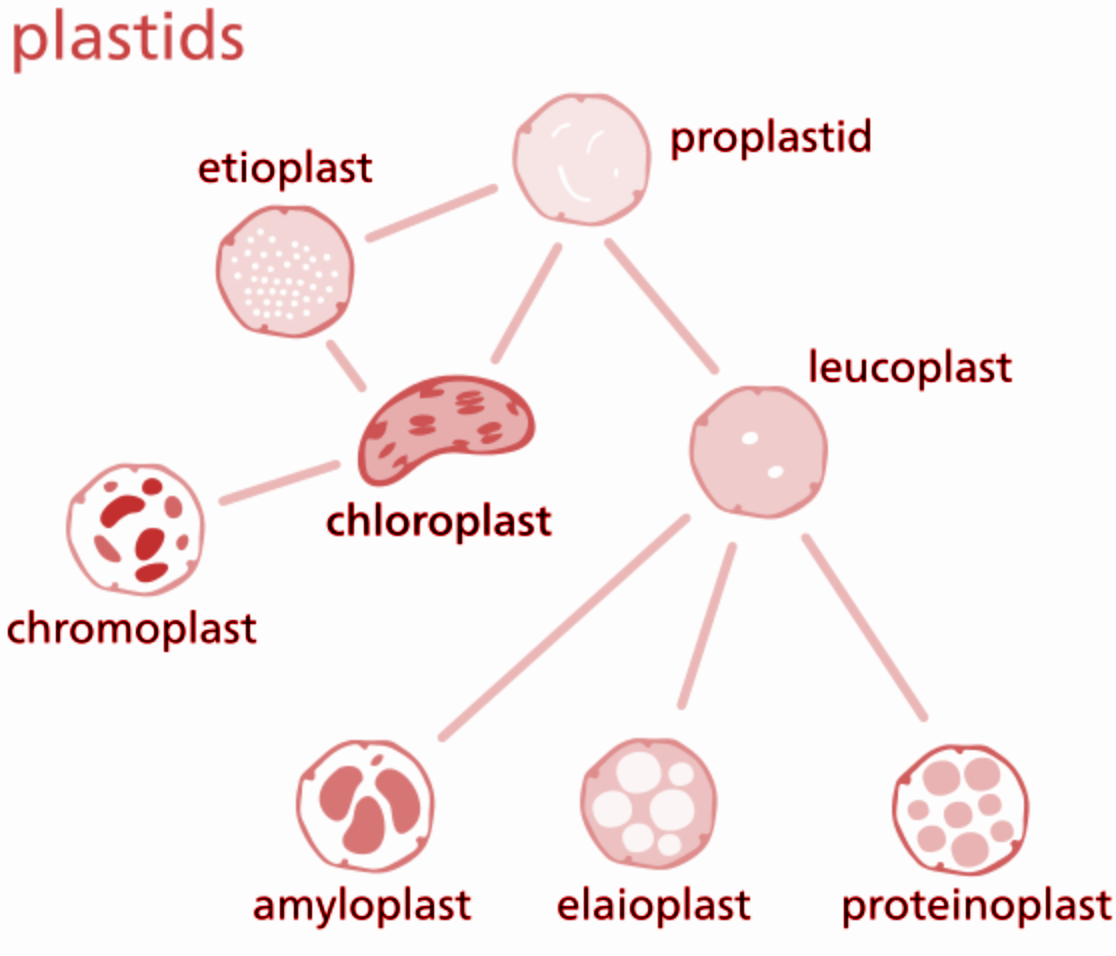
Hint: Plastids are cell organelles found in plant cells and euglenoids that are easily observed by microscope as they are large in size. Plastids contain pigments in them which are responsible for giving color to the cells. On the basis of pigments, plastids are characterized into chloroplasts, chromoplasts, and leucoplasts.
Complete Answer:
The chloroplasts contain green colored pigments in them known as chlorophyll which is essential for trapping light during photosynthesis. Chromoplasts also store pigments but other than green pigments, such as carotenoids like carotene, xanthophylls, etc. They are responsible for giving red, yellow, or orange color to the plant. Leucoplasts do not store pigments and thus are colorless, but they store nutrients such as amyloplasts store starch, elaioplasts store oils and fats, and aleuroplasts store proteins.
Additional information: Let us look at the structure of chloroplast in detail.
Chloroplasts are double membrane-bound cell organelles. The inner membrane of the chloroplast is relatively less permeable.
The space inside the inner membrane of the chloroplast is known as stoma and it contains flattened membranous sacs called thylakoids in it. The thylakoids are arranged in stacks like piles of coins known as grana.
Stroma lamellae are the structures that connect the thylakoids of different grana.
The membrane of the thylakoids encloses a space known as lumen in which a hydrogen gradient is developed.
The stroma also contains enzymes for the synthesis of carbohydrate and proteins, double-stranded circular DNA, and ribosomes.
So, the correct option is ‘(b) Aleuroplasts’.
Note: Chloroplasts are mostly found inside the mesophyll cells of the leaves. Their number varies from 1 cell in Chlamydomonas which is a green alga to 20-40 chloroplasts in mesophyll cells. The shape of chloroplasts can be lens-shaped, oval, spherical, discoid, or even ribbon-like.
Complete Answer:
The chloroplasts contain green colored pigments in them known as chlorophyll which is essential for trapping light during photosynthesis. Chromoplasts also store pigments but other than green pigments, such as carotenoids like carotene, xanthophylls, etc. They are responsible for giving red, yellow, or orange color to the plant. Leucoplasts do not store pigments and thus are colorless, but they store nutrients such as amyloplasts store starch, elaioplasts store oils and fats, and aleuroplasts store proteins.
Additional information: Let us look at the structure of chloroplast in detail.
Chloroplasts are double membrane-bound cell organelles. The inner membrane of the chloroplast is relatively less permeable.
The space inside the inner membrane of the chloroplast is known as stoma and it contains flattened membranous sacs called thylakoids in it. The thylakoids are arranged in stacks like piles of coins known as grana.
Stroma lamellae are the structures that connect the thylakoids of different grana.
The membrane of the thylakoids encloses a space known as lumen in which a hydrogen gradient is developed.
The stroma also contains enzymes for the synthesis of carbohydrate and proteins, double-stranded circular DNA, and ribosomes.
So, the correct option is ‘(b) Aleuroplasts’.
Note: Chloroplasts are mostly found inside the mesophyll cells of the leaves. Their number varies from 1 cell in Chlamydomonas which is a green alga to 20-40 chloroplasts in mesophyll cells. The shape of chloroplasts can be lens-shaped, oval, spherical, discoid, or even ribbon-like.
Recently Updated Pages
Master Class 11 Social Science: Engaging Questions & Answers for Success

Master Class 11 English: Engaging Questions & Answers for Success
Master Class 11 Maths: Engaging Questions & Answers for Success
Master Class 11 Chemistry: Engaging Questions & Answers for Success
Master Class 11 Biology: Engaging Questions & Answers for Success
Master Class 11 Physics: Engaging Questions & Answers for Success
Trending doubts
One Metric ton is equal to kg A 10000 B 1000 C 100 class 11 physics CBSE
Difference Between Prokaryotic Cells and Eukaryotic Cells
How many of the following diseases can be studied with class 11 biology CBSE
Which of the following enzymes is used for carboxylation class 11 biology CBSE
Two of the body parts which do not appear in MRI are class 11 biology CBSE
Draw a diagram of a plant cell and label at least eight class 11 biology CBSE