




Which of the following statements regarding the structure of the microsporangium are correct?
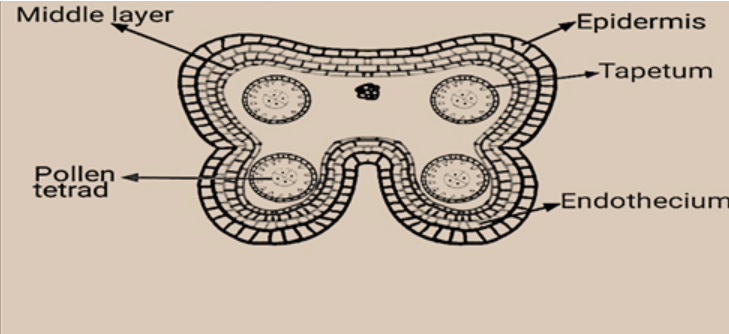
(i)Microsporangium is generally surrounded by four wall layers-epidermis, endothecium, middle layers, and tapetum.
(ii)The outer three layers perform functions of protection and dehiscence of anthers.
(iii)Cells of tapetum undergo meiosis and produce microscope tetrads.
(a)(i) and (ii)
(b)(ii) and (iii)
(c)(i) and (iii)
(d)(i), (ii) and (iii)
Answer
 Verified
640.8k+ views
Hint: The microsporangium is also known as the pollen sac as it contains pollen grains and appears circular in the transverse section. The walls of the microsporangium perform various functions from nourishment to the dispersal of pollen grains.
Complete answer:
The Microsporangia wall has four types of layers, which are epidermis, endothecium, middle layers (1 to 3) of parenchyma cells, and the tapetum. The function of protection in the young anther and mechanism of dehiscence of the ripened anther is performed by the external three layers of the microsporangium.
Additional Information: -The endothecium is the outermost wall layer, lying just below the epidermis is also known as the fibrous layer, because the wall develops fibrous thickening on them, except at the junction of the two pollen sacs.
-Tapetum cells are elongated and rich in protoplasmic content. They are the cells of the innermost wall layer. It forms the nutritive tissue for the nourishment of the developing microspores.
-The cells of the tapetum may be multinucleate or may have a large polyploid nucleus.
-During the microsporogenesis (formation of microspores), the nucleus of each microspore mother cell undergoes meiosis and gives rise to four haploid nuclei known as microspore tetrads.
-A haploid pollen grain develops from the diploid microspore mother cell in the pollen sacs of anthers. It is a single haploid body with a single nucleus.
So, the correct answer is, ‘(i) and (ii).’
Note: In the beginning, the microsporocytes are polygonal and closely packed, but as the anther enlarges, the pollen sac becomes spacious and gets loosely arranged. A few microspore mother cells (microsporocytes) become non-functional and are finally absorbed by the developing microspores.
Complete answer:
The Microsporangia wall has four types of layers, which are epidermis, endothecium, middle layers (1 to 3) of parenchyma cells, and the tapetum. The function of protection in the young anther and mechanism of dehiscence of the ripened anther is performed by the external three layers of the microsporangium.
Additional Information: -The endothecium is the outermost wall layer, lying just below the epidermis is also known as the fibrous layer, because the wall develops fibrous thickening on them, except at the junction of the two pollen sacs.
-Tapetum cells are elongated and rich in protoplasmic content. They are the cells of the innermost wall layer. It forms the nutritive tissue for the nourishment of the developing microspores.
-The cells of the tapetum may be multinucleate or may have a large polyploid nucleus.
-During the microsporogenesis (formation of microspores), the nucleus of each microspore mother cell undergoes meiosis and gives rise to four haploid nuclei known as microspore tetrads.
-A haploid pollen grain develops from the diploid microspore mother cell in the pollen sacs of anthers. It is a single haploid body with a single nucleus.
So, the correct answer is, ‘(i) and (ii).’
Note: In the beginning, the microsporocytes are polygonal and closely packed, but as the anther enlarges, the pollen sac becomes spacious and gets loosely arranged. A few microspore mother cells (microsporocytes) become non-functional and are finally absorbed by the developing microspores.
Recently Updated Pages
Basicity of sulphurous acid and sulphuric acid are

Master Class 12 Economics: Engaging Questions & Answers for Success
Master Class 12 Biology: Engaging Questions & Answers for Success
Master Class 11 English: Engaging Questions & Answers for Success
Master Class 11 Physics: Engaging Questions & Answers for Success
Master Class 11 Computer Science: Engaging Questions & Answers for Success
Trending doubts
Draw a labelled sketch of the human eye class 12 physics CBSE
The chemical formula of tear gas is A CO Cl 2 B C 10 class 12 chemistry CBSE
Draw ray diagrams each showing i myopic eye and ii class 12 physics CBSE
Which are the Top 10 Largest Countries of the World?
Differentiate between homogeneous and heterogeneous class 12 chemistry CBSE
Which is the correct genotypic ratio of mendel dihybrid class 12 biology CBSE