




Which of the following statements regarding these glands is not correct?
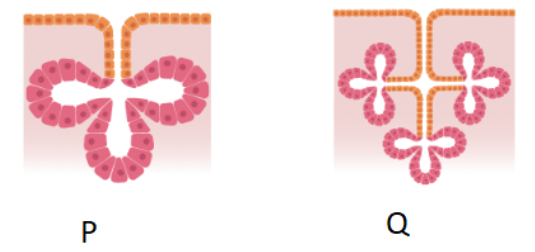
A. These are the multicellular glands that pour their secretions directly through ducts at the site of action
B. Sebaceous glands in human skin are ‘P’ type of glands
C. Brunner’s gland of human intestine and sweat glands of human skin is ‘Q’ type of glands
D. In the ‘P’ type of glands, the secretory portion comprises a flask-like structure wherein in the ‘Q’ type of glands, the secretory portion is both tubular and flask-shaped.
Answer
 Verified
587.7k+ views
Hint: Gland refers to an organ present in the body which produces and releases substances in less quantity but are very much important for the functioning of the body. There are various different types of glands present in the human body.
Complete answer:
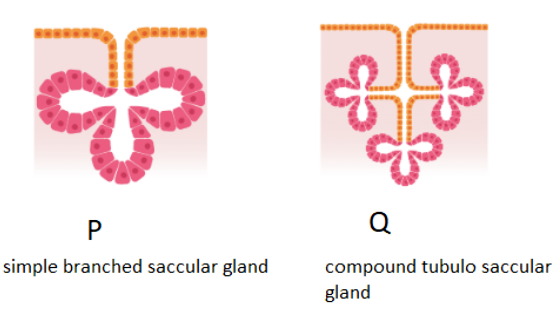
The glands present in the human body are the accessory organs that regulate various processes of the body. These glands secrete hormones which are released in less quantity but regulate important functions of the body and maintain the balance and homeostasis of the body. These glands can be further classified as endocrine glands and exocrine glands. Endocrine glands refer to the gland which secretes their production into the body directly into the bloodstream. Exocrine glands release their secretion into the body cavities. The above-given diagrams P and Q are of simple branched saccular gland and compound tubular saccular glands respectively. Saccular glands are also called alveolar glands. These glands have a sac-like structures and thus called saccular glands. These are multicellular glands and their secretions are poured at the site of action through the ducts. Sebaceous glands present in the human body are of a simple branched saccular type. These glands secrete a substance called sebum which is an oil substance. Hence, also called oil glands. Sweat glands present in the human body are of simple small tubular structures and not compound tubulo saccular glands. Brunner’s glands are compound tubular submucosal glands.
So, option C is the correct answer.
Note: Liver is the largest gland. Different types of endocrine glands are thymus gland, pineal gland, pituitary gland, thyroid gland, and adrenal glands. Types of exocrine glands present in the human body are Apocrine glands, holocrine glands, merocrine glands, serous glands, mucous glands, and sebaceous glands.
Complete answer:
The glands present in the human body are the accessory organs that regulate various processes of the body. These glands secrete hormones which are released in less quantity but regulate important functions of the body and maintain the balance and homeostasis of the body. These glands can be further classified as endocrine glands and exocrine glands. Endocrine glands refer to the gland which secretes their production into the body directly into the bloodstream. Exocrine glands release their secretion into the body cavities. The above-given diagrams P and Q are of simple branched saccular gland and compound tubular saccular glands respectively. Saccular glands are also called alveolar glands. These glands have a sac-like structures and thus called saccular glands. These are multicellular glands and their secretions are poured at the site of action through the ducts. Sebaceous glands present in the human body are of a simple branched saccular type. These glands secrete a substance called sebum which is an oil substance. Hence, also called oil glands. Sweat glands present in the human body are of simple small tubular structures and not compound tubulo saccular glands. Brunner’s glands are compound tubular submucosal glands.
So, option C is the correct answer.
Note: Liver is the largest gland. Different types of endocrine glands are thymus gland, pineal gland, pituitary gland, thyroid gland, and adrenal glands. Types of exocrine glands present in the human body are Apocrine glands, holocrine glands, merocrine glands, serous glands, mucous glands, and sebaceous glands.
Recently Updated Pages
Master Class 11 Social Science: Engaging Questions & Answers for Success

Master Class 11 English: Engaging Questions & Answers for Success
Master Class 11 Maths: Engaging Questions & Answers for Success
Master Class 11 Chemistry: Engaging Questions & Answers for Success
Master Class 11 Biology: Engaging Questions & Answers for Success
Master Class 11 Physics: Engaging Questions & Answers for Success
Trending doubts
One Metric ton is equal to kg A 10000 B 1000 C 100 class 11 physics CBSE
Difference Between Prokaryotic Cells and Eukaryotic Cells
How many of the following diseases can be studied with class 11 biology CBSE
Which of the following enzymes is used for carboxylation class 11 biology CBSE
Draw a diagram of a plant cell and label at least eight class 11 biology CBSE
Two of the body parts which do not appear in MRI are class 11 biology CBSE