




Which of the following statements are false for properties of electromagnetic waves?
A) Both electric and magnetic field vectors attend the maximum and minimum at same place and same time.
B) The energy and electromagnetic wave is divided equally between electric and magnetic field vectors.
C) Both electric and magnetic field vectors are parallel to each other and perpendicular to the direction of propagation of waves.
D) These waves do not require any material medium for propagation.
Answer
 Verified
618k+ views
Hint: We know that in an electromagnetic wave Both electric and magnetic field vectors are perpendicular to each other and perpendicular to the direction of propagation of the wave, it doesn’t require any medium for propagation.
Complete step by step solution:
Propagation of electromagnetic waves be like:
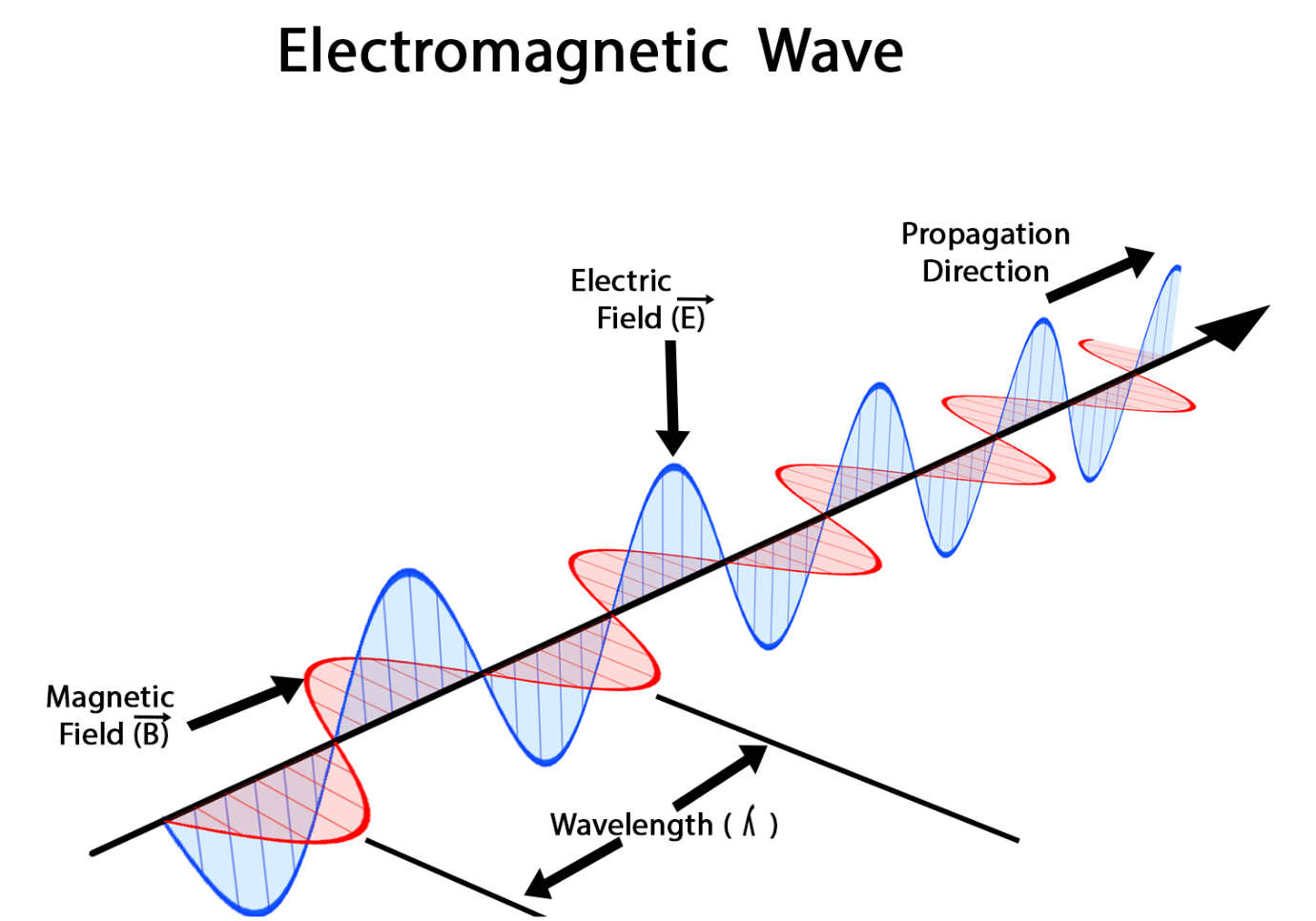
As we see in the diagram, Both electric and magnetic field vectors attend the maximum and minimum at same place and same time, Both electric and magnetic field vectors are parallel to each other and perpendicular to the direction of propagation of the wave.
We know that electromagnetic waves don't need any medium to propagate, it also propagates in vacuum.
The energy of the electromagnetic is in a bundle form. There is no energy flow from one node to another node. Energy is bounded between two nodes but there is the flow of energy within node to node. The energy and electromagnetic wave is divided equally between electric and magnetic field vector
Hence, option (C) is correct.
Additional Information:
All electromagnetic waves travel across space at the speed of light, which is about $300$ million meters per second 3.0 $ \times {{10}^{8}}$ m/s. Electromagnetic waves vary in wavelength and frequency. Longer wavelength electromagnetic waves have lower frequencies, and shorter wavelength waves have higher frequencies. Higher frequency waves have more energy. The speed of a wave is a product of its wavelength and frequency. Because the speed of electromagnetic waves through space is constant, the wavelength or frequency of an electromagnetic wave can be calculated if the other value is known.
Note: We have to remember that the direction of wave propagation of electromagnetic waves is always perpendicular to electric vector, and magnetic vector both. And these two vectors are also always perpendicular to each other.
Complete step by step solution:
Propagation of electromagnetic waves be like:
As we see in the diagram, Both electric and magnetic field vectors attend the maximum and minimum at same place and same time, Both electric and magnetic field vectors are parallel to each other and perpendicular to the direction of propagation of the wave.
We know that electromagnetic waves don't need any medium to propagate, it also propagates in vacuum.
The energy of the electromagnetic is in a bundle form. There is no energy flow from one node to another node. Energy is bounded between two nodes but there is the flow of energy within node to node. The energy and electromagnetic wave is divided equally between electric and magnetic field vector
Hence, option (C) is correct.
Additional Information:
All electromagnetic waves travel across space at the speed of light, which is about $300$ million meters per second 3.0 $ \times {{10}^{8}}$ m/s. Electromagnetic waves vary in wavelength and frequency. Longer wavelength electromagnetic waves have lower frequencies, and shorter wavelength waves have higher frequencies. Higher frequency waves have more energy. The speed of a wave is a product of its wavelength and frequency. Because the speed of electromagnetic waves through space is constant, the wavelength or frequency of an electromagnetic wave can be calculated if the other value is known.
Note: We have to remember that the direction of wave propagation of electromagnetic waves is always perpendicular to electric vector, and magnetic vector both. And these two vectors are also always perpendicular to each other.
Recently Updated Pages
Master Class 12 Business Studies: Engaging Questions & Answers for Success

Master Class 12 Chemistry: Engaging Questions & Answers for Success
Master Class 12 Biology: Engaging Questions & Answers for Success
Class 12 Question and Answer - Your Ultimate Solutions Guide
Master Class 11 English: Engaging Questions & Answers for Success
Master Class 11 Social Science: Engaging Questions & Answers for Success
Trending doubts
Which are the Top 10 Largest Countries of the World?
Draw a labelled sketch of the human eye class 12 physics CBSE
Differentiate between homogeneous and heterogeneous class 12 chemistry CBSE
Differentiate between Pyramid of energy and pyramid class 12 biology CBSE
Why is the cell called the structural and functional class 12 biology CBSE
Draw the diagram of the pyramid of energy Explain In class 12 biology CBSE