




Which of the following require maximum energy?
A) Secondary consumer
B) Decomposer
C) Primary consumer
D) Primary producer
Answer
 Verified
518.4k+ views
Hint: The flow of energy in the form of food takes place from the producers followed by consumers and then decomposers. These are termed as different trophic levels in a food chain. Only ten percent of the energy is transferred to the next trophic level.
Complete answer:
The food chain represents the linear flow of energy in terms of food in an ecosystem. It shows which organisms eat whom. Each level in a food chain is known as the trophic level. The ultimate source of energy in the ecosystem is the sun. The energy of the sun is harnessed by the producers which are consumed by consumers and then decomposers.
Let us discuss each trophic level-
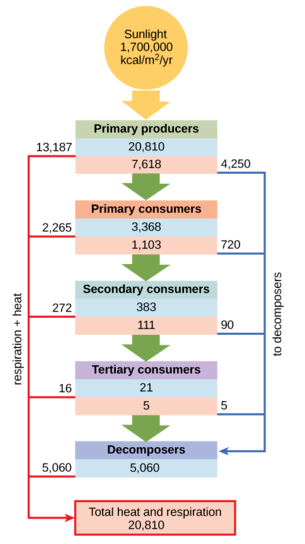
I) Primary producers are the autotrophs or the plants which convert the solar energy into chemical energy which can be utilised by other organisms. The maximum energy is required as well as produced in this trophic level as the other organisms depend directly or indirectly on the producers for food and energy.
II) Primary consumers- This level comprises herbivores that depend on the producers completely. They receive only ten percent of the energy produced from the producers.
III) Secondary consumers include the carnivores which feed on the primary consumers. They receive only ten percent of the energy from the primary consumers.
IV) Decomposers- They occupy the highest trophic level. The energy requirement is the lowest at this level. They feed on the dead remains of plants and animals.
Therefore the correct answer is option ‘D’.
Note: There is successive loss of energy as we move up in the trophic levels. Only ten percent of energy is passed on to the next level and the rest ninety percent is lost in the form of heat. So the pyramid of energy is always upright.
Complete answer:
The food chain represents the linear flow of energy in terms of food in an ecosystem. It shows which organisms eat whom. Each level in a food chain is known as the trophic level. The ultimate source of energy in the ecosystem is the sun. The energy of the sun is harnessed by the producers which are consumed by consumers and then decomposers.
Let us discuss each trophic level-
I) Primary producers are the autotrophs or the plants which convert the solar energy into chemical energy which can be utilised by other organisms. The maximum energy is required as well as produced in this trophic level as the other organisms depend directly or indirectly on the producers for food and energy.
II) Primary consumers- This level comprises herbivores that depend on the producers completely. They receive only ten percent of the energy produced from the producers.
III) Secondary consumers include the carnivores which feed on the primary consumers. They receive only ten percent of the energy from the primary consumers.
IV) Decomposers- They occupy the highest trophic level. The energy requirement is the lowest at this level. They feed on the dead remains of plants and animals.
Therefore the correct answer is option ‘D’.
Note: There is successive loss of energy as we move up in the trophic levels. Only ten percent of energy is passed on to the next level and the rest ninety percent is lost in the form of heat. So the pyramid of energy is always upright.
Recently Updated Pages
Master Class 11 Social Science: Engaging Questions & Answers for Success

Master Class 11 English: Engaging Questions & Answers for Success
Master Class 11 Maths: Engaging Questions & Answers for Success
Master Class 11 Chemistry: Engaging Questions & Answers for Success
Master Class 11 Biology: Engaging Questions & Answers for Success
Master Class 11 Physics: Engaging Questions & Answers for Success
Trending doubts
Differentiate between an exothermic and an endothermic class 11 chemistry CBSE
One Metric ton is equal to kg A 10000 B 1000 C 100 class 11 physics CBSE
Difference Between Prokaryotic Cells and Eukaryotic Cells
There are 720 permutations of the digits 1 2 3 4 5 class 11 maths CBSE
Draw a diagram of a plant cell and label at least eight class 11 biology CBSE
Two of the body parts which do not appear in MRI are class 11 biology CBSE