




Which of the following represents the correct direction of passage of an impulse in a multipolar neuron?
A. Collaterals- axon- Soma- Dendrite
B. Dendrites- Soma- Axon-Terminal arborization
C. Dendrites- Axon-Soma= Collaterals
D. Soma-Dendrite = Axon = Terminal arborization
Answer
 Verified
506.7k+ views
Hint: The passing of information from axons to dendrites carry through neurotransmitters. Neurotransmitters are neuron signals which pass information in the form of transmitters. In a nerve ganglia or neuron or nerve cell, the dendrites are placed in the head region which is exactly the posterior to another neuron.
Complete answer:
Option A: Collaterals- axon- Soma- Dendrite- axon is the terminal end of the neuron cell, then dendrite is present at the head region.
Option A is not the correct answer.
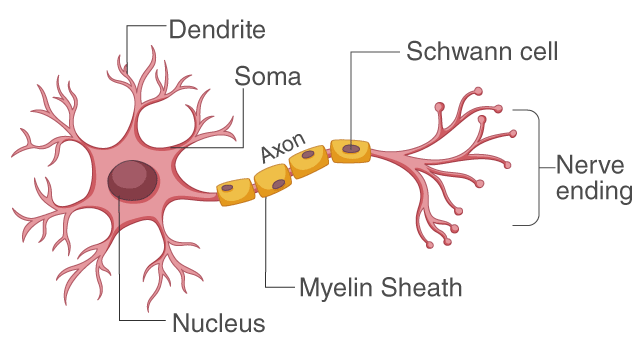
Option B: Dendrites- Soma- Axon-Terminal arborization- action potential is the transmission of neuro-transmitters from axon to the dendrites.
Option B is the correct answer.
Option C: Dendrites- Axon-Soma= Collaterals- signal propagation or signal transduction is the transmission of signals as in information from one axon ending to dendritic anterior head.
Option C is not the correct answer.
Option D: Soma-Dendrite = Axon = Terminal arborization- terminal arborization is the stoppage of signals resulting that action potential is over. No further signal transduction will occur.
Option D is not the correct answer.
Therefore, Option B is the correct answer.
Note:
Nerve cell or neuron is the functional and structural unit of the nervous system. The presence of nerve ganglia, axons and dendritic cells all combine to form the nerve cell. The nerve cell has only one major function to carry and process information in the form of signals through neuro-transmitters. A nerve cell has a head, cell body and tail.
Complete answer:
Option A: Collaterals- axon- Soma- Dendrite- axon is the terminal end of the neuron cell, then dendrite is present at the head region.
Option A is not the correct answer.
Option B: Dendrites- Soma- Axon-Terminal arborization- action potential is the transmission of neuro-transmitters from axon to the dendrites.
Option B is the correct answer.
Option C: Dendrites- Axon-Soma= Collaterals- signal propagation or signal transduction is the transmission of signals as in information from one axon ending to dendritic anterior head.
Option C is not the correct answer.
Option D: Soma-Dendrite = Axon = Terminal arborization- terminal arborization is the stoppage of signals resulting that action potential is over. No further signal transduction will occur.
Option D is not the correct answer.
Therefore, Option B is the correct answer.
Note:
Nerve cell or neuron is the functional and structural unit of the nervous system. The presence of nerve ganglia, axons and dendritic cells all combine to form the nerve cell. The nerve cell has only one major function to carry and process information in the form of signals through neuro-transmitters. A nerve cell has a head, cell body and tail.
Recently Updated Pages
Master Class 11 Computer Science: Engaging Questions & Answers for Success

Master Class 11 Business Studies: Engaging Questions & Answers for Success
Master Class 11 Economics: Engaging Questions & Answers for Success
Master Class 11 English: Engaging Questions & Answers for Success
Master Class 11 Maths: Engaging Questions & Answers for Success
Master Class 11 Biology: Engaging Questions & Answers for Success
Trending doubts
One Metric ton is equal to kg A 10000 B 1000 C 100 class 11 physics CBSE
There are 720 permutations of the digits 1 2 3 4 5 class 11 maths CBSE
Discuss the various forms of bacteria class 11 biology CBSE
Draw a diagram of a plant cell and label at least eight class 11 biology CBSE
State the laws of reflection of light
10 examples of friction in our daily life