




Which of the following represents the correct combination without any exception?
Characteristics Class 1. Sucking and circular mouth, jaws absent, integument without scales, paired appendages Cyclostomata 2. Body covered with feathers, skin moist and glandular, forelimbs form wings, lungs with air sacs Aves 3. Mammary gland, the hair on the body, pinnae, two pairs of limbs Mammalia 4. Mouth ventral, gills without operculum, skin with placoid scales, persistent notochord Chondrichthyes
A. 3
B. 1
C. 2
D. 4
| Characteristics | Class | |
| 1. | Sucking and circular mouth, jaws absent, integument without scales, paired appendages | Cyclostomata |
| 2. | Body covered with feathers, skin moist and glandular, forelimbs form wings, lungs with air sacs | Aves |
| 3. | Mammary gland, the hair on the body, pinnae, two pairs of limbs | Mammalia |
| 4. | Mouth ventral, gills without operculum, skin with placoid scales, persistent notochord | Chondrichthyes |
Answer
 Verified
593.1k+ views
Hint: Vertebrates are a member of a large group that includes skates, rays, and chimeras. Vertebrates are by far the most complex species that are unable to adapt quickly to changes in the environment, and a few of them are often used for many different purposes and sources of food.
Complete answer: Classification of kingdom Vertebrata is as follows:
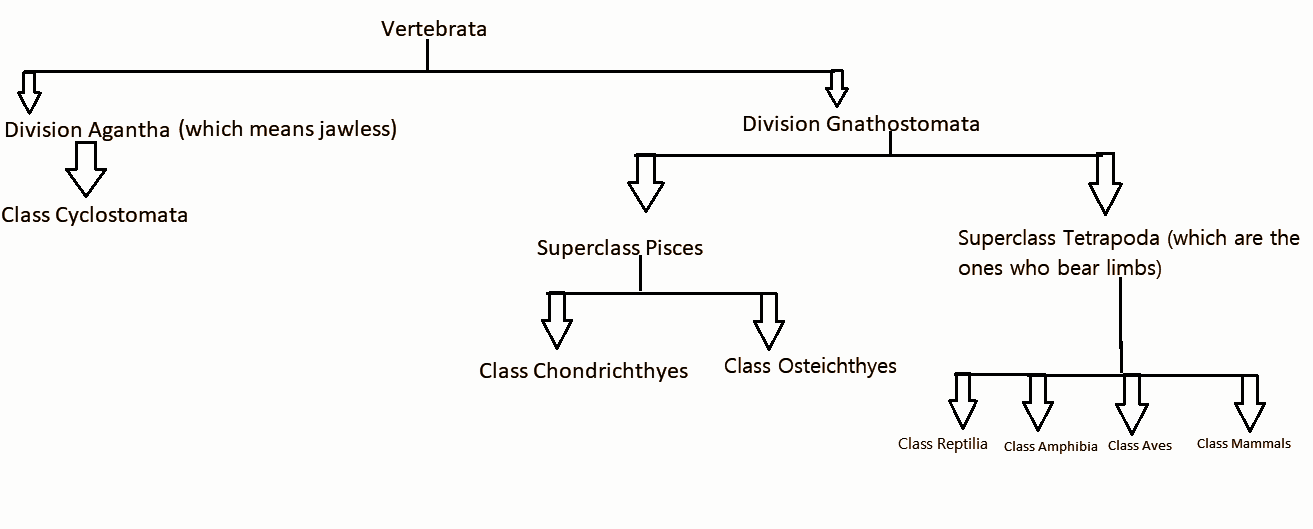
Let us look at all the options to get the correct answer,
-Cyclostomata lacks teeth, and have sucked and circular mouths. There are median fins (appendages), but however paired fins (appendages) are absent. Integuments do not have scales, e.g., Lamprey and hagfish.
-In aves, the forelimbs are transformed for flight into wings, and hind limbs are used for running and walking. The skin layer is thin, dry, and non-glandular. The body is coated with feathers. The lungs have sacks of air.
-Mammary glands are found in mammals for the feeding of young ones. Hair is seen on the body. They've got two sets of lower legs. Pinnae are absent in monotreme (egg-laying mammals).
-Chondrichthyes, as the exoskeleton and ventrally positioned jaw, have persistent notochord, and placoid scales. An operculum does not cover the gill slits.
Thus, choice D is the correct answer.
Note: Agnatha are fish that are jawless. There are lampreys and hagfish in this class. The earliest vertebrates are likely to be members of the agnatha class. Fossils of agnatha organisms from the late cambrian period that occurred 500 million years ago have been discovered by scientists. Gnathostoma is a genus of parasitic nematodes. Gnathostomiasis can be caused by the Gnathostoma spinigerum species and Gnathostoma hispidum. In the USA, neuro gnathostomiasis is seen.
Complete answer: Classification of kingdom Vertebrata is as follows:
Let us look at all the options to get the correct answer,
-Cyclostomata lacks teeth, and have sucked and circular mouths. There are median fins (appendages), but however paired fins (appendages) are absent. Integuments do not have scales, e.g., Lamprey and hagfish.
-In aves, the forelimbs are transformed for flight into wings, and hind limbs are used for running and walking. The skin layer is thin, dry, and non-glandular. The body is coated with feathers. The lungs have sacks of air.
-Mammary glands are found in mammals for the feeding of young ones. Hair is seen on the body. They've got two sets of lower legs. Pinnae are absent in monotreme (egg-laying mammals).
-Chondrichthyes, as the exoskeleton and ventrally positioned jaw, have persistent notochord, and placoid scales. An operculum does not cover the gill slits.
Thus, choice D is the correct answer.
Note: Agnatha are fish that are jawless. There are lampreys and hagfish in this class. The earliest vertebrates are likely to be members of the agnatha class. Fossils of agnatha organisms from the late cambrian period that occurred 500 million years ago have been discovered by scientists. Gnathostoma is a genus of parasitic nematodes. Gnathostomiasis can be caused by the Gnathostoma spinigerum species and Gnathostoma hispidum. In the USA, neuro gnathostomiasis is seen.
Recently Updated Pages
Master Class 11 Social Science: Engaging Questions & Answers for Success

Master Class 11 English: Engaging Questions & Answers for Success
Master Class 11 Maths: Engaging Questions & Answers for Success
Master Class 11 Chemistry: Engaging Questions & Answers for Success
Master Class 11 Biology: Engaging Questions & Answers for Success
Master Class 11 Physics: Engaging Questions & Answers for Success
Trending doubts
Differentiate between an exothermic and an endothermic class 11 chemistry CBSE
One Metric ton is equal to kg A 10000 B 1000 C 100 class 11 physics CBSE
Difference Between Prokaryotic Cells and Eukaryotic Cells
There are 720 permutations of the digits 1 2 3 4 5 class 11 maths CBSE
Two of the body parts which do not appear in MRI are class 11 biology CBSE
Which gas is abundant in air class 11 chemistry CBSE