




Which of the following regions of the alimentary canal of man does not secrete a digestive enzyme?
(a)Oesophagus
(b)Stomach
(c)Duodenum
(d)Mouth
Answer
 Verified
595.2k+ views
Hint: It helps in passing the food to the stomach by a wave-like muscular movement called peristalsis. It is a 22- 25 cm long, tubular and muscular structure. It is also known as ‘food pipe.’
Complete answer:
The esophagus is a tubular pipe-like structure, it does not secrete any digestive enzyme. It runs downwards through the neck behind the trachea, passes through the diaphragm, and opens in the stomach in the abdomen.
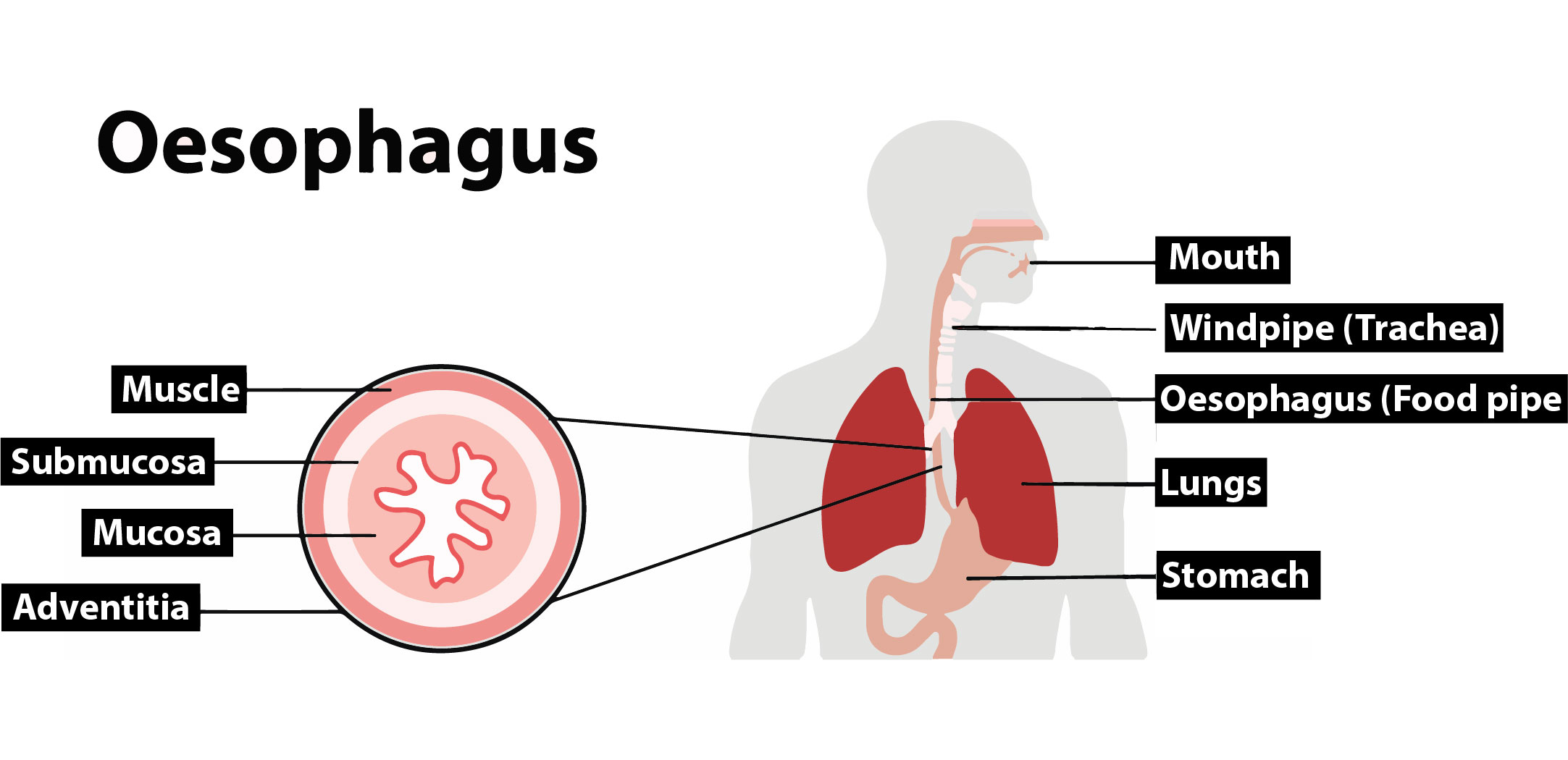
Additional Information:
-The mouth is a transverse slit-like structure bounded by two soft movable lips. It is the foregut part of the alimentary canal and is for the food ingestion. The mouth contains sublingual, submaxillary, and parotid glands, which secrete the enzyme salivary amylase.
-The stomach is the most distensible portion of the alimentary canal. It is the midgut part of the alimentary canal and is a J- shaped structure. The stomach is present at the upper left side of the alimentary canal, below the diaphragm, and is formed of three parts: cardiac stomach, fundic part, and pyloric antrum. The stomach helps in mechanical churning and digestion of protein.
-Duodenum is the widest, shortest (25 cm), and most flexed part of the small intestine. It is the midgut part of the alimentary canal and is a C-shaped structure. The bile-pancreatic duct opens in the duodenum. Duodenum itself secretes cholecystokinin hormone.
So, the correct answer is, ‘Oesophagus.’
Note:
-The inner mucosa of the stomach is raised into longitudinal folds called oesophageal rugae, which close it to prevent the entry of air and expands to receive the food bolus.
- The alimentary canal is formed of three parts that are foregut, midgut, and hindgut including mouth to anus.
Complete answer:
The esophagus is a tubular pipe-like structure, it does not secrete any digestive enzyme. It runs downwards through the neck behind the trachea, passes through the diaphragm, and opens in the stomach in the abdomen.
Additional Information:
-The mouth is a transverse slit-like structure bounded by two soft movable lips. It is the foregut part of the alimentary canal and is for the food ingestion. The mouth contains sublingual, submaxillary, and parotid glands, which secrete the enzyme salivary amylase.
-The stomach is the most distensible portion of the alimentary canal. It is the midgut part of the alimentary canal and is a J- shaped structure. The stomach is present at the upper left side of the alimentary canal, below the diaphragm, and is formed of three parts: cardiac stomach, fundic part, and pyloric antrum. The stomach helps in mechanical churning and digestion of protein.
-Duodenum is the widest, shortest (25 cm), and most flexed part of the small intestine. It is the midgut part of the alimentary canal and is a C-shaped structure. The bile-pancreatic duct opens in the duodenum. Duodenum itself secretes cholecystokinin hormone.
So, the correct answer is, ‘Oesophagus.’
Note:
-The inner mucosa of the stomach is raised into longitudinal folds called oesophageal rugae, which close it to prevent the entry of air and expands to receive the food bolus.
- The alimentary canal is formed of three parts that are foregut, midgut, and hindgut including mouth to anus.
Recently Updated Pages
Master Class 11 Computer Science: Engaging Questions & Answers for Success

Master Class 11 Business Studies: Engaging Questions & Answers for Success
Master Class 11 Economics: Engaging Questions & Answers for Success
Master Class 11 English: Engaging Questions & Answers for Success
Master Class 11 Maths: Engaging Questions & Answers for Success
Master Class 11 Biology: Engaging Questions & Answers for Success
Trending doubts
One Metric ton is equal to kg A 10000 B 1000 C 100 class 11 physics CBSE
There are 720 permutations of the digits 1 2 3 4 5 class 11 maths CBSE
Discuss the various forms of bacteria class 11 biology CBSE
Draw a diagram of a plant cell and label at least eight class 11 biology CBSE
State the laws of reflection of light
Explain zero factorial class 11 maths CBSE