




Which of the following reactions are feasible?
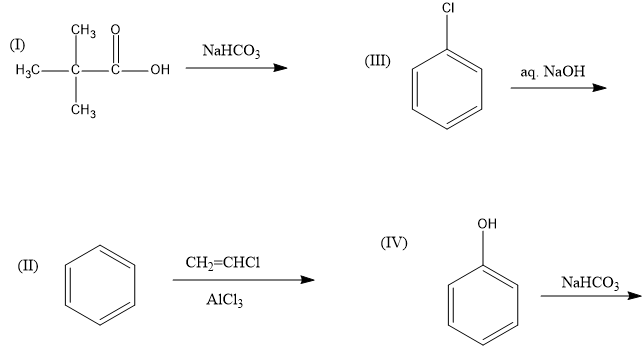
(A) $I,II$ and $IV$
(B) $I,II$ and $III$
(C) Only $III$
(D) Only $I$
Answer
 Verified
575.4k+ views
Hint: To know whether a chemical reaction (organic reaction) is feasible or not, we need to know the structure of the reactants and their chemical properties. We should also know about the chemical properties of the reagents which are used in these reactions. Based on these properties, we will be able to know if a reaction is feasible or not.
Complete answer:
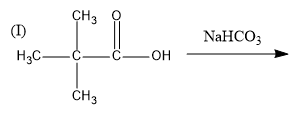
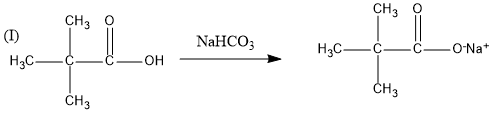
In this reaction, reactant is an acid and sodium bicarbonate $(NaHC{O_3})$ is a base. Therefore, it is an acid-base reaction and sodium salt of carboxylic acid will be formed. This reaction is feasible.
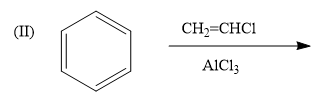
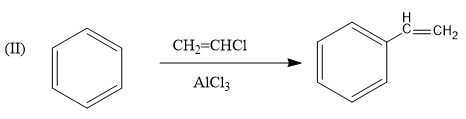
This reaction is known as the friedel crafts reaction in which a Lewis acid is added as a reagent which increases electron density on the benzene ring. Therefore, it is a feasible reaction and the reaction is given as follows:
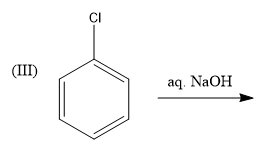
At normal temperature and pressure conditions, Chlorobenzene does not react with aqueous NaOH to form phenol because Chlorobenzene is very stable due to resonance. Hence, this reaction is not feasible.
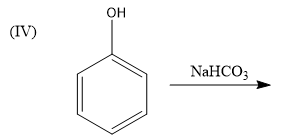
We know that sodium bicarbonate is a base and it reacts with acids to form a sodium salt. But phenol is weakly acidic in nature and hence, phenoxide ion (sodium salt of phenol) will not be formed in this reaction. Hence, this reaction is not feasible.
Therefore, the correct option is (C) Only $III$ .
Note:
We should remember that phenols are acidic in nature but they do not react with sodium bicarbonate to give sodium salt of phenol and a brisk effervescence. This is because phenols are not strong acids. So, based on the chemical properties of the substances we can determine the feasibility of any reaction.
Complete answer:
In this reaction, reactant is an acid and sodium bicarbonate $(NaHC{O_3})$ is a base. Therefore, it is an acid-base reaction and sodium salt of carboxylic acid will be formed. This reaction is feasible.
This reaction is known as the friedel crafts reaction in which a Lewis acid is added as a reagent which increases electron density on the benzene ring. Therefore, it is a feasible reaction and the reaction is given as follows:
At normal temperature and pressure conditions, Chlorobenzene does not react with aqueous NaOH to form phenol because Chlorobenzene is very stable due to resonance. Hence, this reaction is not feasible.
We know that sodium bicarbonate is a base and it reacts with acids to form a sodium salt. But phenol is weakly acidic in nature and hence, phenoxide ion (sodium salt of phenol) will not be formed in this reaction. Hence, this reaction is not feasible.
Therefore, the correct option is (C) Only $III$ .
Note:
We should remember that phenols are acidic in nature but they do not react with sodium bicarbonate to give sodium salt of phenol and a brisk effervescence. This is because phenols are not strong acids. So, based on the chemical properties of the substances we can determine the feasibility of any reaction.
Recently Updated Pages
Which will be the least stable resonating structure class 11 chemistry CBSE

How many 5 digit telephone numbers can be construc-class-11-maths-CBSE
How do you find the angle of the resultant vector class 11 physics CBSE
Draw labelled diagram of the following i Gram seed class 11 biology CBSE
1 Quintal is equal to a 110 kg b 10 kg c 100kg d 1000 class 11 physics CBSE
What is the need and importance of classification class 11 biology CBSE
Trending doubts
Find the value of the expression given below sin 30circ class 11 maths CBSE
One Metric ton is equal to kg A 10000 B 1000 C 100 class 11 physics CBSE
10 examples of friction in our daily life
Draw a diagram of a plant cell and label at least eight class 11 biology CBSE
Difference between physical and chemical change class 11 chemistry CBSE
Proton was discovered by A Thomson B Rutherford C Chadwick class 11 chemistry CBSE