




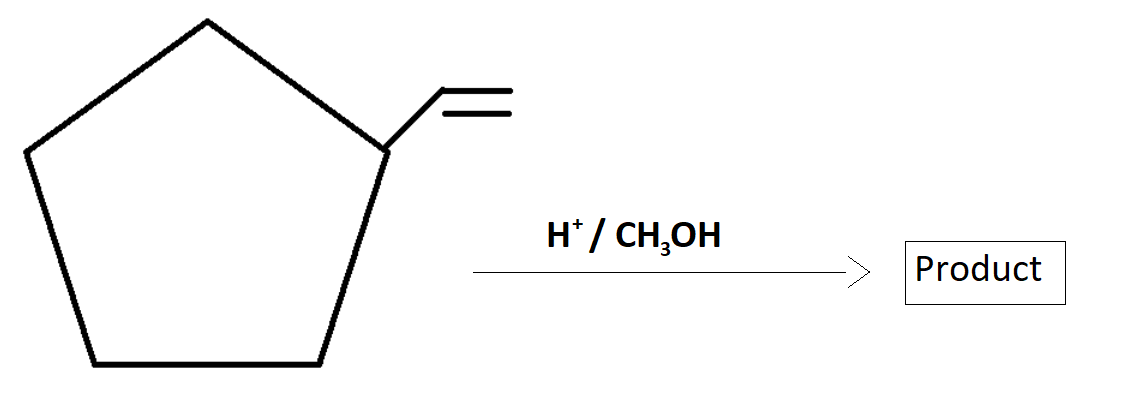
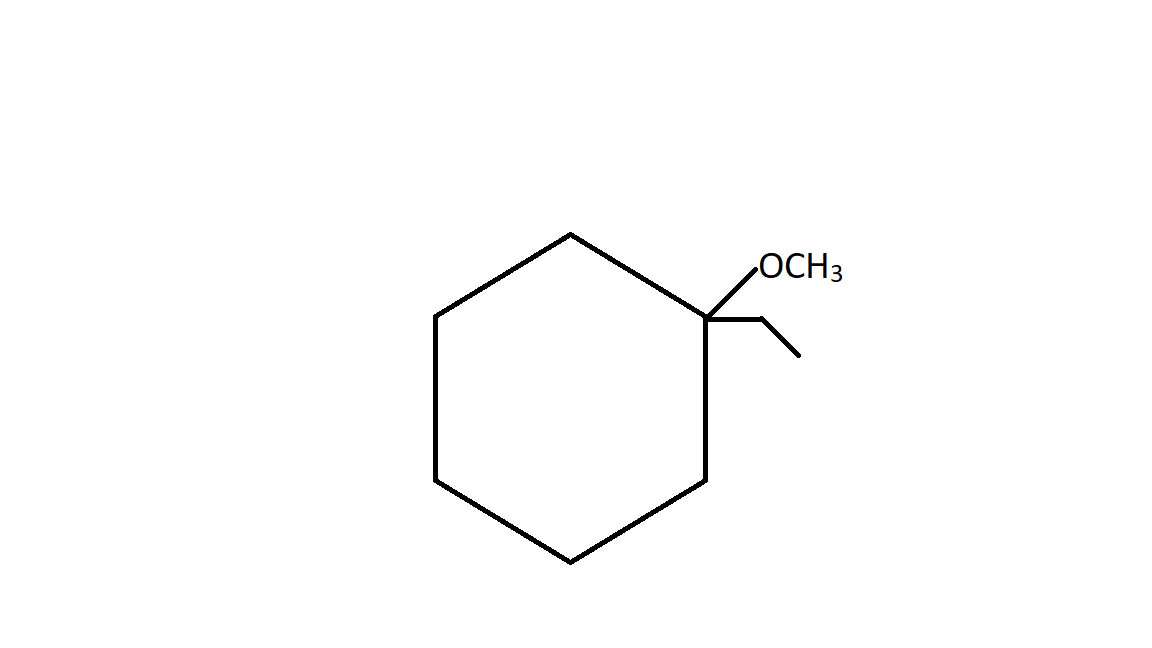
Which of the following product is formed in the below reaction:
A.
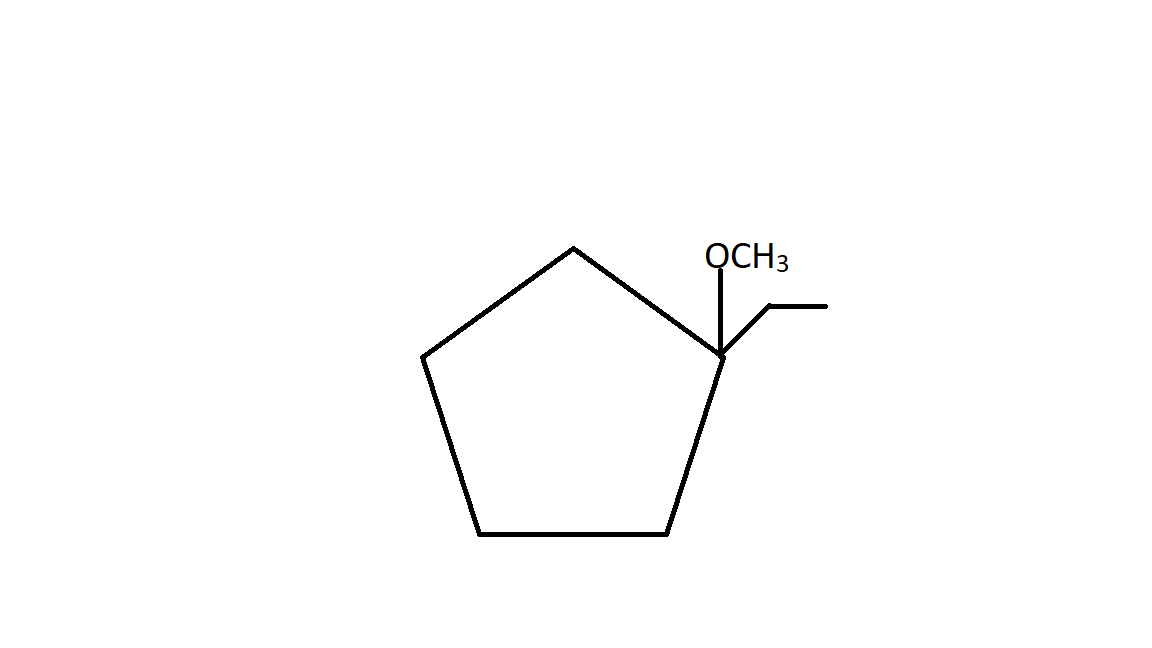
B.
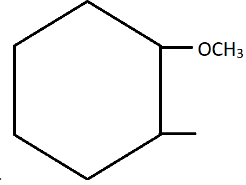
C.
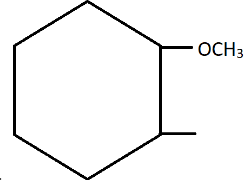
D.
Answer
 Verified
544.2k+ views
Hint: Addition of alkene is an electrophilic addition reaction in which there is a formation of carbocation $\left[ {{C^ + }} \right]$. Rearrange the cation to that carbon where it is most stable. If ring expansion takes place then make a ring of 6 carbon atoms. Six carbon rings are the most stable cycloalkane.
Complete answer:
Addition of nucleophile and takes place through the bond breaking process. Once the pi bond of alkene breaks, then electrophile attacks on the compound.
$1.$ Breaking of pi bond.
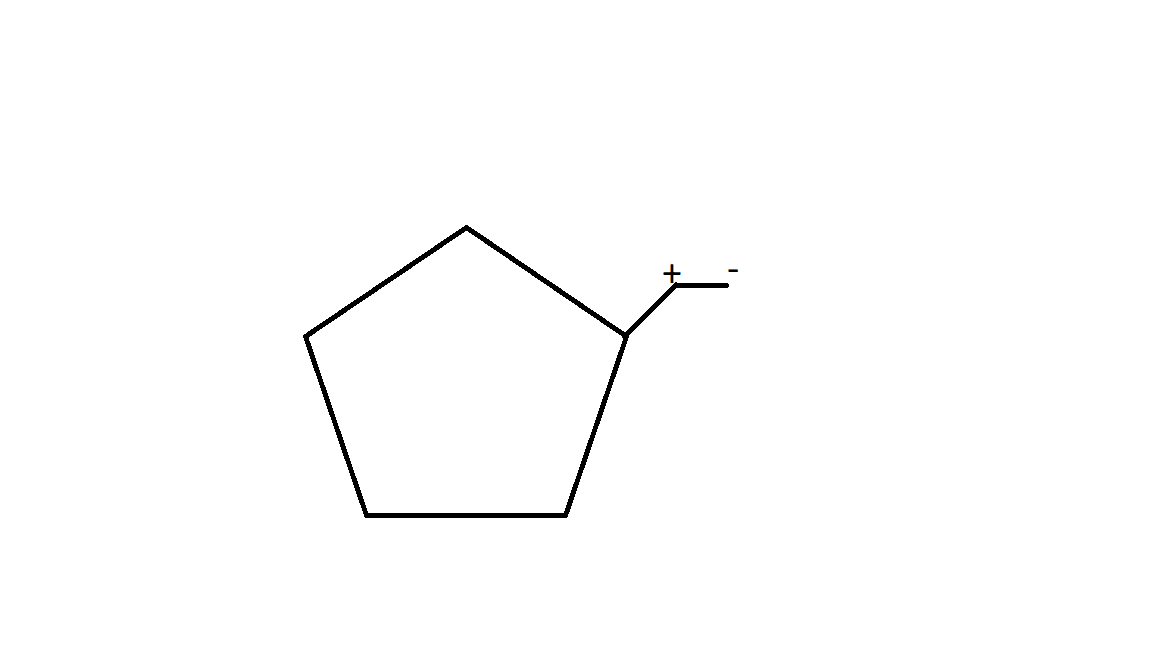
$2.$Now the carbocation formed is not stable at ${2^ \circ }$ carbocation. Reason for the stability of carbocation depends on the inductive effect of the alkyl group. ${3^ \circ }$ carbocation is the most stable carbocation.
While moving the carbocation, ring expansion takes place.
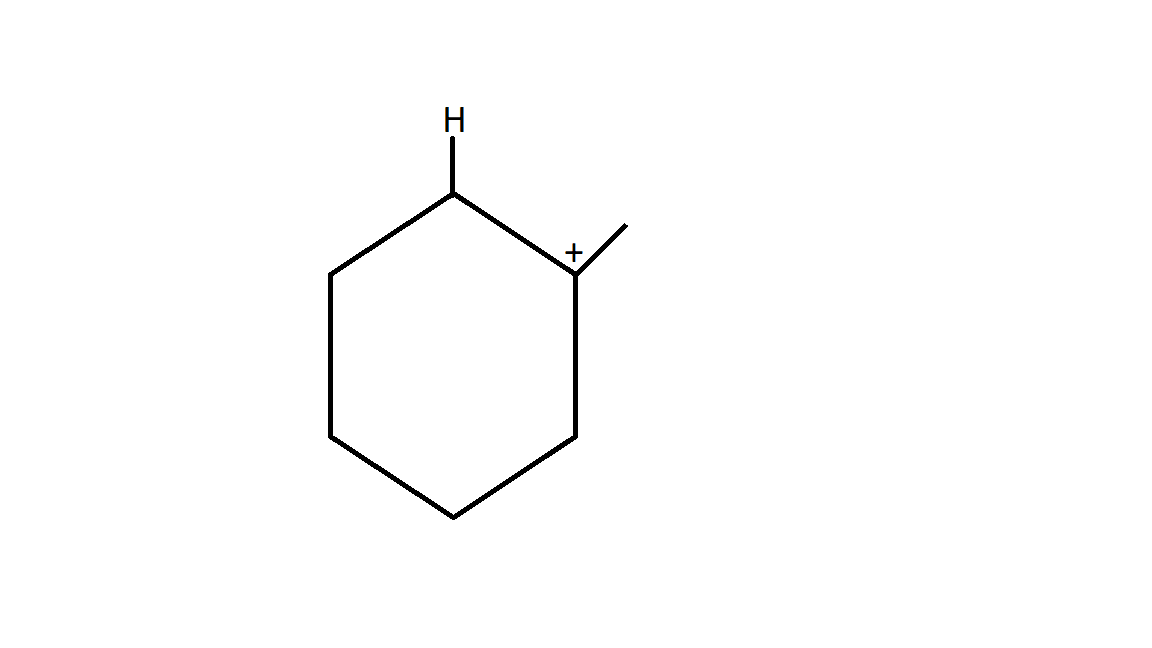
$3.$ Generation of nucleophiles .
$C{H_3}OH{\text{ }}\xrightarrow{{}}{\text{ C}}{{\text{H}}_3}{O^ - }{\text{ + }}{{\text{H}}^ + }$
Now the nucleophile will attack at carbocation. Here the degree of carbocation is ${3^ \bullet }$, which is the most stable form of carbocation.
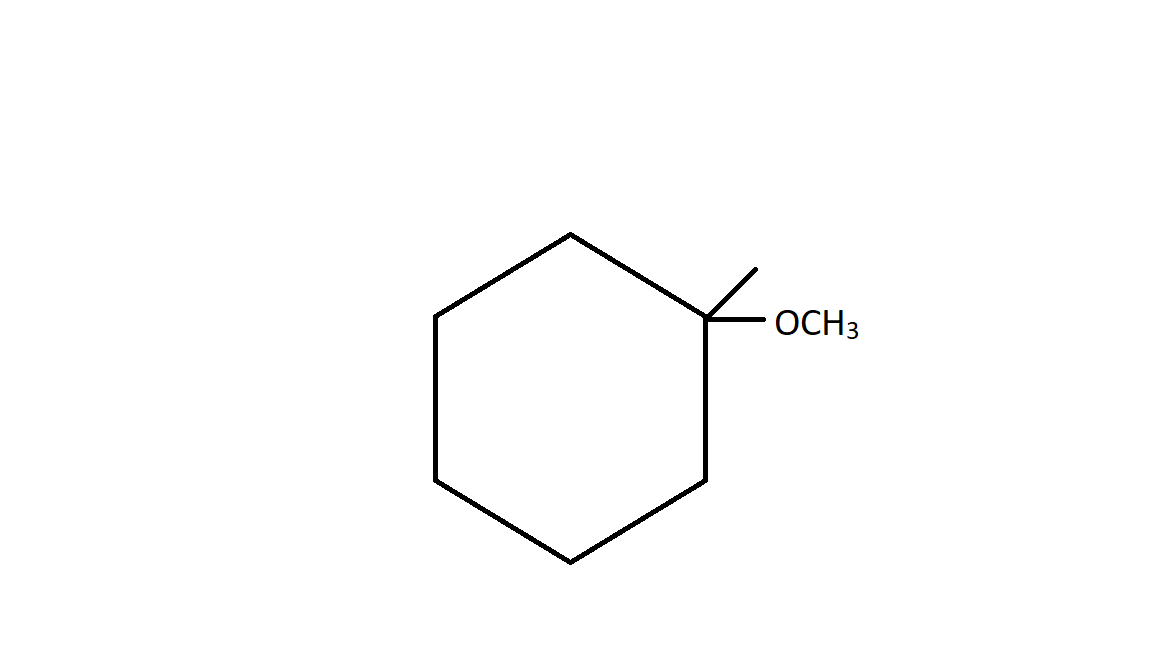
Hence after rearrangement of carbocation and ring expansion the product formed is a six member ring which is more stable than a five member ring. Therefore nucleophile attack on ${3^ \bullet }$carbocation and thus giving the above structure.
Hence the correct answer is option C.
Additional Information:
The order of stability of carbocation is:
The least stable carbocation is ${{\text{1}}^{^ \bullet }}$.
Cyclohexane is more stable than cyclopentane because of lesser angle strain.
Note:
While doing ring expansion make sure the number of carbon in the ring does not exceed more than six. After six, the stability of the compound decreases. The stability of carbocation must be satisfied while performing ring expansion. Nucleophile attacks at the last stage of reaction.
Complete answer:
Addition of nucleophile and takes place through the bond breaking process. Once the pi bond of alkene breaks, then electrophile attacks on the compound.
$1.$ Breaking of pi bond.
$2.$Now the carbocation formed is not stable at ${2^ \circ }$ carbocation. Reason for the stability of carbocation depends on the inductive effect of the alkyl group. ${3^ \circ }$ carbocation is the most stable carbocation.
While moving the carbocation, ring expansion takes place.
$3.$ Generation of nucleophiles .
$C{H_3}OH{\text{ }}\xrightarrow{{}}{\text{ C}}{{\text{H}}_3}{O^ - }{\text{ + }}{{\text{H}}^ + }$
Now the nucleophile will attack at carbocation. Here the degree of carbocation is ${3^ \bullet }$, which is the most stable form of carbocation.
Hence after rearrangement of carbocation and ring expansion the product formed is a six member ring which is more stable than a five member ring. Therefore nucleophile attack on ${3^ \bullet }$carbocation and thus giving the above structure.
Hence the correct answer is option C.
Additional Information:
The order of stability of carbocation is:
The least stable carbocation is ${{\text{1}}^{^ \bullet }}$.
Cyclohexane is more stable than cyclopentane because of lesser angle strain.
Note:
While doing ring expansion make sure the number of carbon in the ring does not exceed more than six. After six, the stability of the compound decreases. The stability of carbocation must be satisfied while performing ring expansion. Nucleophile attacks at the last stage of reaction.
Recently Updated Pages
Basicity of sulphurous acid and sulphuric acid are

Master Class 12 Economics: Engaging Questions & Answers for Success
Master Class 12 Biology: Engaging Questions & Answers for Success
Master Class 11 English: Engaging Questions & Answers for Success
Master Class 11 Physics: Engaging Questions & Answers for Success
Master Class 11 Computer Science: Engaging Questions & Answers for Success
Trending doubts
Draw a labelled sketch of the human eye class 12 physics CBSE
The chemical formula of tear gas is A CO Cl 2 B C 10 class 12 chemistry CBSE
Draw ray diagrams each showing i myopic eye and ii class 12 physics CBSE
Which are the Top 10 Largest Countries of the World?
Differentiate between homogeneous and heterogeneous class 12 chemistry CBSE
Which is the correct genotypic ratio of mendel dihybrid class 12 biology CBSE