




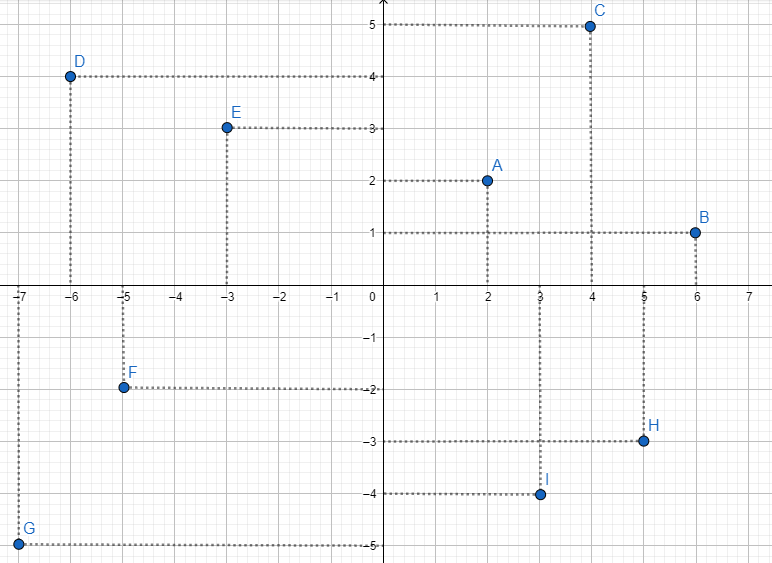
Which of the following points lies in $II$ quadrant?
$\left( A \right)\text{ A}$
$\left( B \right)\text{ D}$
$\left( C \right)\text{ G}$
$\left( D \right)\text{ H}$
Answer
 Verified
533.7k+ views
Hint: In this question we have been provided with a graph which have various coordinates on them which are from $A$ to $I$. We have to find the coordinate from the given set of options which lies in the $II$ quadrant. We will use the rule that a point in the second coordinate will have the abscissa as negative which is the $x$- coordinate and the ordinate as positive which is the $y$- coordinate. We will look at all the options given and find their coordinates from the graph and get the required solution.
Complete step by step solution:
Consider the first option which is point $\text{A}$.
We can see from the graph that the coordinates of $\text{A=}\left( 2,2 \right)$.
Since both the points are positive, the point lies in the first coordinate therefore, it is not a part of our solution.
Consider the second option which is $\text{D}$,
We can see from the graph that the coordinates of $\text{A=}\left( -6,4 \right)$.
Since the abscissa is negative and the ordinate is positive, the point lies in the second coordinate therefore it is part of our solution.
Consider the second option which is point $\text{D}$,
We can see from the graph that the coordinates of $\text{A=}\left( -6,4 \right)$.
Since the abscissa is negative and the ordinate is positive, the point lies in the $II$ quadrant therefore it is part of our solution.
Consider the third option which is $G$,
We can see from the graph that the coordinates of $\text{G=}\left( -7,-5 \right)$.
Since both the points are negative, the point lies in the $III$ quadrant therefore, it is not a part of our solution.
Consider the fourth option which is $H$,
We can see from the graph that the coordinates of $\text{H=}\left( 5,-3 \right)$.
Since the abscissa is positive the ordinate is negative, the point lies in the $IV$ quadrant therefore it is not part of our solution.
Therefore, from the above findings only one point lies in the $II$ quadrant which is point $D$
So, the correct answer is “Option B”.
Note: The general rule of quadrants should be remembered as $\left( +,+ \right),\left( -,+ \right),\left( -,- \right),\left( +,- \right)$ which indicate the first, second, third and fourth quadrants respectively. quadrants are an important part of graphing since they tell us about the nature of the coordinates. Quadrants are used profoundly in trigonometry.
Complete step by step solution:
Consider the first option which is point $\text{A}$.
We can see from the graph that the coordinates of $\text{A=}\left( 2,2 \right)$.
Since both the points are positive, the point lies in the first coordinate therefore, it is not a part of our solution.
Consider the second option which is $\text{D}$,
We can see from the graph that the coordinates of $\text{A=}\left( -6,4 \right)$.
Since the abscissa is negative and the ordinate is positive, the point lies in the second coordinate therefore it is part of our solution.
Consider the second option which is point $\text{D}$,
We can see from the graph that the coordinates of $\text{A=}\left( -6,4 \right)$.
Since the abscissa is negative and the ordinate is positive, the point lies in the $II$ quadrant therefore it is part of our solution.
Consider the third option which is $G$,
We can see from the graph that the coordinates of $\text{G=}\left( -7,-5 \right)$.
Since both the points are negative, the point lies in the $III$ quadrant therefore, it is not a part of our solution.
Consider the fourth option which is $H$,
We can see from the graph that the coordinates of $\text{H=}\left( 5,-3 \right)$.
Since the abscissa is positive the ordinate is negative, the point lies in the $IV$ quadrant therefore it is not part of our solution.
Therefore, from the above findings only one point lies in the $II$ quadrant which is point $D$
So, the correct answer is “Option B”.
Note: The general rule of quadrants should be remembered as $\left( +,+ \right),\left( -,+ \right),\left( -,- \right),\left( +,- \right)$ which indicate the first, second, third and fourth quadrants respectively. quadrants are an important part of graphing since they tell us about the nature of the coordinates. Quadrants are used profoundly in trigonometry.
Recently Updated Pages
Master Class 11 Computer Science: Engaging Questions & Answers for Success

Master Class 11 Business Studies: Engaging Questions & Answers for Success
Master Class 11 Economics: Engaging Questions & Answers for Success
Master Class 11 English: Engaging Questions & Answers for Success
Master Class 11 Maths: Engaging Questions & Answers for Success
Master Class 11 Biology: Engaging Questions & Answers for Success
Trending doubts
One Metric ton is equal to kg A 10000 B 1000 C 100 class 11 physics CBSE
There are 720 permutations of the digits 1 2 3 4 5 class 11 maths CBSE
Discuss the various forms of bacteria class 11 biology CBSE
Draw a diagram of a plant cell and label at least eight class 11 biology CBSE
State the laws of reflection of light
Explain zero factorial class 11 maths CBSE