



Which of the following plants do not bear flowers?
(A)Grass
(B)Betelnut
(C)Banyan
(D)Cycas
Answer
 Verified
617.4k+ views
Hint: Flowers are the characteristic of the angiosperm plants not of the gymnosperm plant. The plant name in these options which does not bear flowers is a genus of plants belonging to a very ancient lineage, the Cycadophyta, which are not closely related to palms and ferns.
Complete answer:
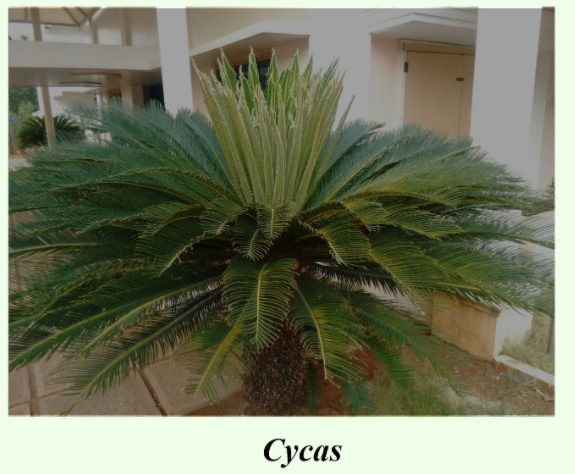
The flowers are seen in the angiosperms. Examples of angiosperms are grass, betelnut, banyan, and many more. The gymnosperm does not bear flowers and includes plants like Cycas.
Additional Information: The endemic species of India is the Cycas circinalis, and was described in the western literature as the primary cycad species to be described in western literature, and was the kind of the generic name, Cycas. Cycas revoluta is the best-known Cycas species. A flower, which is sometimes referred to as a bloom or blossom, is the plant organ found in flowering plants ( angiosperms). The main function of the flower is to facilitate the reproduction in plants, as it provides a mechanism for the union of sperm with eggs. Flowers facilitate fertilization in two ways i.e by outcrossing (fusion of sperm and eggs from different individuals during a population) resulting from cross-pollination or allow selfing (fusion of sperm and egg from an equivalent flower) when self-pollination occurs. In those species of the plant that have more than one flower on an axis, the collective cluster of flowers is termed an inflorescence. It was seen that some inflorescences are composed of the many small flowers which are arranged in the form that resembles one flower.
So, the correct answer is ‘Cycas’.
Note: Grass is an angiosperm, it doesn't have showy petals and sepals like other plants. Betelnut produces beautiful white flowers that are arranged in small spikes. In banyan, the flower is present inside the fruit.
Complete answer:
The flowers are seen in the angiosperms. Examples of angiosperms are grass, betelnut, banyan, and many more. The gymnosperm does not bear flowers and includes plants like Cycas.
Additional Information: The endemic species of India is the Cycas circinalis, and was described in the western literature as the primary cycad species to be described in western literature, and was the kind of the generic name, Cycas. Cycas revoluta is the best-known Cycas species. A flower, which is sometimes referred to as a bloom or blossom, is the plant organ found in flowering plants ( angiosperms). The main function of the flower is to facilitate the reproduction in plants, as it provides a mechanism for the union of sperm with eggs. Flowers facilitate fertilization in two ways i.e by outcrossing (fusion of sperm and eggs from different individuals during a population) resulting from cross-pollination or allow selfing (fusion of sperm and egg from an equivalent flower) when self-pollination occurs. In those species of the plant that have more than one flower on an axis, the collective cluster of flowers is termed an inflorescence. It was seen that some inflorescences are composed of the many small flowers which are arranged in the form that resembles one flower.
So, the correct answer is ‘Cycas’.
Note: Grass is an angiosperm, it doesn't have showy petals and sepals like other plants. Betelnut produces beautiful white flowers that are arranged in small spikes. In banyan, the flower is present inside the fruit.
Recently Updated Pages
Master Class 11 English: Engaging Questions & Answers for Success

Master Class 11 Social Science: Engaging Questions & Answers for Success
Master Class 11 Maths: Engaging Questions & Answers for Success
Master Class 11 Biology: Engaging Questions & Answers for Success
Master Class 11 Physics: Engaging Questions & Answers for Success
Master Class 11 Chemistry: Engaging Questions & Answers for Success
Trending doubts
One Metric ton is equal to kg A 10000 B 1000 C 100 class 11 physics CBSE
Difference Between Prokaryotic Cells and Eukaryotic Cells
Two of the body parts which do not appear in MRI are class 11 biology CBSE
Find the value of the expression given below sin 30circ class 11 maths CBSE
Draw a diagram of a plant cell and label at least eight class 11 biology CBSE
10 examples of friction in our daily life