




Which of the following planets take minimum time to take a one revolution around the sun?
A) Mercury
B) Jupiter
C) Saturn
D) Pluto
Answer
 Verified
609k+ views
Hint: There is a relationship between the time period of revolution and major axis of elliptical path in the path in which the planet is moving. This theory is given by Kepler and it is the third law of Kepler's.
Complete solution:
Kepler say that when a planet revolves around the sun or another star, then its path will be elliptical. According to the kepler’s third law
${{T}^{2}}\propto {{a}^{3}}$ where $T$ is the time taken by planet in one revolution and $a$ is major axis of that elliptical path in which planet is revolving. That’s why if we go from near to far from sun then mercury is nearest one of the planets to the sun and then Jupiter, Saturn and then Pluto is one of the farest planets from the sun.
So, the major axis of elliptical path in which mercury is revolving is less than others. So, the time period of revolution or time taken by a planet for one revolution around the sun is least.
Hence, option (A) is correct.
Additional Information:
In this picture planets are shown in sequential and comparable size manner.
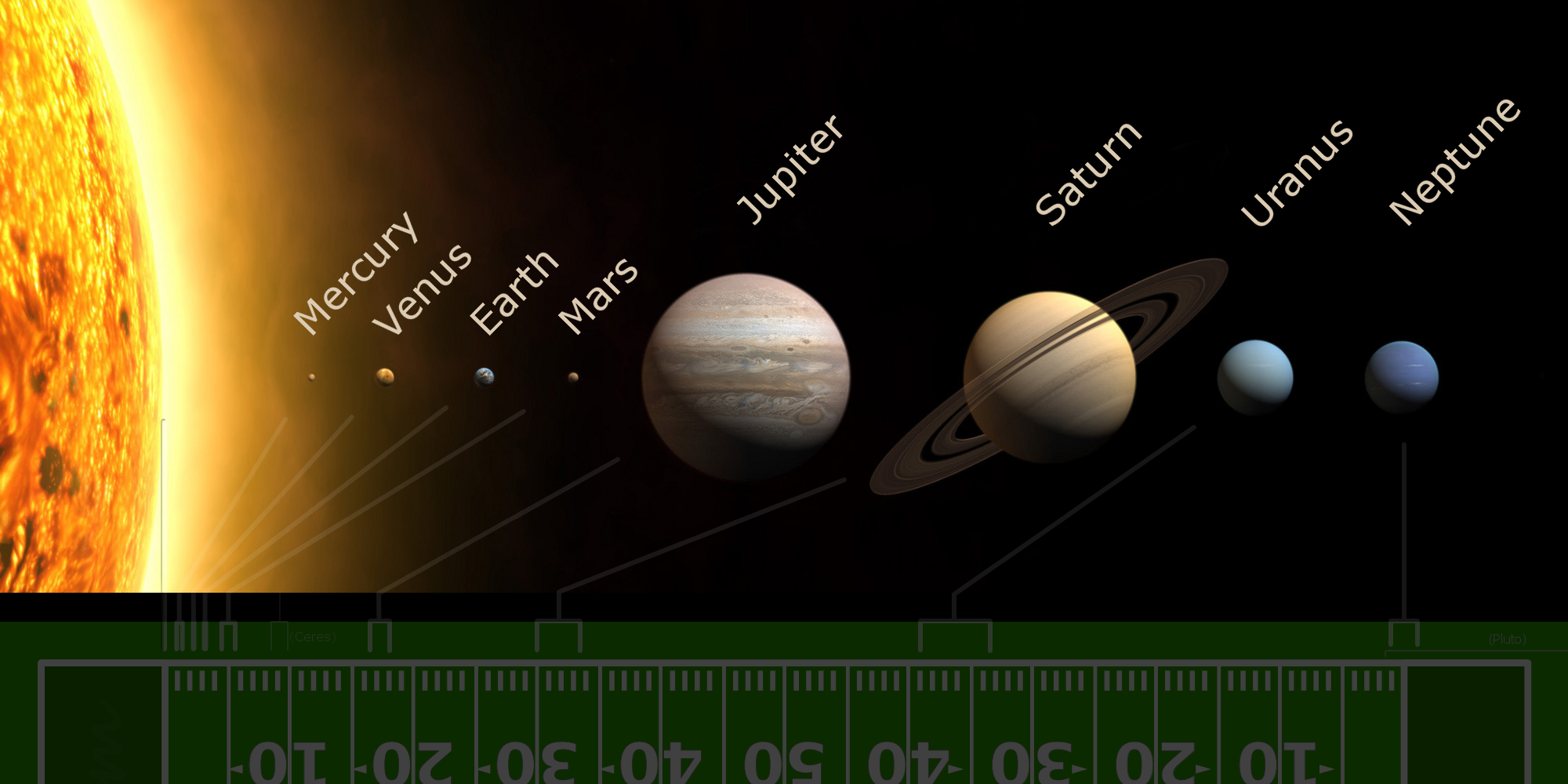
Time periods of planets in solar system to complete one revolutions are
Mercury- $88days$
Venus- $225days$
Earth- $365days$
Mars- $687days$
Jupiter- $12years$
Saturn- $28years$
Uranus- $84years$
Neptune- $165years$
Note: You have to memorise the correct sequence of planets from near to far from sun, or learn the time period of planets in which one revolution of planet is completed. The time period does not depend on the mass and size of the planet.
Complete solution:
Kepler say that when a planet revolves around the sun or another star, then its path will be elliptical. According to the kepler’s third law
${{T}^{2}}\propto {{a}^{3}}$ where $T$ is the time taken by planet in one revolution and $a$ is major axis of that elliptical path in which planet is revolving. That’s why if we go from near to far from sun then mercury is nearest one of the planets to the sun and then Jupiter, Saturn and then Pluto is one of the farest planets from the sun.
So, the major axis of elliptical path in which mercury is revolving is less than others. So, the time period of revolution or time taken by a planet for one revolution around the sun is least.
Hence, option (A) is correct.
Additional Information:
In this picture planets are shown in sequential and comparable size manner.
Time periods of planets in solar system to complete one revolutions are
Mercury- $88days$
Venus- $225days$
Earth- $365days$
Mars- $687days$
Jupiter- $12years$
Saturn- $28years$
Uranus- $84years$
Neptune- $165years$
Note: You have to memorise the correct sequence of planets from near to far from sun, or learn the time period of planets in which one revolution of planet is completed. The time period does not depend on the mass and size of the planet.
Recently Updated Pages
Master Class 5 English: Engaging Questions & Answers for Success

Master Class 5 Maths: Engaging Questions & Answers for Success
Master Class 5 Social Science: Engaging Questions & Answers for Success
Master Class 5 Science: Engaging Questions & Answers for Success
Class 5 Question and Answer - Your Ultimate Solutions Guide
Master Class 9 General Knowledge: Engaging Questions & Answers for Success
Trending doubts
Explain the Treaty of Vienna of 1815 class 10 social science CBSE
What is the Total Duration of Football Match?
The shortest day of the year in India
In which year voting age was reduced from 21 to 18?
10 examples of evaporation in daily life with explanations
What planets have no moons Which one has only one moon class 10 physics CBSE