




Which of the following pairs of d-orbitals will have electron density along the axis.
A. ${{\text{d}}_{{{\text{z}}^{\text{2}}}}}{\text{,}}{{\text{d}}_{{{\text{x}}^2} - {{\text{y}}^{\text{2}}}}}$
B. ${{\text{d}}_{{\text{xy}}}},{{\text{d}}_{{{\text{x}}^2} - {{\text{y}}^{\text{2}}}}}$
C. ${{\text{d}}_{{{\text{z}}^{\text{2}}}}}{\text{,}}\,{{\text{d}}_{xz}}$
D. ${{\text{d}}_{xz}},{{\text{d}}_{yz}}$
Answer
 Verified
645.3k+ views
Hint: The ${{\text{d}}_{{{\text{z}}^{\text{2}}}}}$ and ${{\text{d}}_{{{\text{x}}^2} - {{\text{y}}^{\text{2}}}}}$ orbitals which lies on the axis and the ${{\text{d}}_{xz}}$,${{\text{d}}_{yz}}$, and ${{\text{d}}_{xy}}$ lies in between the axis. Total five orbitals are present in the d - orbitals.
Complete step by step answer:
The position of electron density depends upon the position of the orbitals.
The d-orbital is a set of five denigrate orbitals named as ${{\text{d}}_{{{\text{z}}^{\text{2}}}}}$, ${{\text{d}}_{{{\text{x}}^2} - {{\text{y}}^{\text{2}}}}}$, ${{\text{d}}_{xz}}$,${{\text{d}}_{yz}}$, and ${{\text{d}}_{xy}}$.
The positions of these five d-orbitals on the axis is represented as follows:
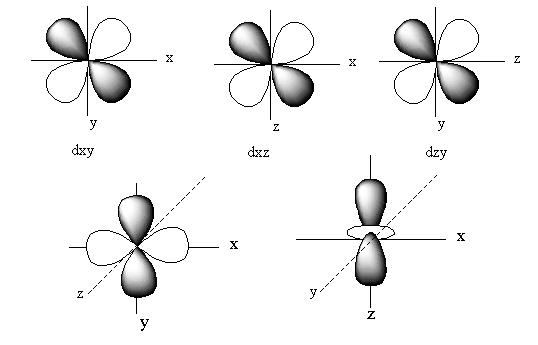
The orbitals of ${{\text{d}}_{xy}}$ lie in between the x and y-axis. So, the electron density of the ${{\text{d}}_{xy}}$ lies in between the x and y-axis.
The orbitals of ${{\text{d}}_{yz}}$ lie in between the z and y-axis. So, the electron density of the ${{\text{d}}_{yz}}$ lies in between the z and y-axis.
The orbitals of ${{\text{d}}_{xz}}$ lie in between the x and z-axis. So, the electron density of the ${{\text{d}}_{xz}}$ lies in between the x and z-axis.
The orbital of ${{\text{d}}_{{{\text{z}}^{\text{2}}}}}$lies on the z-axis. So, the electron density of the ${{\text{d}}_{{{\text{z}}^{\text{2}}}}}$lies on the z-axis.
The orbitals of ${{\text{d}}_{{{\text{x}}^2} - {{\text{y}}^{\text{2}}}}}$ lie on the x and y-axis. So, the electron density of the ${{\text{d}}_{{{\text{x}}^2} - {{\text{y}}^{\text{2}}}}}$ lies on the x and y-axis.
So, ${{\text{d}}_{{{\text{z}}^{\text{2}}}}}{\text{,}}{{\text{d}}_{{{\text{x}}^2} - {{\text{y}}^{\text{2}}}}}$ pairs of d-orbitals will have electron density along the axis.
Therefore, option (A) ${{\text{d}}_{{{\text{z}}^{\text{2}}}}}{\text{,}}{{\text{d}}_{{{\text{x}}^2} - {{\text{y}}^{\text{2}}}}}$ is correct.
Note: Out of five d-orbitals, two lie on the axis and three lie in between the axis. So, when ligands form a complex with the metal it affects the three orbitals differently and two orbitals differently, so the five d-orbitals break into two parts of three and two.
Complete step by step answer:
The position of electron density depends upon the position of the orbitals.
The d-orbital is a set of five denigrate orbitals named as ${{\text{d}}_{{{\text{z}}^{\text{2}}}}}$, ${{\text{d}}_{{{\text{x}}^2} - {{\text{y}}^{\text{2}}}}}$, ${{\text{d}}_{xz}}$,${{\text{d}}_{yz}}$, and ${{\text{d}}_{xy}}$.
The positions of these five d-orbitals on the axis is represented as follows:
The orbitals of ${{\text{d}}_{xy}}$ lie in between the x and y-axis. So, the electron density of the ${{\text{d}}_{xy}}$ lies in between the x and y-axis.
The orbitals of ${{\text{d}}_{yz}}$ lie in between the z and y-axis. So, the electron density of the ${{\text{d}}_{yz}}$ lies in between the z and y-axis.
The orbitals of ${{\text{d}}_{xz}}$ lie in between the x and z-axis. So, the electron density of the ${{\text{d}}_{xz}}$ lies in between the x and z-axis.
The orbital of ${{\text{d}}_{{{\text{z}}^{\text{2}}}}}$lies on the z-axis. So, the electron density of the ${{\text{d}}_{{{\text{z}}^{\text{2}}}}}$lies on the z-axis.
The orbitals of ${{\text{d}}_{{{\text{x}}^2} - {{\text{y}}^{\text{2}}}}}$ lie on the x and y-axis. So, the electron density of the ${{\text{d}}_{{{\text{x}}^2} - {{\text{y}}^{\text{2}}}}}$ lies on the x and y-axis.
So, ${{\text{d}}_{{{\text{z}}^{\text{2}}}}}{\text{,}}{{\text{d}}_{{{\text{x}}^2} - {{\text{y}}^{\text{2}}}}}$ pairs of d-orbitals will have electron density along the axis.
Therefore, option (A) ${{\text{d}}_{{{\text{z}}^{\text{2}}}}}{\text{,}}{{\text{d}}_{{{\text{x}}^2} - {{\text{y}}^{\text{2}}}}}$ is correct.
Note: Out of five d-orbitals, two lie on the axis and three lie in between the axis. So, when ligands form a complex with the metal it affects the three orbitals differently and two orbitals differently, so the five d-orbitals break into two parts of three and two.
Recently Updated Pages
If x a + bt + ct2 where x is in meters and t is in class 11 physics CBSE

A car covers the first half distance between two places class 11 physics CBSE
The resultant of two vectors overrightarrow P and overrightarrow class 11 physics CBSE
Find the value of cos 135 class 11 maths CBSE
A mass M is held in place by an applied force F and class 11 physics CBSE
A solution of glucose in water is labelled as 10 dfracwv class 11 chemistry CBSE
Trending doubts
One Metric ton is equal to kg A 10000 B 1000 C 100 class 11 physics CBSE
Find the value of the expression given below sin 30circ class 11 maths CBSE
Draw a diagram of nephron and explain its structur class 11 biology CBSE
10 examples of friction in our daily life
Proton was discovered by A Thomson B Rutherford C Chadwick class 11 chemistry CBSE
Bond order ofO2 O2+ O2 and O22 is in order A O2 langle class 11 chemistry CBSE