




Which of the following options shows the correct measurements of an adult human kidney?
A. \[10 - 12\]cm \[5 - 7\]cm \[2 - 3\]cm \[120 - 170\]g
B. \[10 - 12\]cm \[10 - 12\]cm \[6 - 12\]cm \[40 - 50\]g
C. \[2 - 6\]cm \[8 - 10\]cm \[5 - 10\]cm \[60 - 70\]g
D. \[10 - 12\]mm \[5 - 7\]mm \[2 - 3\]mm \[120 - 170\]mg
Answer
 Verified
584.1k+ views
Hint: The kidneys are 2 bean-shaped organs found invertebrates. they're situated on the left and right within the retroperitoneal space. They receive blood from the paired nephritic arteries; blood exits into the paired nephritic veins. Mainly filtration of blood is done here through the glomerulus.
Complete answer:
The kidneys are dark-red, bean-shaped organs which are about 10 - 12cm long, 5 - 7cm wide, and 2 - 3cm thick, each weight is about \[150\]gm in an adult male and about 135gm in an adult female, generally, the kidney has three regions—an outer cortex, a medulla in the middle, and the renal pelvis in the region called the hilum of the kidney. Overall the hilum is the concave part of the bean-shaped where blood vessels and nerves enter and exit the kidney; even it is also the point of exit for the ureters.
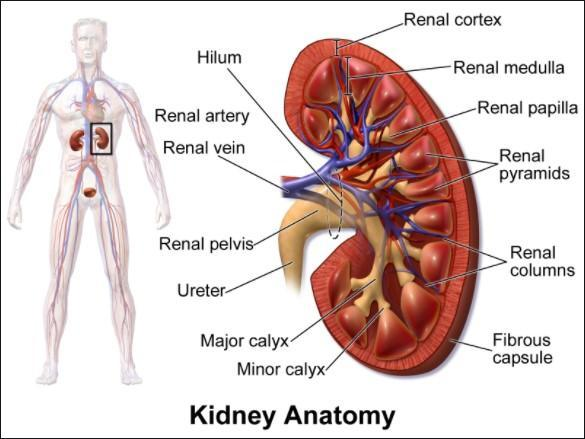
In humans, the kidneys are situated high within the cavity, one on both sides of the spine, and consist of a retroperitoneal position at a rather angle. The imbalance inside the cavity, caused by the position of the liver, generally leads to the proper excretory organ being slightly lower and smaller than the left and being placed slightly additional to the centre than the left kidney. The left kidney is around at the vertebral level T12 to L3, and the right is slightly lower. The correct excretory organ sits slightly below the diaphragm and posterior to the liver. The left excretory organ sits below the diaphragm and posterior to the spleen. The prime of every excretory organ is associate with the nursing endocrine. The higher elements of the kidneys are part protected by the eleventh and twelfth ribs. every excretory organ, with its endocrine, is enclosed by 2 layers of fat: the perirenal fat gift between renal fascia and renal capsule and pararenal fat superior to the excretory organ facia.
The excretory organ could be a bean-shaped structure with a protrusive and a concave border. A recessed space on the concave border is that the excretory organ hilum, wherever the renal artery enters the kidney and therefore the renal vein and channel left. The excretory organ is enclosed by tough fibrous tissue, the renal capsule, which is itself fascia by perirenal fat, renal fascia, and pararenal fat. The anterior (front) surface of those tissues is that of the serosa, whereas the posterior (rear) surface is that of the transversalis fascia.
Hence, option A is the correct answer.
Note: In the kidney, the capillary, and its close glomerular capsule represent a malpighian body, the essential filtration unit of the excretory organ. The speed at that blood is filtered through all of the glomeruli, and therefore the life of the excretory organ performs the capillary vessel filtration rate.
Complete answer:
The kidneys are dark-red, bean-shaped organs which are about 10 - 12cm long, 5 - 7cm wide, and 2 - 3cm thick, each weight is about \[150\]gm in an adult male and about 135gm in an adult female, generally, the kidney has three regions—an outer cortex, a medulla in the middle, and the renal pelvis in the region called the hilum of the kidney. Overall the hilum is the concave part of the bean-shaped where blood vessels and nerves enter and exit the kidney; even it is also the point of exit for the ureters.
In humans, the kidneys are situated high within the cavity, one on both sides of the spine, and consist of a retroperitoneal position at a rather angle. The imbalance inside the cavity, caused by the position of the liver, generally leads to the proper excretory organ being slightly lower and smaller than the left and being placed slightly additional to the centre than the left kidney. The left kidney is around at the vertebral level T12 to L3, and the right is slightly lower. The correct excretory organ sits slightly below the diaphragm and posterior to the liver. The left excretory organ sits below the diaphragm and posterior to the spleen. The prime of every excretory organ is associate with the nursing endocrine. The higher elements of the kidneys are part protected by the eleventh and twelfth ribs. every excretory organ, with its endocrine, is enclosed by 2 layers of fat: the perirenal fat gift between renal fascia and renal capsule and pararenal fat superior to the excretory organ facia.
The excretory organ could be a bean-shaped structure with a protrusive and a concave border. A recessed space on the concave border is that the excretory organ hilum, wherever the renal artery enters the kidney and therefore the renal vein and channel left. The excretory organ is enclosed by tough fibrous tissue, the renal capsule, which is itself fascia by perirenal fat, renal fascia, and pararenal fat. The anterior (front) surface of those tissues is that of the serosa, whereas the posterior (rear) surface is that of the transversalis fascia.
Hence, option A is the correct answer.
Note: In the kidney, the capillary, and its close glomerular capsule represent a malpighian body, the essential filtration unit of the excretory organ. The speed at that blood is filtered through all of the glomeruli, and therefore the life of the excretory organ performs the capillary vessel filtration rate.
Recently Updated Pages
Master Class 11 Social Science: Engaging Questions & Answers for Success

Master Class 11 English: Engaging Questions & Answers for Success
Master Class 11 Maths: Engaging Questions & Answers for Success
Master Class 11 Chemistry: Engaging Questions & Answers for Success
Master Class 11 Biology: Engaging Questions & Answers for Success
Master Class 11 Physics: Engaging Questions & Answers for Success
Trending doubts
Differentiate between an exothermic and an endothermic class 11 chemistry CBSE
One Metric ton is equal to kg A 10000 B 1000 C 100 class 11 physics CBSE
Difference Between Prokaryotic Cells and Eukaryotic Cells
There are 720 permutations of the digits 1 2 3 4 5 class 11 maths CBSE
Two of the body parts which do not appear in MRI are class 11 biology CBSE
Which gas is abundant in air class 11 chemistry CBSE