




Which of the following options is/are true for wheel of Theodorus?
$\begin{align}
& \text{a) It doesn }\!\!'\!\!\text{ t have any isosceles triangle}\text{.} \\
& \text{b) The spiral chord is strated with an isosceles triangle with each leg having length 2 units}\text{.} \\
& \text{c) The spiral is stated with an isosceles right angle triangle each having unit length}\text{.} \\
& \text{d)None of these}\text{.} \\
\end{align}$
Answer
 Verified
582.6k+ views
Hint:Now to construct the wheel of Theodorus we start with a triangle such that two of its side are of length 1 unit and perpendicular to each other. Now we draw the third side. Now we will again take a unit length perpendicular to this side and form another triangle. We will go on with this process to form a wheel. Now to find the length of the third side in each step we will use the Pythagoras theorem.
Complete step by step answer:
Now let us first understand the wheel of Theodorus.
$\Rightarrow$ Now to construct this we will first start with two sides, both length 1 unit perpendicular to each other.

$\Rightarrow$ Now connect the endpoints to form a triangle.
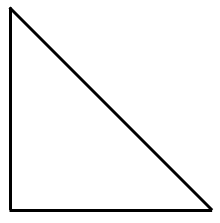
$\Rightarrow$ Now we know that the sides are of length 1 unit.
$\Rightarrow$ Hence by Pythagoras theorem we have length of hypotenuse is $\sqrt{{{1}^{2}}+{{1}^{2}}}=\sqrt{2}$
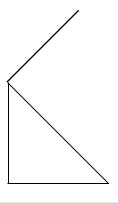
Now again draw a unit side perpendicular to one end of the hypotenuse. Hence we get
$\Rightarrow$ Now again join the two sides to form a triangle.
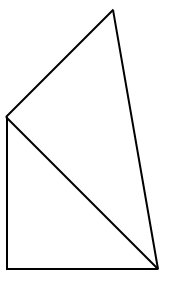
$\Rightarrow$ Now in this new triangle, we have one length is $\sqrt{2}$ and another is 1.
Hence we get the length of hypotenuse is $\sqrt{{{\left( \sqrt{2} \right)}^{2}}+{{1}^{2}}}=\sqrt{2+1}=\sqrt{3}$
$\Rightarrow$ Now we continue these steps after 5 triangles we get a structure in the form of
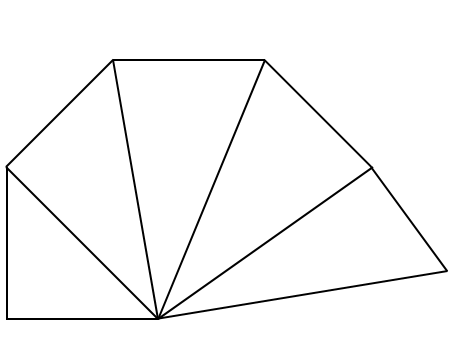
Now as we keep continuing this we can see the structure forming a wheel.
$\Rightarrow$ This is called the wheel of Theodore.
Now consider the given options
Now in the first step since both, the sides of the triangle are of length 1 unit the first triangle is an isosceles triangle. Hence option a is false.
Now from step 2 onwards, we can see that the triangles are not an isosceles triangle. Hence option b is also false.
$\Rightarrow$ Now as we discussed the triangles in the first step are an isosceles triangle of unit length. Hence option c is the correct option.
Note: Note that here in each step one side of the triangle is always 1 and the other side of the triangle is changing. For ${{n}^{th}}$ step we will have one side as $\sqrt{n}$ and other side as 1 and hence the hypotenuse in ${{n}^{th}}$ triangle will be $\left( \sqrt{n+1} \right)$ hence at any given point we have length of sides of triangle.
Complete step by step answer:
Now let us first understand the wheel of Theodorus.
$\Rightarrow$ Now to construct this we will first start with two sides, both length 1 unit perpendicular to each other.
$\Rightarrow$ Now connect the endpoints to form a triangle.
$\Rightarrow$ Now we know that the sides are of length 1 unit.
$\Rightarrow$ Hence by Pythagoras theorem we have length of hypotenuse is $\sqrt{{{1}^{2}}+{{1}^{2}}}=\sqrt{2}$
Now again draw a unit side perpendicular to one end of the hypotenuse. Hence we get
$\Rightarrow$ Now again join the two sides to form a triangle.
$\Rightarrow$ Now in this new triangle, we have one length is $\sqrt{2}$ and another is 1.
Hence we get the length of hypotenuse is $\sqrt{{{\left( \sqrt{2} \right)}^{2}}+{{1}^{2}}}=\sqrt{2+1}=\sqrt{3}$
$\Rightarrow$ Now we continue these steps after 5 triangles we get a structure in the form of
Now as we keep continuing this we can see the structure forming a wheel.
$\Rightarrow$ This is called the wheel of Theodore.
Now consider the given options
Now in the first step since both, the sides of the triangle are of length 1 unit the first triangle is an isosceles triangle. Hence option a is false.
Now from step 2 onwards, we can see that the triangles are not an isosceles triangle. Hence option b is also false.
$\Rightarrow$ Now as we discussed the triangles in the first step are an isosceles triangle of unit length. Hence option c is the correct option.
Note: Note that here in each step one side of the triangle is always 1 and the other side of the triangle is changing. For ${{n}^{th}}$ step we will have one side as $\sqrt{n}$ and other side as 1 and hence the hypotenuse in ${{n}^{th}}$ triangle will be $\left( \sqrt{n+1} \right)$ hence at any given point we have length of sides of triangle.
Recently Updated Pages
Master Class 11 English: Engaging Questions & Answers for Success

Master Class 11 Maths: Engaging Questions & Answers for Success
Master Class 11 Biology: Engaging Questions & Answers for Success
Master Class 11 Physics: Engaging Questions & Answers for Success
Master Class 11 Accountancy: Engaging Questions & Answers for Success
Class 11 Question and Answer - Your Ultimate Solutions Guide
Trending doubts
Why is there a time difference of about 5 hours between class 10 social science CBSE
What is the median of the first 10 natural numbers class 10 maths CBSE
The draft of the Preamble of the Indian Constitution class 10 social science CBSE
Who gave "Inqilab Zindabad" slogan?
Write a letter to the principal requesting him to grant class 10 english CBSE
Who was Subhash Chandra Bose Why was he called Net class 10 english CBSE