




Which of the following nitroso compounds are in a dynamic equilibrium with their tautomers?
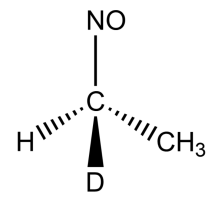
(A)
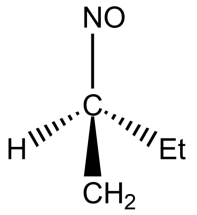
(B)
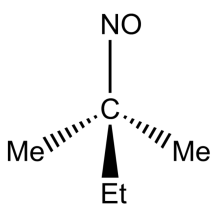
(C)
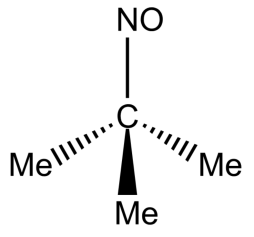
(D)
Answer
 Verified
635.7k+ views
Hint: The isomers of compounds which differ only in the position of the protons and electrons are known as tautomers. When a reaction between such compounds occurs, there is only a transfer of protons.
Complete Step by step answer:
-The phenomenon where a single chemical compound tends to exist in two or more interconvertible structures that are different in terms of the relative position of one atomic nucleus which is generally the hydrogen is known as tautomerism.
-Tautomerism is also known as desmotropism.
- For a compound to exhibit tautomerism, it must have the following structural requirements-
(i) the compound must have at least one alpha hydrogen
(ii) the compound must contain polar molecules and weakly acidic functional groups.
(iii) generally, tautomerism occurs in planar or non-planar molecules.
-Let us now see tautomerism in nitroso compounds.
The shifting of hydrogen produces two forms of tautomers of nitroso compounds, which are ketoxime and aldoxime.
$C{{H}_{3}}-N=O(Ketoxime)\leftrightarrow C{{H}_{2}}=N-OH(Aldoxime)$
-Let us now match with the options and find out which one does exhibit all the structural requirements to be in dynamic equilibrium with their tautomers-
-In option A, the compound has alpha hydrogen, thus it can exhibit tautomerism.
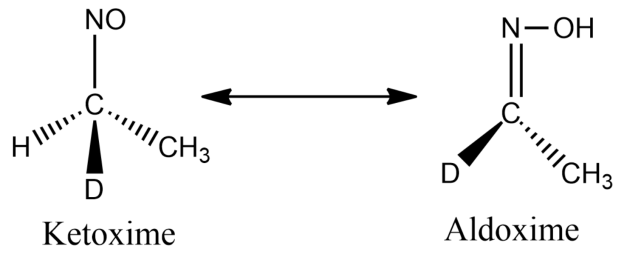
-In option B, the compound has alpha hydrogen, thus it can exhibit tautomerism.
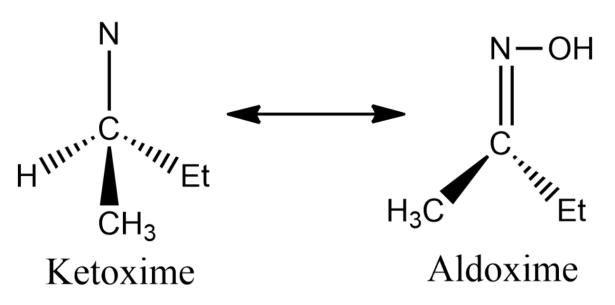
-In option C, the compound does not have alpha hydrogen, hence it will not exhibit tautomerism.
-In option D, the compound does not have alpha hydrogen, hence it will not exhibit tautomerism.
Therefore, the correct answers are options A and B.
Note: Tautomerism happens in the presence of a catalyst which can be either acid-catalyst or base catalyst. In presence of acid-catalyst, the protonation occurs and cation will be delocalized followed by deprotonation occurring in the adjacent position of the cation. In the presence of base-catalyst, the deprotonation occurs in the first step. In this case, anion delocalization occurs instead of cation delocalization and finally, protonation occurs to the different position of the anion.
Complete Step by step answer:
-The phenomenon where a single chemical compound tends to exist in two or more interconvertible structures that are different in terms of the relative position of one atomic nucleus which is generally the hydrogen is known as tautomerism.
-Tautomerism is also known as desmotropism.
- For a compound to exhibit tautomerism, it must have the following structural requirements-
(i) the compound must have at least one alpha hydrogen
(ii) the compound must contain polar molecules and weakly acidic functional groups.
(iii) generally, tautomerism occurs in planar or non-planar molecules.
-Let us now see tautomerism in nitroso compounds.
The shifting of hydrogen produces two forms of tautomers of nitroso compounds, which are ketoxime and aldoxime.
$C{{H}_{3}}-N=O(Ketoxime)\leftrightarrow C{{H}_{2}}=N-OH(Aldoxime)$
-Let us now match with the options and find out which one does exhibit all the structural requirements to be in dynamic equilibrium with their tautomers-
-In option A, the compound has alpha hydrogen, thus it can exhibit tautomerism.
-In option B, the compound has alpha hydrogen, thus it can exhibit tautomerism.
-In option C, the compound does not have alpha hydrogen, hence it will not exhibit tautomerism.
-In option D, the compound does not have alpha hydrogen, hence it will not exhibit tautomerism.
Therefore, the correct answers are options A and B.
Note: Tautomerism happens in the presence of a catalyst which can be either acid-catalyst or base catalyst. In presence of acid-catalyst, the protonation occurs and cation will be delocalized followed by deprotonation occurring in the adjacent position of the cation. In the presence of base-catalyst, the deprotonation occurs in the first step. In this case, anion delocalization occurs instead of cation delocalization and finally, protonation occurs to the different position of the anion.
Recently Updated Pages
Which will be the least stable resonating structure class 11 chemistry CBSE

How many 5 digit telephone numbers can be construc-class-11-maths-CBSE
How do you find the angle of the resultant vector class 11 physics CBSE
Draw labelled diagram of the following i Gram seed class 11 biology CBSE
What is the need and importance of classification class 11 biology CBSE
The way in which the sparrows expressed their sorrow class 11 english CBSE
Trending doubts
One Metric ton is equal to kg A 10000 B 1000 C 100 class 11 physics CBSE
Find the value of the expression given below sin 30circ class 11 maths CBSE
1 Quintal is equal to a 110 kg b 10 kg c 100kg d 1000 class 11 physics CBSE
Draw a diagram of nephron and explain its structur class 11 biology CBSE
10 examples of friction in our daily life
Proton was discovered by A Thomson B Rutherford C Chadwick class 11 chemistry CBSE