




Which of the following National Parks is home to the famous musk deer or Hangul?
a. Eaglenest Wildlife Sanctuary, Arunachal Pradesh
b. Dachigam National Park, Jammu and Kashmir
c. Keibul Lamjao National Park, Manipur
d. Bandhavgarh National Park, Madhya Pradesh
Answer
 Verified
600.6k+ views
Hint: The name of this park stands for “ten villages” because it was formed by the relocation of ten villages in that area. This park was initially created for supplying clean drinking water to the nearest cities.
Complete step-by-step solution:
The famous musk stag deer or Hangul is also called Kashmir stag and is a subspecies of ‘elk’ that is native to India. In our country, it is found in the northern Chamba district of Himachal Pradesh and the dense riverine forests present in the high valleys and mountains of Jammu and Kashmir. The Dachigam National Park in Jammu and Kashmir is considered as home to the Hangul.
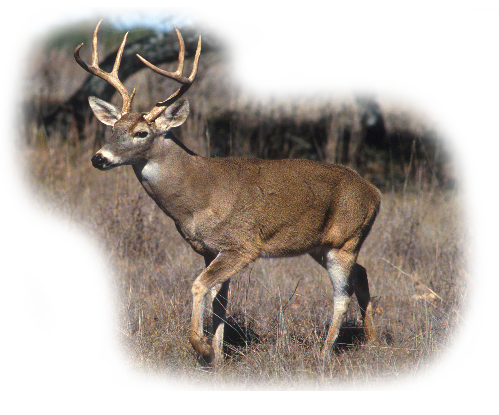
Fig.- Musk deer
Additional information
-A place is called home where one feels safe and secure. The same applies to this deer and the Dachigam National Park is called home for this animal because besides getting a suitable living environment they get maximum protection here.
-The deer lives in a group that may have 2-18 individuals. Considering appearance, these have a brown coat color which becomes greyish white in the regions of the inner side of buttocks. Its antlers consist of five tines which are usually curved inward.
So, the correct answer is ‘Dachigam National Park, Jammu and Kashmir’.
Note: Before World War I, there were 10 villages in the region where Dachigam National Park is located. All these 10 villages were relocated to some other place to establish the Dachigam National Park. In the memory of those villages, this park got the name ‘Dachigam‘. Initially, this was created for supplying clean water to the city of Srinagar but later in 1981, it was upgraded to a National Park.
Complete step-by-step solution:
The famous musk stag deer or Hangul is also called Kashmir stag and is a subspecies of ‘elk’ that is native to India. In our country, it is found in the northern Chamba district of Himachal Pradesh and the dense riverine forests present in the high valleys and mountains of Jammu and Kashmir. The Dachigam National Park in Jammu and Kashmir is considered as home to the Hangul.
Fig.- Musk deer
Additional information
-A place is called home where one feels safe and secure. The same applies to this deer and the Dachigam National Park is called home for this animal because besides getting a suitable living environment they get maximum protection here.
-The deer lives in a group that may have 2-18 individuals. Considering appearance, these have a brown coat color which becomes greyish white in the regions of the inner side of buttocks. Its antlers consist of five tines which are usually curved inward.
So, the correct answer is ‘Dachigam National Park, Jammu and Kashmir’.
Note: Before World War I, there were 10 villages in the region where Dachigam National Park is located. All these 10 villages were relocated to some other place to establish the Dachigam National Park. In the memory of those villages, this park got the name ‘Dachigam‘. Initially, this was created for supplying clean water to the city of Srinagar but later in 1981, it was upgraded to a National Park.
Recently Updated Pages
Master Class 11 Computer Science: Engaging Questions & Answers for Success

Master Class 11 Business Studies: Engaging Questions & Answers for Success
Master Class 11 Economics: Engaging Questions & Answers for Success
Master Class 11 English: Engaging Questions & Answers for Success
Master Class 11 Maths: Engaging Questions & Answers for Success
Master Class 11 Biology: Engaging Questions & Answers for Success
Trending doubts
One Metric ton is equal to kg A 10000 B 1000 C 100 class 11 physics CBSE
There are 720 permutations of the digits 1 2 3 4 5 class 11 maths CBSE
Discuss the various forms of bacteria class 11 biology CBSE
Draw a diagram of a plant cell and label at least eight class 11 biology CBSE
State the laws of reflection of light
Explain zero factorial class 11 maths CBSE