




which of the following names does not fit like a real name?
A.3-methyl 3-hexanone
B.4-methyl 3-hexanone
C.3-methyl 3-hexanol
D.2-methylcyclohexanone
Answer
 Verified
643.5k+ views
Hint:The IUPAC nomenclature of the organic compounds is done on the basis of a fixed set of rules and the substituents attached to the carbon atoms are named based on their preference. Each carbon forms four bonds exactly.
Complete step by step answer:
3-methyl 3-hexanone should look like:
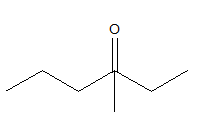
According to the name, as there is “hex”, the compound should be a six membered chain. At the third carbon of the chain there should be a carbonyl bond. But that satisfies the four valences of carbon and it cannot form another bond with a methyl group.
4-methyl 3-hexanone
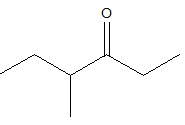
The structure of the compound should be like this as above. The carbonyl group is at the third position and the methyl group is at the fourth position.
3-methyl 3-hexanol
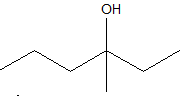
As, the hydroxyl group has a single bond with the carbon atom, so it can form one more bond with the methyl group at the third position. Hence 3-methyl 3-hexanol is possible.
2-methylcyclohexanone
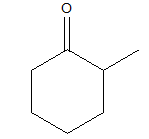
In 2-methylcyclohexanone, there should be a cyclohexane ring, to which at the axial position or the first position there should be a carbonyl group and at the second position, there should be a methyl group. So the structure lives up to its name and hence the name is justified.
So seeing the structure it can be said that only the first name cannot have a structure due to the valency satisfaction of the third carbon by the carbonyl group.
Hence, the correct option is A.
Note:
According to the rules of organic nomenclature, the longest chain of carbon is considered and the naming should start from the end closest to the substituents attached to the carbon atom of the main chain. The substituents have an order of preference and the highest priority group is named at the end of the compound. For example, if a ketone group is present then “one” comes at the end of the compound.
Complete step by step answer:
3-methyl 3-hexanone should look like:
According to the name, as there is “hex”, the compound should be a six membered chain. At the third carbon of the chain there should be a carbonyl bond. But that satisfies the four valences of carbon and it cannot form another bond with a methyl group.
4-methyl 3-hexanone
The structure of the compound should be like this as above. The carbonyl group is at the third position and the methyl group is at the fourth position.
3-methyl 3-hexanol
As, the hydroxyl group has a single bond with the carbon atom, so it can form one more bond with the methyl group at the third position. Hence 3-methyl 3-hexanol is possible.
2-methylcyclohexanone
In 2-methylcyclohexanone, there should be a cyclohexane ring, to which at the axial position or the first position there should be a carbonyl group and at the second position, there should be a methyl group. So the structure lives up to its name and hence the name is justified.
So seeing the structure it can be said that only the first name cannot have a structure due to the valency satisfaction of the third carbon by the carbonyl group.
Hence, the correct option is A.
Note:
According to the rules of organic nomenclature, the longest chain of carbon is considered and the naming should start from the end closest to the substituents attached to the carbon atom of the main chain. The substituents have an order of preference and the highest priority group is named at the end of the compound. For example, if a ketone group is present then “one” comes at the end of the compound.
Recently Updated Pages
If x a + bt + ct2 where x is in meters and t is in class 11 physics CBSE

A car covers the first half distance between two places class 11 physics CBSE
The resultant of two vectors overrightarrow P and overrightarrow class 11 physics CBSE
Find the value of cos 135 class 11 maths CBSE
A mass M is held in place by an applied force F and class 11 physics CBSE
A solution of glucose in water is labelled as 10 dfracwv class 11 chemistry CBSE
Trending doubts
One Metric ton is equal to kg A 10000 B 1000 C 100 class 11 physics CBSE
Find the value of the expression given below sin 30circ class 11 maths CBSE
Draw a diagram of nephron and explain its structur class 11 biology CBSE
10 examples of friction in our daily life
Proton was discovered by A Thomson B Rutherford C Chadwick class 11 chemistry CBSE
Bond order ofO2 O2+ O2 and O22 is in order A O2 langle class 11 chemistry CBSE