




Which of the following layers of soil is called a zone of leaching?
A. $A0$
B. $A00$
C. $A2$
D. $A1$
Answer
 Verified
521.7k+ views
Hint: A soil profile is the vertical division of the soil displaying the several layers from the surface to the unaffected parent material. A soil profile includes O, A, B, C, and R master horizons, and master horizons are divided into sub-horizons. The O horizon is divided into $O1$and $O2$. A horizon is classified into $A1$, $A2$and $A3$. B horizon is categorized into $B1$, $B2$, and $B3$. A, B, and C represent the main horizons.
Complete answer:
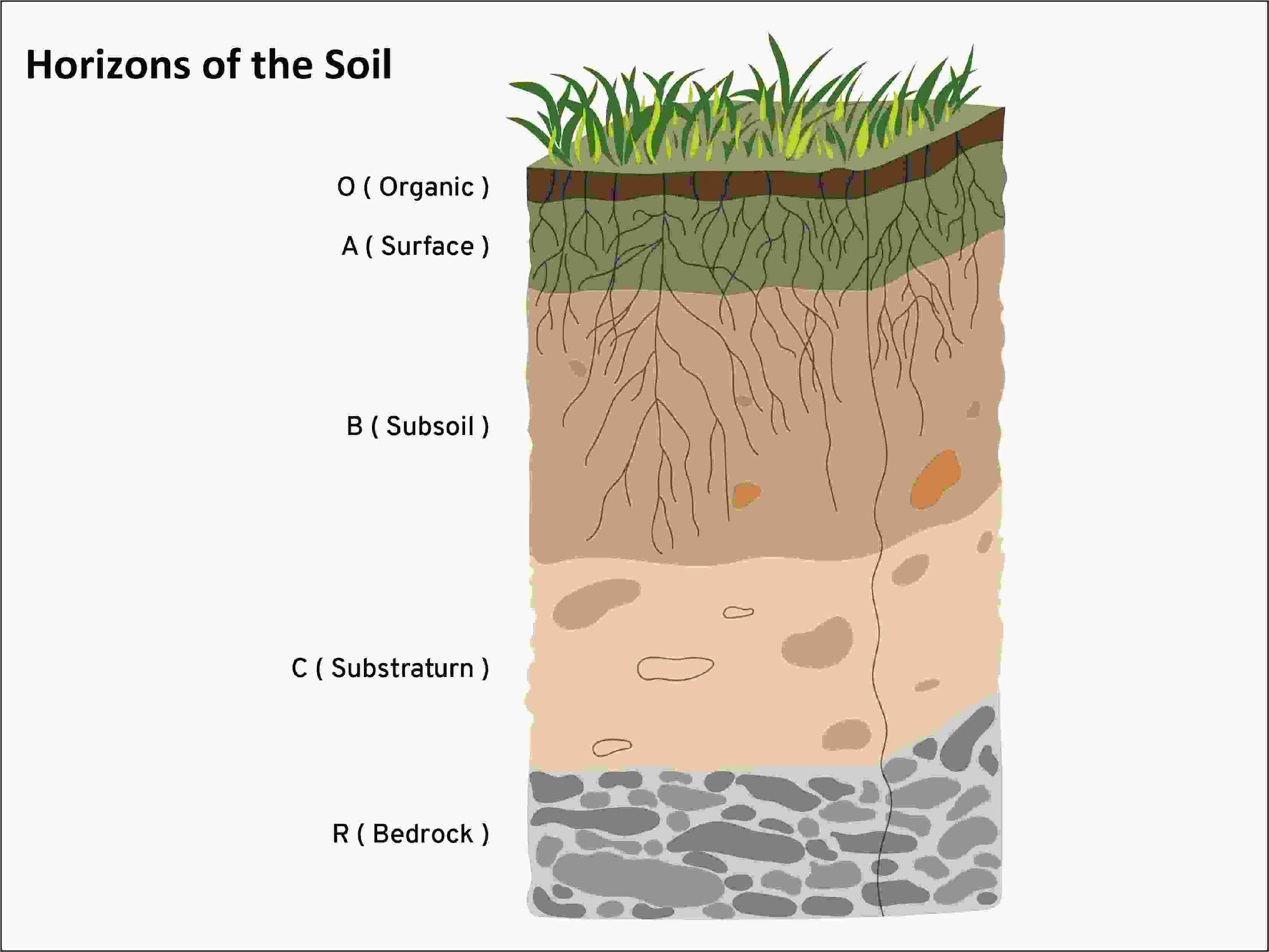
Fig: Soil Profile - Horizons
The zone of leaching is the area present beneath the topsoil. Within this region, the nutrient elements are dissolved and transported downward via the soil, until the zone of saturation is attained. Leaching is a process, where soluble nutrients are lost from the soil. The horizon of the soil is the surface layer, containing more minerals. It is soft and porous, which holds enough water and air.
Option C $A2$: It is the horizon of maximum eluviation of iron, clay, organic matter, and aluminium oxides. Loss of these materials results in the accumulation of quartz and silt size resistant materials. It is constantly leached by rain water, which is also called surface soil.
Therefore Option C is the correct answer.
Additional Information:
Option A $A0$: This sub-horizon is not present in A horizon.
Hence, Option A is not correct
Option B $A00$: This sub-horizon is not included in A horizon.
So, Option B is not correct
Option D $A1$: It is the top most mineral horizon, formed adjacent to the surface of the soil. There is an accumulation of humified organic matter and mineral fraction, appearing darker in color.
Option D is not correct
Note:
The soil profile bears the historic record of soil-forming processes, thus forming the basis for the study in pedagogical examinations. The soil profile acts as a clue for the classification of soils, forming the basis for the practical utility of seeds. The various layers of the soil are termed horizons. The soil gets leached out of A horizon and accumulates in B horizon, as it is called the zone of accumulation.
Complete answer:
Fig: Soil Profile - Horizons
The zone of leaching is the area present beneath the topsoil. Within this region, the nutrient elements are dissolved and transported downward via the soil, until the zone of saturation is attained. Leaching is a process, where soluble nutrients are lost from the soil. The horizon of the soil is the surface layer, containing more minerals. It is soft and porous, which holds enough water and air.
Option C $A2$: It is the horizon of maximum eluviation of iron, clay, organic matter, and aluminium oxides. Loss of these materials results in the accumulation of quartz and silt size resistant materials. It is constantly leached by rain water, which is also called surface soil.
Therefore Option C is the correct answer.
Additional Information:
Option A $A0$: This sub-horizon is not present in A horizon.
Hence, Option A is not correct
Option B $A00$: This sub-horizon is not included in A horizon.
So, Option B is not correct
Option D $A1$: It is the top most mineral horizon, formed adjacent to the surface of the soil. There is an accumulation of humified organic matter and mineral fraction, appearing darker in color.
Option D is not correct
Note:
The soil profile bears the historic record of soil-forming processes, thus forming the basis for the study in pedagogical examinations. The soil profile acts as a clue for the classification of soils, forming the basis for the practical utility of seeds. The various layers of the soil are termed horizons. The soil gets leached out of A horizon and accumulates in B horizon, as it is called the zone of accumulation.
Recently Updated Pages
Master Class 11 English: Engaging Questions & Answers for Success

Master Class 11 Social Science: Engaging Questions & Answers for Success
Master Class 11 Maths: Engaging Questions & Answers for Success
Master Class 11 Biology: Engaging Questions & Answers for Success
Master Class 11 Physics: Engaging Questions & Answers for Success
Master Class 11 Chemistry: Engaging Questions & Answers for Success
Trending doubts
Explain the Treaty of Vienna of 1815 class 10 social science CBSE
What is the Total Duration of Football Match?
The shortest day of the year in India
In which year voting age was reduced from 21 to 18?
10 examples of evaporation in daily life with explanations
What planets have no moons Which one has only one moon class 10 physics CBSE