



Which of the following is/are proper fraction(s):-
A)
B)

C)
D)
Answer
 Verified
638.7k+ views
Hint: Before solving this question, we must know about Proper Fractions.
PROPER FRACTIONS: Fractions whose numerator is smaller than the denominator is called a proper fraction. For example: \[\dfrac{2}{3},\text{ }\dfrac{4}{9},\text{ }\dfrac{3}{13}\] , etc.
Complete step-by-step answer:
Let us now solve this question. We shall consider every option.
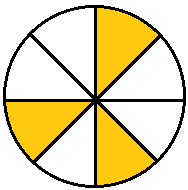
A) We can see that this circle is divided into eight parts out of which three are shaded or colored.
So, the fraction of parts which are colored in the circle is \[\dfrac{3}{8}\] .
And as we can see that \[\dfrac{3}{8}\] is a proper fraction because 3 < 8, therefore, this is one of the correct options.
B) We can see in the figure above that the whole rectangle is shaded. Therefore, the fraction that we get here is 1/1. And, as the numerator is not smaller than the denominator, this is not a proper fraction.
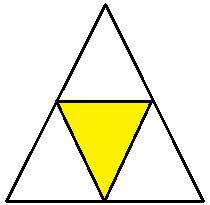
C) We can see that this triangle is divided into four parts out of which one is shaded or colored.
So, the fraction of parts which are colored in the triangle is \[\dfrac{1}{4}\] .
And as we can see that \[\dfrac{1}{4}\] is a proper fraction because 1 < 4, therefore, this is one of the correct options.
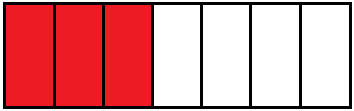
D) We can see that this rectangle is divided into seven parts out of which three are shaded or colored.
So, the fraction of parts which are colored in the rectangle is \[\dfrac{3}{7}\] .
And as we can see that \[\dfrac{3}{7}\] is a proper fraction because 3 < 7, therefore, this is one of the correct options.
Note:- Students should know about Improper Fraction as well.
IMPROPER FRACTIONS: Fractions whose numerator is greater than the numerator is called an improper fraction. For example: \[\dfrac{3}{2},\text{ }\dfrac{9}{4},\text{ }\dfrac{13}{3}\] , etc.
PROPER FRACTIONS: Fractions whose numerator is smaller than the denominator is called a proper fraction. For example: \[\dfrac{2}{3},\text{ }\dfrac{4}{9},\text{ }\dfrac{3}{13}\] , etc.
Complete step-by-step answer:
Let us now solve this question. We shall consider every option.
A) We can see that this circle is divided into eight parts out of which three are shaded or colored.
So, the fraction of parts which are colored in the circle is \[\dfrac{3}{8}\] .
And as we can see that \[\dfrac{3}{8}\] is a proper fraction because 3 < 8, therefore, this is one of the correct options.
B) We can see in the figure above that the whole rectangle is shaded. Therefore, the fraction that we get here is 1/1. And, as the numerator is not smaller than the denominator, this is not a proper fraction.
C) We can see that this triangle is divided into four parts out of which one is shaded or colored.
So, the fraction of parts which are colored in the triangle is \[\dfrac{1}{4}\] .
And as we can see that \[\dfrac{1}{4}\] is a proper fraction because 1 < 4, therefore, this is one of the correct options.
D) We can see that this rectangle is divided into seven parts out of which three are shaded or colored.
So, the fraction of parts which are colored in the rectangle is \[\dfrac{3}{7}\] .
And as we can see that \[\dfrac{3}{7}\] is a proper fraction because 3 < 7, therefore, this is one of the correct options.
Note:- Students should know about Improper Fraction as well.
IMPROPER FRACTIONS: Fractions whose numerator is greater than the numerator is called an improper fraction. For example: \[\dfrac{3}{2},\text{ }\dfrac{9}{4},\text{ }\dfrac{13}{3}\] , etc.
Recently Updated Pages
Master Class 11 Social Science: Engaging Questions & Answers for Success

Master Class 11 Chemistry: Engaging Questions & Answers for Success
Master Class 12 Business Studies: Engaging Questions & Answers for Success
Master Class 12 Chemistry: Engaging Questions & Answers for Success
Master Class 12 Biology: Engaging Questions & Answers for Success
Class 12 Question and Answer - Your Ultimate Solutions Guide
Trending doubts
What is the situation called when no party gets the class 9 social science CBSE
Find the sum of series 1 + 2 + 3 + 4 + 5 + + 100 class 9 maths CBSE
Fill the blanks with the suitable prepositions 1 The class 9 english CBSE
Difference Between Plant Cell and Animal Cell
What is pollution? How many types of pollution? Define it
Name 10 Living and Non living things class 9 biology CBSE