




Which of the following is/are positive?
A. ${\log _{\sin 1}}\tan 1$
B. ${\log _{\cos 1}}\left( {1 + \tan 3} \right)$
C. ${\log _{{{\log }_{10}}5}}\left( {\cos \theta + \sec \theta } \right)$
D. ${\log _{\tan {{15}^o}}}\left( {2\sin {{18}^o}} \right)$
Answer
 Verified
505.8k+ views
Hint: In this question, from the given functions, we have to tell the positive ones. We have that, in ${\log _a}x$ , if $a > 1$ and $x > 1$ or $a < 1$ and $x < 1$ then, ${\log _a}x > 0$ , otherwise, it is negative.
$\tan \theta $ is always an increasing function, whereas, $\sin \theta $ and $\cos \theta $ are neither increasing nor decreasing.
Complete answer:
Given are four logarithmic functions.
To tell which of these are positive.
Firstly, we know, the graph of ${\log _a}x$ , when $a > 1$ is given by
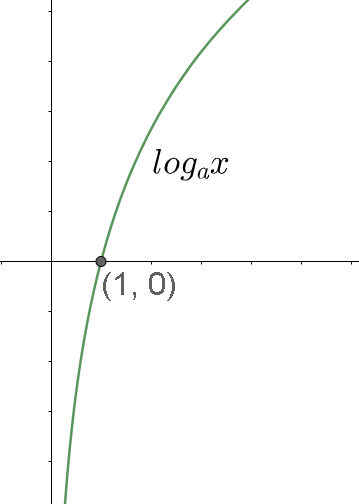
Then, ${\log _a}x > 0$ , when $x > 1$ .
And when $a < 1$ , the graph is given by
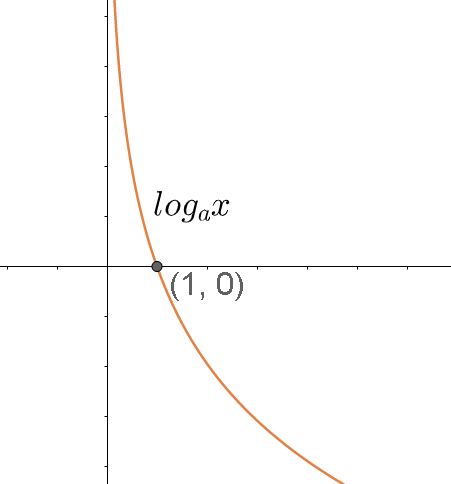
Then, ${\log _a}x > 0$ , when $x < 1$ .
Now, consider the function, ${\log _{\sin 1}}\tan 1$ , we have, $\dfrac{\pi }{2} = \dfrac{{3.14}}{2} > 1$ , so, $\sin \dfrac{\pi }{2} > \sin 1$ which gives $\sin 1 < 1$ .
And, $\dfrac{\pi }{4} = \dfrac{{3.14}}{4} < 1$ , so, $\tan \dfrac{\pi }{4} < \tan 1$ which give $\tan 1 > 1$ . Now, $\sin 1 < 1$ and $\tan 1 > 1$ , hence, ${\log _{\sin 1}}\tan 1 < 0$ .
Now, consider the function, ${\log _{\cos 1}}\left( {1 + \tan 3} \right)$ , $0 < 1 < \dfrac{\pi }{2}$ , so, $\cos 0 > \cos 1 > \cos \dfrac{\pi }{2}$ , since, the function is decreasing for $0 < \theta < \pi $ , hence, $\cos 1 < 1$
And, $\dfrac{\pi }{2} < 3 < \pi $ , which means it is in the second quadrant, and the second quadrant $\tan $ is negative, which means $1 + \tan 3 < 1$ .
Now, $\cos 1 < 1$ and $1 + \tan 3 < 1$ , hence, ${\log _{\cos 1}}\left( {1 + \tan 3} \right) > 0$ .
Now, consider the function, ${\log _{\tan {{15}^o}}}\left( {2\sin {{18}^o}} \right)$ , we know, $\sin {18^o} < \sin {30^o}$ , which means, $\sin {18^o} < \dfrac{1}{2}$ i.e., $2\sin {18^o} < 1$ .
And, we know, $\tan {15^o} < \tan {45^o}$ , which gives, $\tan {15^o} < 1$ . Now, $2\sin {18^o} < 1$ and $\tan {15^o} < 1$ , so, ${\log _{\tan {{15}^o}}}\left( {2\sin {{18}^o}} \right) > 0$ .
Now, at last, consider the function, ${\log _{{{\log }_{10}}5}}\left( {\cos \theta + \sec \theta } \right)$ , we know, ${\log _{10}}5 < {\log _{10}}10$ i.e., ${\log _{10}}5 < 1$ .
And, we know, the Arithmetic mean is always greater than the geometric mean, therefore, $\dfrac{{\left( {\cos \theta + \sec \theta } \right)}}{2} > {\left( {\cos \theta \cdot \sec \theta } \right)^{\dfrac{1}{2}}}$ , which gives, $\cos \theta + \sec \theta > 2 > 1$ .
Now, ${\log _{10}}5 < 1$ and $\cos \theta + \sec \theta > 2 > 1$ , hence, ${\log _{{{\log }_{10}}5}}\left( {\cos \theta + \sec \theta } \right) < 0$ .
Thus, ${\log _{\tan {{15}^o}}}\left( {2\sin {{18}^o}} \right)$ and ${\log _{\cos 1}}\left( {1 + \tan 3} \right)$ are positive.
Therefore, the correct option is B and C
Note: We know that, $\sec \theta $ is reciprocal of $\cos \theta $ .
“Arithmetic mean is always greater than the geometric mean” is true for every function or equation.
For checking, if a logarithmic function is positive or negative, we have to check if $a$ and $x$ are greater than or less than $1$ , if the sign of $a$ and $x$ are same i.e., either both greater than $1$ or both less than $1$, then, the logarithmic function is positive, and if the sign of $a$ and $x$ are not same, i.e., one is greater than $1$ and other is less than $1$, then the logarithmic function is negative.
$\tan \theta $ is always an increasing function, whereas, $\sin \theta $ and $\cos \theta $ are neither increasing nor decreasing.
Complete answer:
Given are four logarithmic functions.
To tell which of these are positive.
Firstly, we know, the graph of ${\log _a}x$ , when $a > 1$ is given by
Then, ${\log _a}x > 0$ , when $x > 1$ .
And when $a < 1$ , the graph is given by
Then, ${\log _a}x > 0$ , when $x < 1$ .
Now, consider the function, ${\log _{\sin 1}}\tan 1$ , we have, $\dfrac{\pi }{2} = \dfrac{{3.14}}{2} > 1$ , so, $\sin \dfrac{\pi }{2} > \sin 1$ which gives $\sin 1 < 1$ .
And, $\dfrac{\pi }{4} = \dfrac{{3.14}}{4} < 1$ , so, $\tan \dfrac{\pi }{4} < \tan 1$ which give $\tan 1 > 1$ . Now, $\sin 1 < 1$ and $\tan 1 > 1$ , hence, ${\log _{\sin 1}}\tan 1 < 0$ .
Now, consider the function, ${\log _{\cos 1}}\left( {1 + \tan 3} \right)$ , $0 < 1 < \dfrac{\pi }{2}$ , so, $\cos 0 > \cos 1 > \cos \dfrac{\pi }{2}$ , since, the function is decreasing for $0 < \theta < \pi $ , hence, $\cos 1 < 1$
And, $\dfrac{\pi }{2} < 3 < \pi $ , which means it is in the second quadrant, and the second quadrant $\tan $ is negative, which means $1 + \tan 3 < 1$ .
Now, $\cos 1 < 1$ and $1 + \tan 3 < 1$ , hence, ${\log _{\cos 1}}\left( {1 + \tan 3} \right) > 0$ .
Now, consider the function, ${\log _{\tan {{15}^o}}}\left( {2\sin {{18}^o}} \right)$ , we know, $\sin {18^o} < \sin {30^o}$ , which means, $\sin {18^o} < \dfrac{1}{2}$ i.e., $2\sin {18^o} < 1$ .
And, we know, $\tan {15^o} < \tan {45^o}$ , which gives, $\tan {15^o} < 1$ . Now, $2\sin {18^o} < 1$ and $\tan {15^o} < 1$ , so, ${\log _{\tan {{15}^o}}}\left( {2\sin {{18}^o}} \right) > 0$ .
Now, at last, consider the function, ${\log _{{{\log }_{10}}5}}\left( {\cos \theta + \sec \theta } \right)$ , we know, ${\log _{10}}5 < {\log _{10}}10$ i.e., ${\log _{10}}5 < 1$ .
And, we know, the Arithmetic mean is always greater than the geometric mean, therefore, $\dfrac{{\left( {\cos \theta + \sec \theta } \right)}}{2} > {\left( {\cos \theta \cdot \sec \theta } \right)^{\dfrac{1}{2}}}$ , which gives, $\cos \theta + \sec \theta > 2 > 1$ .
Now, ${\log _{10}}5 < 1$ and $\cos \theta + \sec \theta > 2 > 1$ , hence, ${\log _{{{\log }_{10}}5}}\left( {\cos \theta + \sec \theta } \right) < 0$ .
Thus, ${\log _{\tan {{15}^o}}}\left( {2\sin {{18}^o}} \right)$ and ${\log _{\cos 1}}\left( {1 + \tan 3} \right)$ are positive.
Therefore, the correct option is B and C
Note: We know that, $\sec \theta $ is reciprocal of $\cos \theta $ .
“Arithmetic mean is always greater than the geometric mean” is true for every function or equation.
For checking, if a logarithmic function is positive or negative, we have to check if $a$ and $x$ are greater than or less than $1$ , if the sign of $a$ and $x$ are same i.e., either both greater than $1$ or both less than $1$, then, the logarithmic function is positive, and if the sign of $a$ and $x$ are not same, i.e., one is greater than $1$ and other is less than $1$, then the logarithmic function is negative.
Recently Updated Pages
Master Class 12 Business Studies: Engaging Questions & Answers for Success

Master Class 12 Biology: Engaging Questions & Answers for Success
Master Class 12 Chemistry: Engaging Questions & Answers for Success
Class 12 Question and Answer - Your Ultimate Solutions Guide
Master Class 11 Social Science: Engaging Questions & Answers for Success
Master Class 11 English: Engaging Questions & Answers for Success
Trending doubts
Explain the Treaty of Vienna of 1815 class 10 social science CBSE
Who Won 36 Oscar Awards? Record Holder Revealed
What is the median of the first 10 natural numbers class 10 maths CBSE
Why is it 530 pm in india when it is 1200 afternoon class 10 social science CBSE
The highest temperature in Karnataka is recorded in class 10 social science CBSE
Define Potential, Developed, Stock and Reserved resources