




Which of the following is/are correctly matched?
a.) \[[Ni{{(CO)}_{4}}]-ds{{p}^{2}}\] and diamagnetic
b.) \[[Ni{{(en)}_{3}}]{{(N{{O}_{2}})}_{2}}-s{{p}^{3}}{{d}^{2}}\] and two unpaired electrons
c.) \[[V{{(N{{H}_{3}})}_{6}}]C{{l}_{3}}-s{{p}^{3}}{{d}^{2}}\] and two unpaired electrons
d.) \[[Mn{{(N{{O}^{+}})}_{3}}(CO)]-s{{p}^{3}}\]and diamagnetic
Answer
 Verified
663.6k+ views
Hint: In order to solve this question, check the oxidation state of the central atom of each compound. Using that, predict the compound’s hybridization. If any orbital contains unpaired electrons, it is paramagnetic, otherwise it is diamagnetic.
Complete step by step solution:
Let us look at all the compounds one by one.
\[[Ni{{(CO)}_{4}}]\]
Oxidation state of Ni = 0.
Its electronic configuration is - \[[Ar]3{{d}^{8}}4{{s}^{2}}\]
Carbon monoxide is a strong field ligand. Therefore, pairing of electrons takes place. This can be represented as –
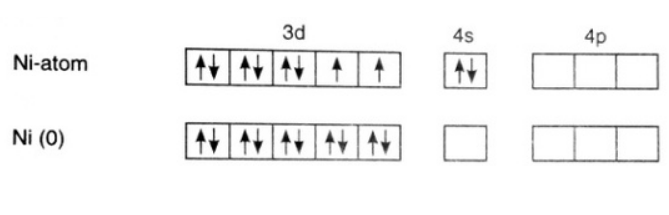
The hybridization of the compound is – \[s{{p}^{3}}\].
As all electrons in this compound are paired, it is a diamagnetic compound.
Option (a) is incorrect.
\[[Ni{{(en)}_{3}}]{{(N{{O}_{2}})}_{2}}\]
Oxidation state of Ni = +2
Its electronic configuration is - \[[Ar]3{{d}^{8}}4{{s}^{0}}\]
Ethylene diamine is a weak field ligand. Hence, there is no pairing of electrons. This can be represented as –

The hybridization of the compound is – \[s{{p}^{3}}{{d}^{2}}\].
As we can see, 2 electrons in 3d are unpaired, it is a paramagnetic compound.
Option (b) is correct.
\[[V{{(N{{H}_{3}})}_{6}}]C{{l}_{3}}\]
Oxidation state of V = +3
Its electronic configuration is - \[[Ar]3{{d}^{2}}4{{s}^{0}}\]
Ammonia is a strong field ligand. Therefore, pairing of electrons takes place. This can be represented as –

The hybridization of the compound is – \[{{d}^{2}}s{{p}^{3}}\].
As all electrons in this compound are paired, it is a diamagnetic compound.
Option (c) is incorrect.
\[[Mn{{(N{{O}^{+}})}_{3}}(CO)]\]
Oxidation state of Mn = +2
Its electronic configuration is - \[[Ar]3{{d}^{5}}4{{s}^{0}}\]
Nitrosonium is a weak field ligand. Hence, there is no pairing of electrons. This can be represented as –
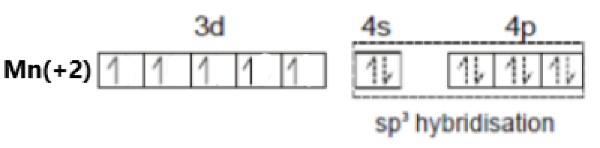
The hybridization of the compound is – \[s{{p}^{3}}\].
As all electrons in this compound are unpaired, it is a paramagnetic compound.
Option (d) is incorrect.
Therefore, the answer is – option (b).
Note: Compounds not attracted to magnetic fields are known as diamagnetic compounds. They have all paired electrons. Whereas, compounds which are attracted to magnetic fields, are known as paramagnetic compounds. They have unpaired electrons.
Complete step by step solution:
Let us look at all the compounds one by one.
\[[Ni{{(CO)}_{4}}]\]
Oxidation state of Ni = 0.
Its electronic configuration is - \[[Ar]3{{d}^{8}}4{{s}^{2}}\]
Carbon monoxide is a strong field ligand. Therefore, pairing of electrons takes place. This can be represented as –
The hybridization of the compound is – \[s{{p}^{3}}\].
As all electrons in this compound are paired, it is a diamagnetic compound.
Option (a) is incorrect.
\[[Ni{{(en)}_{3}}]{{(N{{O}_{2}})}_{2}}\]
Oxidation state of Ni = +2
Its electronic configuration is - \[[Ar]3{{d}^{8}}4{{s}^{0}}\]
Ethylene diamine is a weak field ligand. Hence, there is no pairing of electrons. This can be represented as –
The hybridization of the compound is – \[s{{p}^{3}}{{d}^{2}}\].
As we can see, 2 electrons in 3d are unpaired, it is a paramagnetic compound.
Option (b) is correct.
\[[V{{(N{{H}_{3}})}_{6}}]C{{l}_{3}}\]
Oxidation state of V = +3
Its electronic configuration is - \[[Ar]3{{d}^{2}}4{{s}^{0}}\]
Ammonia is a strong field ligand. Therefore, pairing of electrons takes place. This can be represented as –
The hybridization of the compound is – \[{{d}^{2}}s{{p}^{3}}\].
As all electrons in this compound are paired, it is a diamagnetic compound.
Option (c) is incorrect.
\[[Mn{{(N{{O}^{+}})}_{3}}(CO)]\]
Oxidation state of Mn = +2
Its electronic configuration is - \[[Ar]3{{d}^{5}}4{{s}^{0}}\]
Nitrosonium is a weak field ligand. Hence, there is no pairing of electrons. This can be represented as –
The hybridization of the compound is – \[s{{p}^{3}}\].
As all electrons in this compound are unpaired, it is a paramagnetic compound.
Option (d) is incorrect.
Therefore, the answer is – option (b).
Note: Compounds not attracted to magnetic fields are known as diamagnetic compounds. They have all paired electrons. Whereas, compounds which are attracted to magnetic fields, are known as paramagnetic compounds. They have unpaired electrons.
Recently Updated Pages
If x a + bt + ct2 where x is in meters and t is in class 11 physics CBSE

A car covers the first half distance between two places class 11 physics CBSE
The resultant of two vectors overrightarrow P and overrightarrow class 11 physics CBSE
Find the value of cos 135 class 11 maths CBSE
A mass M is held in place by an applied force F and class 11 physics CBSE
A solution of glucose in water is labelled as 10 dfracwv class 11 chemistry CBSE
Trending doubts
One Metric ton is equal to kg A 10000 B 1000 C 100 class 11 physics CBSE
Find the value of the expression given below sin 30circ class 11 maths CBSE
Draw a diagram of nephron and explain its structur class 11 biology CBSE
10 examples of friction in our daily life
Proton was discovered by A Thomson B Rutherford C Chadwick class 11 chemistry CBSE
Bond order ofO2 O2+ O2 and O22 is in order A O2 langle class 11 chemistry CBSE