




Which of the following is true for the mathematical expression $\log \left( {{x}^{n}} \right)=n\log x$
[a] $\forall n\in \mathbb{N}$
[b] $\forall n\in \mathbb{Z}$
[c] n is a positive odd integer
[d] n is a positive even integer
Answer
 Verified
608.1k+ views
- Hint: Use the fact that if a = log x, then $x={{10}^{a}}$. Use the property ${{\left( {{10}^{a}} \right)}^{n}}={{10}^{an}}$. Use the property that log x is defined for x >0. Verify that the above property fails to hold for x<0.
Complete step by step answer -
Let $a=\log {{x}^{n}}$.
Hence, we have ${{x}^{n}}={{10}^{a}}$
Raising power to $\dfrac{1}{n}$ on both sides, we get
\[x={{10}^{\dfrac{a}{n}}}\]
Taking log on both sides, we get
$\dfrac{a}{n}=\log x$
Multiplying both sides by n, we get
a = nlogx.
Hence the given statement is true for all n when x>0.
Hence if x>0 all of the options [a], [b] , [c] , [d] are correct.
If x<0 all of the options [a], [b],[c] and [d] are incorrect.
Note: [1] Consider the logarithm of 100,
We know that log 100 =2.
Also $100={{\left( -10 \right)}^{2}}$
Hence If the above-mentioned property holds, we have
$\log 100=2\log \left( -10 \right)$
But, since -10<0, log(-10) is not defined.
Hence the above-mentioned property does not hold for x<0.
For x<0 and even integral value of n, we have
$\log \left( {{x}^{n}} \right)=n\log \left| x \right|$ and for odd integral values and x<0, $\log \left( {{x}^{n}} \right)$ is not defined.
[2] The base of a logarithm is always positive, and since all exponents of positive numbers are positive, the domain of the logarithm is all positive real numbers
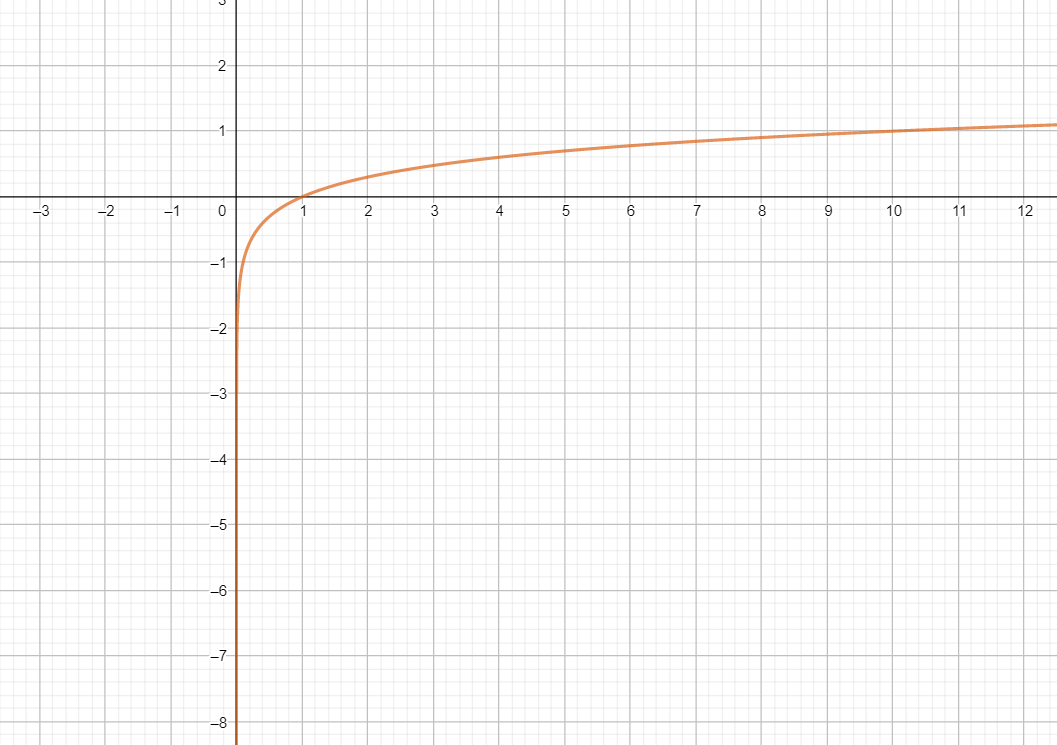
[3] The graph of log x is shown below
Complete step by step answer -
Let $a=\log {{x}^{n}}$.
Hence, we have ${{x}^{n}}={{10}^{a}}$
Raising power to $\dfrac{1}{n}$ on both sides, we get
\[x={{10}^{\dfrac{a}{n}}}\]
Taking log on both sides, we get
$\dfrac{a}{n}=\log x$
Multiplying both sides by n, we get
a = nlogx.
Hence the given statement is true for all n when x>0.
Hence if x>0 all of the options [a], [b] , [c] , [d] are correct.
If x<0 all of the options [a], [b],[c] and [d] are incorrect.
Note: [1] Consider the logarithm of 100,
We know that log 100 =2.
Also $100={{\left( -10 \right)}^{2}}$
Hence If the above-mentioned property holds, we have
$\log 100=2\log \left( -10 \right)$
But, since -10<0, log(-10) is not defined.
Hence the above-mentioned property does not hold for x<0.
For x<0 and even integral value of n, we have
$\log \left( {{x}^{n}} \right)=n\log \left| x \right|$ and for odd integral values and x<0, $\log \left( {{x}^{n}} \right)$ is not defined.
[2] The base of a logarithm is always positive, and since all exponents of positive numbers are positive, the domain of the logarithm is all positive real numbers
[3] The graph of log x is shown below
Recently Updated Pages
Master Class 11 Computer Science: Engaging Questions & Answers for Success

Master Class 11 Business Studies: Engaging Questions & Answers for Success
Master Class 11 Economics: Engaging Questions & Answers for Success
Master Class 11 English: Engaging Questions & Answers for Success
Master Class 11 Maths: Engaging Questions & Answers for Success
Master Class 11 Biology: Engaging Questions & Answers for Success
Trending doubts
One Metric ton is equal to kg A 10000 B 1000 C 100 class 11 physics CBSE
There are 720 permutations of the digits 1 2 3 4 5 class 11 maths CBSE
Discuss the various forms of bacteria class 11 biology CBSE
Draw a diagram of a plant cell and label at least eight class 11 biology CBSE
State the laws of reflection of light
Explain zero factorial class 11 maths CBSE