




Which of the following is the other name for secondary nucleus?
(a) Generative nucleus
(b) Tube nucleus
(c) Definitive nucleus
(d) Primary endosperm nucleus
Answer
 Verified
545.1k+ views
Hint: Cell is developed by the combination of the sperm core and two polar cores of the central cell (or diploid auxiliary endosperm core, in this situation where two polar nuclei fuse before double fertilization). The first cell of the endosperm, often triploid.
Complete answer
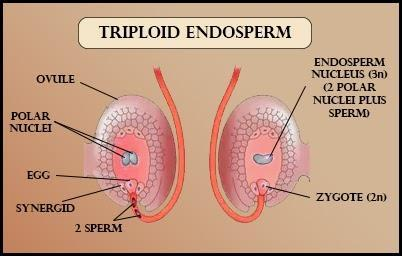
The secondary nucleus is defined as when the diploid nucleus is formed by the fusion of two polar nuclei. And it is also called a primary endosperm nucleus.
The endosperm is made when the 2 sperm cores inside a pollen grain come within a female gametophyte (some of the time called the embryo sac). One sperm core fertilizes the ovum, shaping a zygote, while the contrary sperm core generally fuses with the binucleate focal cell, framing an essential endosperm cell (its core is often called the triple fusion nucleus). That cell created within the process of double fertilization develops into the endosperm. Because it's formed by separate fertilization, the endosperm constitutes an organism that breaks away from the growing embryo.
In polyploid, about $70\%$ of angiosperm species have endosperm cells. These are commonly triploid (containing three arrangements of chromosomes), yet can change generally from diploid (2n) to 15n.
So the correct answer is ‘Primary endosperm nucleus’.
Note:
One species of angiosperm, Nuphar polysepala, has been shown to possess an endosperm that's diploid, resulting from the fusion of a pollen nucleus with one, instead of two, maternal nuclei. The same is meant for a few other basal angiosperms. It's accepted that ahead of schedule inside the advancement of angiosperm ancestries, there was a duplication during this method of proliferation, making seven-celled/eight-nucleate female gametophytes, and triploid endosperms with a 2:1 maternal to fatherly genome proportion.
Complete answer
The secondary nucleus is defined as when the diploid nucleus is formed by the fusion of two polar nuclei. And it is also called a primary endosperm nucleus.
The endosperm is made when the 2 sperm cores inside a pollen grain come within a female gametophyte (some of the time called the embryo sac). One sperm core fertilizes the ovum, shaping a zygote, while the contrary sperm core generally fuses with the binucleate focal cell, framing an essential endosperm cell (its core is often called the triple fusion nucleus). That cell created within the process of double fertilization develops into the endosperm. Because it's formed by separate fertilization, the endosperm constitutes an organism that breaks away from the growing embryo.
In polyploid, about $70\%$ of angiosperm species have endosperm cells. These are commonly triploid (containing three arrangements of chromosomes), yet can change generally from diploid (2n) to 15n.
So the correct answer is ‘Primary endosperm nucleus’.
Note:
One species of angiosperm, Nuphar polysepala, has been shown to possess an endosperm that's diploid, resulting from the fusion of a pollen nucleus with one, instead of two, maternal nuclei. The same is meant for a few other basal angiosperms. It's accepted that ahead of schedule inside the advancement of angiosperm ancestries, there was a duplication during this method of proliferation, making seven-celled/eight-nucleate female gametophytes, and triploid endosperms with a 2:1 maternal to fatherly genome proportion.
Recently Updated Pages
Master Class 12 Business Studies: Engaging Questions & Answers for Success

Master Class 12 Chemistry: Engaging Questions & Answers for Success
Master Class 12 Biology: Engaging Questions & Answers for Success
Class 12 Question and Answer - Your Ultimate Solutions Guide
Master Class 11 English: Engaging Questions & Answers for Success
Master Class 11 Social Science: Engaging Questions & Answers for Success
Trending doubts
Which are the Top 10 Largest Countries of the World?
Draw a labelled sketch of the human eye class 12 physics CBSE
Differentiate between homogeneous and heterogeneous class 12 chemistry CBSE
Differentiate between Pyramid of energy and pyramid class 12 biology CBSE
Why is the cell called the structural and functional class 12 biology CBSE
Draw the diagram of the pyramid of energy Explain In class 12 biology CBSE