




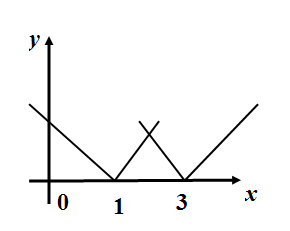
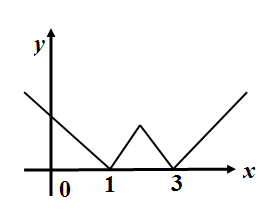
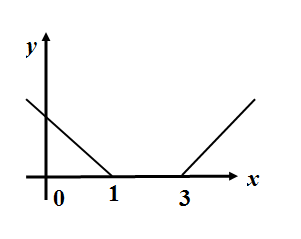
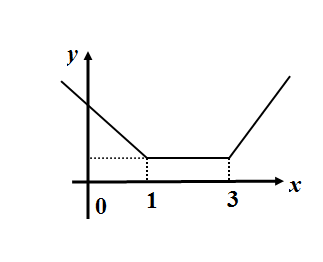
Which of the following is the graph of $ y=\left| x-1 \right|+\left| x-3 \right| $ ? \[\]
A.
B.
C.
D.
Answer
 Verified
616.8k+ views
Hint: We recall the definition modulus function $ \left| x \right| $ which is piecewise defined with breaking point $ x=0 $ . We see in the given function $ y=\left| x-1 \right|+\left| x-3 \right| $ we have two break points that is $ x=1,x=3 $ . We find the definition of the function in the intervals $ \left( -\infty ,1 \right),\left[ 1,3 \right],\left( 3,\infty \right) $ and try to guess the function.
Complete step by step answer:
We know that of absolute value function of modulus function denoted as $ \left| x \right| $ returns a non-negative value without regard for the input of the functions. It is defined in piecewise manner as;
\[\left| x \right|=\left\{ \begin{matrix}
-x & \text{if } x < 0\text{ } \\
x & \text{if }x\ge 0 \\
\end{matrix} \right.\]
We see that the function has break point at $ x=0 $ which means the absolute value function has different definition for $ x\in \left( -\infty ,0 \right) $ and for $ x\in \left[ 0,\infty \right) $ . If we define an absolute value function $ \left| x-a \right| $ for any positive real number $ a $ then $ a $ will be the break point since $ \left| x-a \right| $ has to return non-negative outputs and for that we have to define the function as
\[\left| x-a \right|=\left\{ \begin{matrix}
a-x & \text{if }x < a\text{ } \\
x-a & \text{if }x\ge a \\
\end{matrix} \right.\]
We are given the following function in the question
\[y=\left| x-1 \right|+\left| x-3 \right|\]
We see that we are given two absolute value functions $ \left| x-1 \right|,\left| x-3 \right| $ and we have 2 break points $ x=1,3 $ for the piecewise wise definition. So we need to define the given function $ y $ in the intervals $ \left( -\infty ,1 \right),\left[ 1,3 \right],\left( 3,\infty \right) $ .
We have in the interval $ \left( -\infty ,1 \right) $ the function $ \left| x-1 \right|=1-x $ since $ x < 1 $ for all $ x\in \left( -\infty ,1 \right) $ . We also have $ \left| x-1 \right|=3-x $ since $ x < 3 $ for all $ x\in \left( -\infty ,1 \right) $ . So the given function in the interval $ \left( -\infty ,1 \right) $ can be defined as
\[\begin{align}
& y=1-x+3-x \\
& \Rightarrow y=-2x+4 \\
\end{align}\]
We see that the above equation is an equation of line with negative slope. Let us check the interval $ \left[ 1,3 \right] $ . Since $ x\ge 1 $ for all $ x\in \left[ 1,3 \right] $ we have $ \left| x-1 \right|=x-1 $ and since $ x\le 3 $ for all $ x\in \left[ 1,3 \right] $ we have $ \left| x-3 \right|=3-x $ . So the given function in the interval $ \left[ 1,3 \right] $ can be defined as
\[\begin{align}
& y=x-1+3-x \\
& \Rightarrow y=2 \\
\end{align}\]
So the above equation is a line parallel to $ x- $ axis. . Let us check the interval $ \left( 3,\infty \right) $ . Since $ x\ge 1 $ for all $ x\in \left( 3,\infty \right) $ we have $ \left| x-1 \right|=x-1 $ and since $ x>3 $ for all $ x\in \left( 3,\infty \right) $ we have $ \left| x-3 \right|=x-3 $ . So the given function in the interval $ \left( 3,\infty \right) $ can be defined as
\[\begin{align}
& y=x-1+x-3 \\
& \Rightarrow y=2x-4 \\
\end{align}\]
We see that the above equation is an equation of line with negative slope. We see at the break points $ x=1,3 $ the function values are
\[\begin{align}
& \text{At }x=1:y=-2x+4=-2\left( 1 \right)+4=-2+4=2 \\
& \text{At }x=3:\text{ }y=2x-4=2\left( 3 \right)-4=6-4=2 \\
\end{align}\]
So the give function is a continuous function but a decreasing line in $ \left( -\infty ,1 \right) $ , a parallel line above a distance of 2 from $ x- $ axis in $ \left[ 1,3 \right] $ and an increasing line in $ \left( 3,\infty \right) $ . We check the options and find the correct plot to be in D. \[\]
Note:
We note that the general equation of line with slope and intercept form is given as $ y=mx+c $ where $ m $ is the slope and $ c $ is the $ y- $ intercept. If $ m $ is positive we get an increasing line, if $ m $ is negative we get a deceasing line and if $ m=0 $ we get a line parallel to $ x- $ axis. We can find the break points in $ \left| x+a \right| $ by converting it to $ \left| x-\left( -a \right) \right| $ .
Complete step by step answer:
We know that of absolute value function of modulus function denoted as $ \left| x \right| $ returns a non-negative value without regard for the input of the functions. It is defined in piecewise manner as;
\[\left| x \right|=\left\{ \begin{matrix}
-x & \text{if } x < 0\text{ } \\
x & \text{if }x\ge 0 \\
\end{matrix} \right.\]
We see that the function has break point at $ x=0 $ which means the absolute value function has different definition for $ x\in \left( -\infty ,0 \right) $ and for $ x\in \left[ 0,\infty \right) $ . If we define an absolute value function $ \left| x-a \right| $ for any positive real number $ a $ then $ a $ will be the break point since $ \left| x-a \right| $ has to return non-negative outputs and for that we have to define the function as
\[\left| x-a \right|=\left\{ \begin{matrix}
a-x & \text{if }x < a\text{ } \\
x-a & \text{if }x\ge a \\
\end{matrix} \right.\]
We are given the following function in the question
\[y=\left| x-1 \right|+\left| x-3 \right|\]
We see that we are given two absolute value functions $ \left| x-1 \right|,\left| x-3 \right| $ and we have 2 break points $ x=1,3 $ for the piecewise wise definition. So we need to define the given function $ y $ in the intervals $ \left( -\infty ,1 \right),\left[ 1,3 \right],\left( 3,\infty \right) $ .
We have in the interval $ \left( -\infty ,1 \right) $ the function $ \left| x-1 \right|=1-x $ since $ x < 1 $ for all $ x\in \left( -\infty ,1 \right) $ . We also have $ \left| x-1 \right|=3-x $ since $ x < 3 $ for all $ x\in \left( -\infty ,1 \right) $ . So the given function in the interval $ \left( -\infty ,1 \right) $ can be defined as
\[\begin{align}
& y=1-x+3-x \\
& \Rightarrow y=-2x+4 \\
\end{align}\]
We see that the above equation is an equation of line with negative slope. Let us check the interval $ \left[ 1,3 \right] $ . Since $ x\ge 1 $ for all $ x\in \left[ 1,3 \right] $ we have $ \left| x-1 \right|=x-1 $ and since $ x\le 3 $ for all $ x\in \left[ 1,3 \right] $ we have $ \left| x-3 \right|=3-x $ . So the given function in the interval $ \left[ 1,3 \right] $ can be defined as
\[\begin{align}
& y=x-1+3-x \\
& \Rightarrow y=2 \\
\end{align}\]
So the above equation is a line parallel to $ x- $ axis. . Let us check the interval $ \left( 3,\infty \right) $ . Since $ x\ge 1 $ for all $ x\in \left( 3,\infty \right) $ we have $ \left| x-1 \right|=x-1 $ and since $ x>3 $ for all $ x\in \left( 3,\infty \right) $ we have $ \left| x-3 \right|=x-3 $ . So the given function in the interval $ \left( 3,\infty \right) $ can be defined as
\[\begin{align}
& y=x-1+x-3 \\
& \Rightarrow y=2x-4 \\
\end{align}\]
We see that the above equation is an equation of line with negative slope. We see at the break points $ x=1,3 $ the function values are
\[\begin{align}
& \text{At }x=1:y=-2x+4=-2\left( 1 \right)+4=-2+4=2 \\
& \text{At }x=3:\text{ }y=2x-4=2\left( 3 \right)-4=6-4=2 \\
\end{align}\]
So the give function is a continuous function but a decreasing line in $ \left( -\infty ,1 \right) $ , a parallel line above a distance of 2 from $ x- $ axis in $ \left[ 1,3 \right] $ and an increasing line in $ \left( 3,\infty \right) $ . We check the options and find the correct plot to be in D. \[\]
Note:
We note that the general equation of line with slope and intercept form is given as $ y=mx+c $ where $ m $ is the slope and $ c $ is the $ y- $ intercept. If $ m $ is positive we get an increasing line, if $ m $ is negative we get a deceasing line and if $ m=0 $ we get a line parallel to $ x- $ axis. We can find the break points in $ \left| x+a \right| $ by converting it to $ \left| x-\left( -a \right) \right| $ .
Recently Updated Pages
Basicity of sulphurous acid and sulphuric acid are

Master Class 10 Computer Science: Engaging Questions & Answers for Success
Master Class 10 Social Science: Engaging Questions & Answers for Success
Master Class 10 Science: Engaging Questions & Answers for Success
Class 10 Question and Answer - Your Ultimate Solutions Guide
Master Class 10 Maths: Engaging Questions & Answers for Success
Trending doubts
What is the Total Duration of Football Match?
Explain the Treaty of Vienna of 1815 class 10 social science CBSE
In football, which nation is called "La Roja"?
Why is there a time difference of about 5 hours between class 10 social science CBSE
10 examples of evaporation in daily life with explanations
What is the full form of POSCO class 10 social science CBSE