




Which of the following is the correct dental formula for the child falling under age group $5-6$ years?
A. $I\frac{2}{2},C\frac{1}{1},PM\frac{0}{0},M\frac{2}{2}$
B. $I\frac{2}{2},C\frac{1}{1},PM\frac{2}{2},M\frac{3}{3}$
C. $I\frac{1}{1},C\frac{2}{2},PM\frac{2}{2},M\frac{3}{3}$
D. $I\frac{2}{2},C\frac{2}{2},PM\frac{1}{1},M\frac{3}{3}$
Answer
 Verified
616.8k+ views
Hint: The dental formula tells about the number and types of teeth present in half of the upper or lower jaw. An adult has a total of 32 teeth but children lack 12 teeth and have only 20.
Complete answer: The teeth in a human jaw are arranged in a particular manner in every individual. All of the mammals have 4 types of teeth that are incisors, canines, premolar, and molar. Every tooth type is specialized to perform a particular type of function.
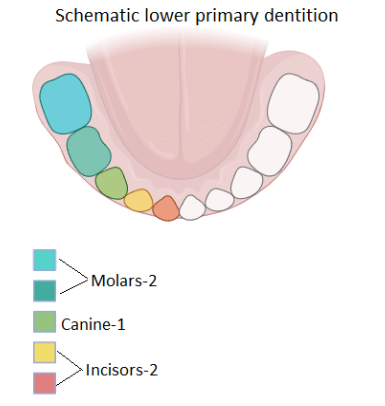
The incisors are present at the front and are used to bite the food. They arise at 6 months of age. They are the first baby teeth. Next are canines. They are sharp-edged teeth used to cut food like meat. They appear around 20 months of age. Premolars are broad teeth used to grind the food. They appear around the age of 11 to 12 years. Thus, they are absent in children of $5-6$. The last ones are molars. The first molars arise at the age of 6 years. They are wide surfaced and used to chew the food into fine particles.
The dental formula represents which type of teeth is present in what number in the half of either upper or lower jaw. Children age 5-6 have a total of 20 teeth only and they lack 12 teeth. They have 2 incisors, 1 canine, 0 premolar, and 2 molars. This makes a total of 5 teeth in half of the upper or the lower jaw.
Therefore, option A. the dental formula for children of age 5-6 is $I\frac{2}{2},C\frac{1}{1},PM\frac{0}{0},M\frac{2}{2}$.
Note: As the dental formula is indicative of the types and number of teeth present in the half jaw, it can be used to know the whole set of teeth in an individual. The children of age 5-6 have milk teeth. These are very sensitive. Once they shed the new adult teeth arise. Proper care should be taken to have healthy and strong teeth.
Complete answer: The teeth in a human jaw are arranged in a particular manner in every individual. All of the mammals have 4 types of teeth that are incisors, canines, premolar, and molar. Every tooth type is specialized to perform a particular type of function.
The incisors are present at the front and are used to bite the food. They arise at 6 months of age. They are the first baby teeth. Next are canines. They are sharp-edged teeth used to cut food like meat. They appear around 20 months of age. Premolars are broad teeth used to grind the food. They appear around the age of 11 to 12 years. Thus, they are absent in children of $5-6$. The last ones are molars. The first molars arise at the age of 6 years. They are wide surfaced and used to chew the food into fine particles.
The dental formula represents which type of teeth is present in what number in the half of either upper or lower jaw. Children age 5-6 have a total of 20 teeth only and they lack 12 teeth. They have 2 incisors, 1 canine, 0 premolar, and 2 molars. This makes a total of 5 teeth in half of the upper or the lower jaw.
Therefore, option A. the dental formula for children of age 5-6 is $I\frac{2}{2},C\frac{1}{1},PM\frac{0}{0},M\frac{2}{2}$.
Note: As the dental formula is indicative of the types and number of teeth present in the half jaw, it can be used to know the whole set of teeth in an individual. The children of age 5-6 have milk teeth. These are very sensitive. Once they shed the new adult teeth arise. Proper care should be taken to have healthy and strong teeth.
Recently Updated Pages
Master Class 11 English: Engaging Questions & Answers for Success

Master Class 11 Social Science: Engaging Questions & Answers for Success
Master Class 11 Maths: Engaging Questions & Answers for Success
Master Class 11 Biology: Engaging Questions & Answers for Success
Master Class 11 Physics: Engaging Questions & Answers for Success
Master Class 11 Chemistry: Engaging Questions & Answers for Success
Trending doubts
One Metric ton is equal to kg A 10000 B 1000 C 100 class 11 physics CBSE
Difference Between Prokaryotic Cells and Eukaryotic Cells
Find the value of the expression given below sin 30circ class 11 maths CBSE
Difference between physical and chemical change class 11 chemistry CBSE
Two of the body parts which do not appear in MRI are class 11 biology CBSE
Draw a diagram of a plant cell and label at least eight class 11 biology CBSE