



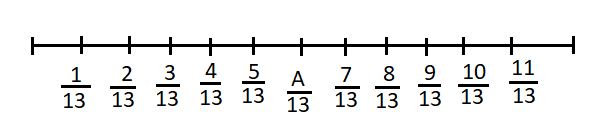
Which of the following is represented by $A$. In the Following Number Line
$a) 13 $
$b)\dfrac{6}{{13}} $
$c) 6$
$d)\dfrac{0}{{13}}$
Answer
 Verified
500.1k+ views
Hint: To solve these types of problems we should know about the basis of a number line. A number line is a diagrammatic representation of numbers on a straight line. This line is used to compare the numbers.
Zero is present at the center. We place positive numbers to the right of Zero. We place negative numbers on the Left of Zero. This line can be drawn horizontally. We can draw the number infinitely on both sides.
Complete Step by Step Answer:
We can express fractions on a Number Line
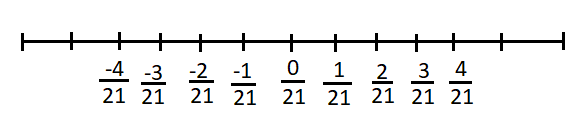
Any number to the right is always greater than the number to its Left.
i.e $\dfrac{3}{{21}}$ is greater than $\dfrac{1}{{21}}$
Any number to the left is always lesser than the number to its right.
i.e $\dfrac{{ - 3}}{{21}}$ is lesser than $\dfrac{{ - 1}}{{21}}$
The Number Line that has been given in the Problem is
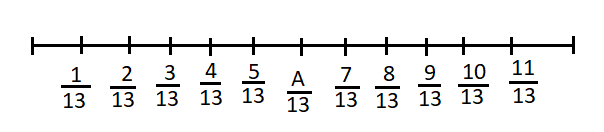
We have to find the value of $A$ in the Number line. In the number line, the numbers are arranged in an increasing order towards the Right and the value of the Fraction is increasing by $\dfrac{1}{{13}}$ in every Step.
So the number is $\dfrac{6}{{13}}$
Hence, the value of $A$ is $6$
The Correct Option is $(c)$
Note:
We should be careful while selecting the options for the answer. They had given the Number as $\dfrac{A}{{13}}$ not $A$. We tend to think that the correct option is $(b)$. But it is Wrong. We should read the Question carefully. They are asking the value of the Numerator of the fraction and not the Whole Fraction.
So the Correct Option is $(c)$. We can also perform Addition and Subtraction of two numbers with the help of a Number Line.
Zero is present at the center. We place positive numbers to the right of Zero. We place negative numbers on the Left of Zero. This line can be drawn horizontally. We can draw the number infinitely on both sides.
Complete Step by Step Answer:
We can express fractions on a Number Line
Any number to the right is always greater than the number to its Left.
i.e $\dfrac{3}{{21}}$ is greater than $\dfrac{1}{{21}}$
Any number to the left is always lesser than the number to its right.
i.e $\dfrac{{ - 3}}{{21}}$ is lesser than $\dfrac{{ - 1}}{{21}}$
The Number Line that has been given in the Problem is
We have to find the value of $A$ in the Number line. In the number line, the numbers are arranged in an increasing order towards the Right and the value of the Fraction is increasing by $\dfrac{1}{{13}}$ in every Step.
So the number is $\dfrac{6}{{13}}$
Hence, the value of $A$ is $6$
The Correct Option is $(c)$
Note:
We should be careful while selecting the options for the answer. They had given the Number as $\dfrac{A}{{13}}$ not $A$. We tend to think that the correct option is $(b)$. But it is Wrong. We should read the Question carefully. They are asking the value of the Numerator of the fraction and not the Whole Fraction.
So the Correct Option is $(c)$. We can also perform Addition and Subtraction of two numbers with the help of a Number Line.

Recently Updated Pages
Master Class 8 English: Engaging Questions & Answers for Success

Master Class 8 Science: Engaging Questions & Answers for Success
Master Class 8 Maths: Engaging Questions & Answers for Success
Class 8 Question and Answer - Your Ultimate Solutions Guide
Master Class 8 Social Science: Engaging Questions & Answers for Success
Master Class 12 Economics: Engaging Questions & Answers for Success
Trending doubts
What is BLO What is the full form of BLO class 8 social science CBSE
Citizens of India can vote at the age of A 18 years class 8 social science CBSE
Right to vote is a AFundamental Right BFundamental class 8 social science CBSE
Give me the opposite gender of Duck class 8 english CBSE
Full form of STD, ISD and PCO
Explain land use pattern in India and why has the land class 8 social science CBSE