




Which of the following is not true about expiration?
a) Diaphragm contracts during expiration.
b) increased size of the thoracic cavity decreases the pressure inside.
c) Expiration begins when inspiration ends.
d) Expiration can either be voluntary or involuntary.
Answer
 Verified
571.5k+ views
Hint: Expiration, otherwise known as exhalation, is the flow of the breath out of an organism. In animals, it is the movement of air from the lungs out of the airways, to the external environment with the assistance of the elastic properties of the lungs and the internal intercostal muscles that help in lowering the rib cage and decreasing the thoracic volume.
Complete answer:
During exhalation, the thoracic diaphragm relaxes and causes the tissue it has depressed to rise dominantly and pressurise the lungs to expel the air. During forced exhalation, expiratory muscles including the abdominal muscles and internal intercostal muscles generate abdominal and thoracic pressure, which forces air out of the lungs. Thus, option (a) is not true since to let air in the diaphragm needs to relax. The diaphragm is a thin skeletal muscle located at the base of the chest, separating the abdomen from the chest. The diaphragm contracts to create a vacuum effect which pulls air into the lungs. During expiration, the diaphragm relaxes and the air is pushed out of the lungs.
Note:
Exhaled air is $4\%$ carbon dioxide which is a waste product of cellular respiration. During the production of energy, it is stored as ATP. Expiration has a complementary relationship with inspiration which together make up the respiratory cycle of a breath.
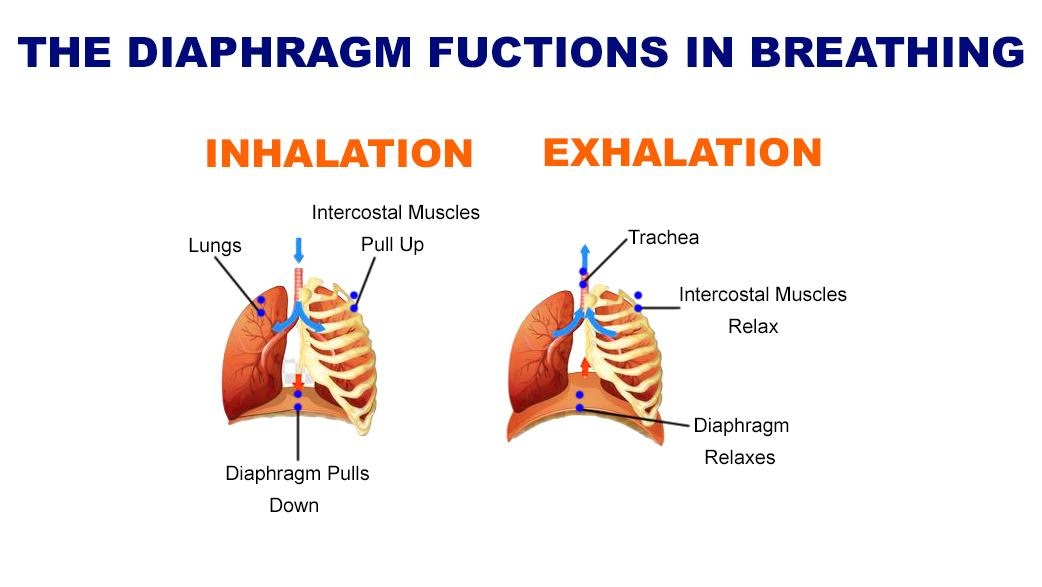
Figure: Diaphragm
Complete answer:
During exhalation, the thoracic diaphragm relaxes and causes the tissue it has depressed to rise dominantly and pressurise the lungs to expel the air. During forced exhalation, expiratory muscles including the abdominal muscles and internal intercostal muscles generate abdominal and thoracic pressure, which forces air out of the lungs. Thus, option (a) is not true since to let air in the diaphragm needs to relax. The diaphragm is a thin skeletal muscle located at the base of the chest, separating the abdomen from the chest. The diaphragm contracts to create a vacuum effect which pulls air into the lungs. During expiration, the diaphragm relaxes and the air is pushed out of the lungs.
Note:
Exhaled air is $4\%$ carbon dioxide which is a waste product of cellular respiration. During the production of energy, it is stored as ATP. Expiration has a complementary relationship with inspiration which together make up the respiratory cycle of a breath.
Figure: Diaphragm
Recently Updated Pages
Master Class 11 English: Engaging Questions & Answers for Success

Master Class 11 Physics: Engaging Questions & Answers for Success
Master Class 11 Computer Science: Engaging Questions & Answers for Success
Master Class 11 Chemistry: Engaging Questions & Answers for Success
Master Class 11 Social Science: Engaging Questions & Answers for Success
Master Class 11 Accountancy: Engaging Questions & Answers for Success
Trending doubts
Difference Between Prokaryotic Cells and Eukaryotic Cells
Two of the body parts which do not appear in MRI are class 11 biology CBSE
One Metric ton is equal to kg A 10000 B 1000 C 100 class 11 physics CBSE
10 examples of friction in our daily life
Draw a diagram of nephron and explain its structur class 11 biology CBSE
Draw a diagram of a plant cell and label at least eight class 11 biology CBSE