




Which of the following is not common in chloroplast and mitochondria?
A. Both are present in animal cells.
B. Both contain their own genetic material
C. Both are present in eukaryotic cells
D. Both are present in plant cells
Answer
 Verified
623.7k+ views
Hint: Mitochondria generates the chemical energy required to power the biochemical reaction of the cell. Chloroplasts play a vital role in the process of photosynthesis.
Complete answer:
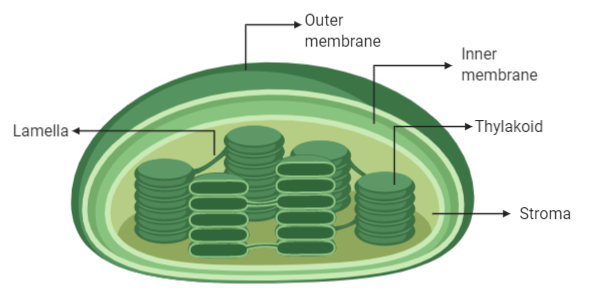
Chloroplasts are the organelles present in plant cells. They are required to produce food through the process of photosynthesis. These organelles have the green pigment, chlorophyll that absorbs sunlight and converts it into chemical energy.
From the diagram below, we can get a clear idea about the different parts of the chloroplast.
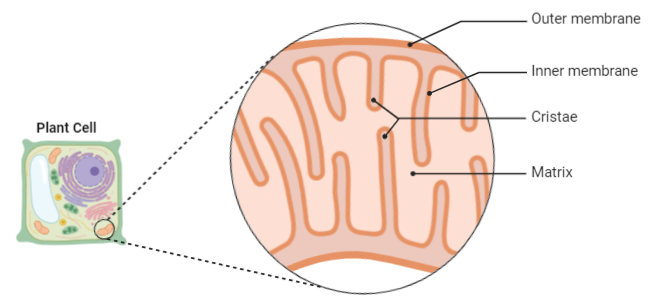
Mitochondria is the powerhouse of the cell. It is the site where ATP or adenosine triphosphate is synthesized by terminal oxidation. ATP is required by cells to perform all the chemical tasks.
From the diagram below, we can get a clear idea of mitochondria.
-In option A, both are present in animal cells. This is not correct because chloroplasts are absent in animal cells. The process of photosynthesis does not happen in animal cells, so chloroplasts are not required in animal cells due to lack of function. Mitochondria is the site of ATP synthesis, required in both animal and plant cells.
-In option B, both contain their own genetic material. Both mitochondria and chloroplast possess their own DNA and their DNA is circular. Both of them are of the same size as a prokaryotic cell. Hence, option B is incorrect.
-In option C, it is given that both are present in eukaryotic cells. This is true because both plant and animal cells are eukaryotic cells. Eukaryotic cells are cells with defined nuclear membranes and organized cell organelles. Hence, option C is also incorrect.
In option D, both are present in plant cells, which is true.
Hence option A is correct.
Note: According to the endosymbiotic theory, mitochondria and chloroplasts were once prokaryotic cells. It is also believed that they are the origin of cells and hence, life. Other than having their own DNA, both of them also possess ribosomes of their own. The theory was expressed in the 1920s by a Russian scientist, Boris Kozo-Polyansky.
Complete answer:
Chloroplasts are the organelles present in plant cells. They are required to produce food through the process of photosynthesis. These organelles have the green pigment, chlorophyll that absorbs sunlight and converts it into chemical energy.
From the diagram below, we can get a clear idea about the different parts of the chloroplast.
Mitochondria is the powerhouse of the cell. It is the site where ATP or adenosine triphosphate is synthesized by terminal oxidation. ATP is required by cells to perform all the chemical tasks.
From the diagram below, we can get a clear idea of mitochondria.
-In option A, both are present in animal cells. This is not correct because chloroplasts are absent in animal cells. The process of photosynthesis does not happen in animal cells, so chloroplasts are not required in animal cells due to lack of function. Mitochondria is the site of ATP synthesis, required in both animal and plant cells.
-In option B, both contain their own genetic material. Both mitochondria and chloroplast possess their own DNA and their DNA is circular. Both of them are of the same size as a prokaryotic cell. Hence, option B is incorrect.
-In option C, it is given that both are present in eukaryotic cells. This is true because both plant and animal cells are eukaryotic cells. Eukaryotic cells are cells with defined nuclear membranes and organized cell organelles. Hence, option C is also incorrect.
In option D, both are present in plant cells, which is true.
Hence option A is correct.
Note: According to the endosymbiotic theory, mitochondria and chloroplasts were once prokaryotic cells. It is also believed that they are the origin of cells and hence, life. Other than having their own DNA, both of them also possess ribosomes of their own. The theory was expressed in the 1920s by a Russian scientist, Boris Kozo-Polyansky.
Recently Updated Pages
Master Class 11 English: Engaging Questions & Answers for Success

Master Class 11 Social Science: Engaging Questions & Answers for Success
Master Class 11 Maths: Engaging Questions & Answers for Success
Master Class 11 Biology: Engaging Questions & Answers for Success
Master Class 11 Physics: Engaging Questions & Answers for Success
Master Class 11 Chemistry: Engaging Questions & Answers for Success
Trending doubts
One Metric ton is equal to kg A 10000 B 1000 C 100 class 11 physics CBSE
Difference Between Prokaryotic Cells and Eukaryotic Cells
1 ton equals to A 100 kg B 1000 kg C 10 kg D 10000 class 11 physics CBSE
Find the value of the expression given below sin 30circ class 11 maths CBSE
Two of the body parts which do not appear in MRI are class 11 biology CBSE
Draw a diagram of a plant cell and label at least eight class 11 biology CBSE