



Which of the following is not an acute triangle?
A)
B)
C)
D)
Answer
 Verified
543k+ views
Hint: We have to find the acute angle triangle. In case of an acute angle triangle, the measure of internal angles of the triangle will always be less than \[{90^ \circ }\]. So, we can conclude that
\[\angle A,\angle B,\angle C \leqslant {90^ \circ }\]. We can solve the sum by carefully looking at the diagrams.
Complete step by step solution:
The sum of measure of all the three angles of the triangle shall be \[{180^ \circ }\]. Triangles can be classified into three types on the basis of their Angles:
Acute angled triangle- In this type of triangle, all the angles in the triangle measure less than \[{90^ \circ }\] E.g. \[{45^ \circ }\], \[{60^ \circ }\], \[{75^ \circ }\].
Right angled triangle - In this type of triangle one of the three angles in the triangle measures \[{90^ \circ }\] E.g. \[{90^ \circ }\], \[{45^ \circ }\], \[{45^ \circ }\].
Obtuse angled triangle - In this type of triangle one of the three Angles of a triangle measures more than \[{90^ \circ }\] E.g. \[{120^ \circ }\], \[{30^ \circ }\], \[{30^ \circ }\].
We can solve the sum by identifying whether any angle if more than \[{90^ \circ }\] as follows:
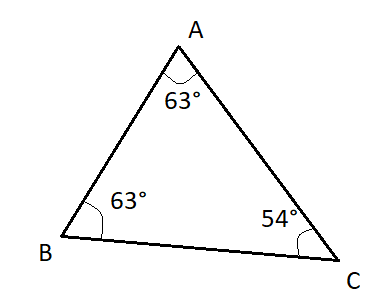
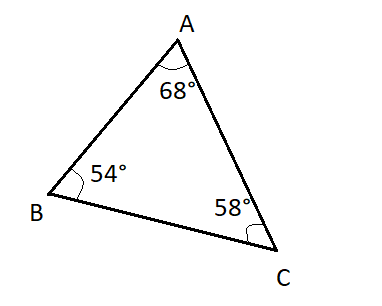
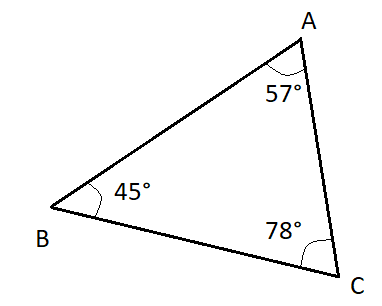
In the case of Option (A), (C) and (D), all the three angles of the triangle are less than \[{90^ \circ }\]. Hence, they all are acute triangles.
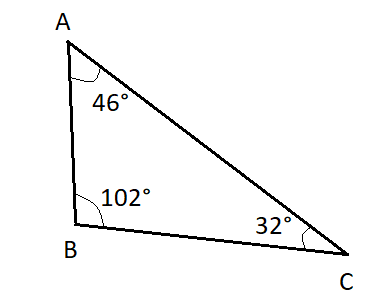
However, in the case of Option (B), \[m\angle B = {102^ \circ }\] which is more than \[{90^ \circ }\]. Hence, it is not an acute triangle; rather it is an obtuse triangle.
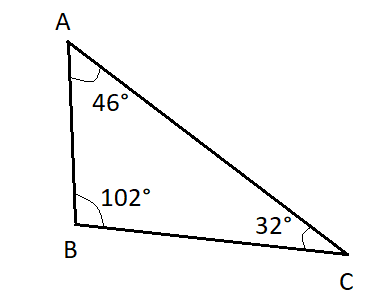
Therefore, Option (B) is the correct answer.
Note:
Some important properties of acute triangle are given below:
All equilateral triangles are acute triangles. An equilateral triangle has three sides of equal length and three equal angles of \[{60^ \circ }\].
Acute triangles can be isosceles, equilateral, or scalene.
The longest side of an acute triangle is opposite the largest angle.
\[\angle A,\angle B,\angle C \leqslant {90^ \circ }\]. We can solve the sum by carefully looking at the diagrams.
Complete step by step solution:
The sum of measure of all the three angles of the triangle shall be \[{180^ \circ }\]. Triangles can be classified into three types on the basis of their Angles:
Acute angled triangle- In this type of triangle, all the angles in the triangle measure less than \[{90^ \circ }\] E.g. \[{45^ \circ }\], \[{60^ \circ }\], \[{75^ \circ }\].
Right angled triangle - In this type of triangle one of the three angles in the triangle measures \[{90^ \circ }\] E.g. \[{90^ \circ }\], \[{45^ \circ }\], \[{45^ \circ }\].
Obtuse angled triangle - In this type of triangle one of the three Angles of a triangle measures more than \[{90^ \circ }\] E.g. \[{120^ \circ }\], \[{30^ \circ }\], \[{30^ \circ }\].
We can solve the sum by identifying whether any angle if more than \[{90^ \circ }\] as follows:
In the case of Option (A), (C) and (D), all the three angles of the triangle are less than \[{90^ \circ }\]. Hence, they all are acute triangles.
However, in the case of Option (B), \[m\angle B = {102^ \circ }\] which is more than \[{90^ \circ }\]. Hence, it is not an acute triangle; rather it is an obtuse triangle.
Therefore, Option (B) is the correct answer.
Note:
Some important properties of acute triangle are given below:
All equilateral triangles are acute triangles. An equilateral triangle has three sides of equal length and three equal angles of \[{60^ \circ }\].
Acute triangles can be isosceles, equilateral, or scalene.
The longest side of an acute triangle is opposite the largest angle.

Recently Updated Pages
Three beakers labelled as A B and C each containing 25 mL of water were taken A small amount of NaOH anhydrous CuSO4 and NaCl were added to the beakers A B and C respectively It was observed that there was an increase in the temperature of the solutions contained in beakers A and B whereas in case of beaker C the temperature of the solution falls Which one of the following statements isarecorrect i In beakers A and B exothermic process has occurred ii In beakers A and B endothermic process has occurred iii In beaker C exothermic process has occurred iv In beaker C endothermic process has occurred

Master Class 7 Social Science: Engaging Questions & Answers for Success
Master Class 7 Science: Engaging Questions & Answers for Success
Master Class 7 Maths: Engaging Questions & Answers for Success
Class 7 Question and Answer - Your Ultimate Solutions Guide
Master Class 9 Social Science: Engaging Questions & Answers for Success
Three beakers labelled as A B and C each containing 25 mL of water were taken A small amount of NaOH anhydrous CuSO4 and NaCl were added to the beakers A B and C respectively It was observed that there was an increase in the temperature of the solutions contained in beakers A and B whereas in case of beaker C the temperature of the solution falls Which one of the following statements isarecorrect i In beakers A and B exothermic process has occurred ii In beakers A and B endothermic process has occurred iii In beaker C exothermic process has occurred iv In beaker C endothermic process has occurred
Master Class 7 Social Science: Engaging Questions & Answers for Success
Master Class 7 Science: Engaging Questions & Answers for Success
Trending doubts
Convert 200 Million dollars in rupees class 7 maths CBSE
Full Form of IASDMIPSIFSIRSPOLICE class 7 social science CBSE
List of coprime numbers from 1 to 100 class 7 maths CBSE
How many thousands make a crore class 7 maths CBSE
What is a subcontinent class 7 social science CBSE
How many crores make 10 million class 7 maths CBSE