



Which of the following is NOT a property of a pentagonal prism?
A) All pentagonal prisms have five sides.
B) All pentagonal prisms have seven sides.
C) All pentagonal prisms have ten vertices.
D) All pentagonal prisms have 15 edges.
Answer
 Verified
584.1k+ views
Hint: A prism is a solid body in \[\text{3-dimension}\] whose two ends are similar, equal and parallel figures. Pentagonal prism refers to a special type of prism having base as pentagon (pentagon is a special type of polygon having \[\text{5}\] sides).
Complete step-by-step answer:
Students before attempting the problem must be clear of the concept of how a prism looks like. The visualization of prisms in the mind of the reader is very important for the solution of this problem. Let us try to understand what a prism looks like and what are its features.
Prism is something which comes in both physics and math. But in math we are only interested in the geometric viewpoint of the solid.
In geometry, a prism is a solid body in \[\text{3-dimension}\] whose two ends are similar, equal and parallel figures.
Depending upon the shape of the base we can give different names to prisms to identify them from one another.
In the given problem as the options suggest we have to just count the number of sides, vertices and edges, advance topics like calculating the volume and surface area will not be the concern for the reader for this problem. Explaining the pentagon, we say that any polygons which have a total of \[\text{5}\] sides are called a pentagon.
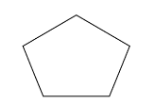
As you can observe it has \[\text{5}\] vertices and \[\text{5}\] edges but we don’t need to calculate a pentagon, we need pentagonal prisms which can be visualized as follows.
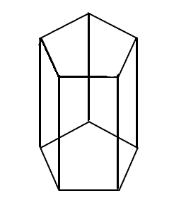
As you can observe both the bases are pentagon therefore we call it as pentagonal prism.
Now we can do the calculation as required in the questions, this pentagonal prism has \[\text{7}\] faces, \[\text{15}\] edges and \[\text{1}0\] vertices.
All the given options except (A) are correct properties of the pentagonal prism.
In the Questions it is asked, which is not a property, so option (A) is the correct answer.
Note: If a polyhedron has a number of faces as F, number of edges as E and the number of vertices as V, then the relationship \[F+V=E+2\] is known as Euler's formula. The formula represents the relation between faces, edges and vertices of a polyhedron.
Complete step-by-step answer:
Students before attempting the problem must be clear of the concept of how a prism looks like. The visualization of prisms in the mind of the reader is very important for the solution of this problem. Let us try to understand what a prism looks like and what are its features.
Prism is something which comes in both physics and math. But in math we are only interested in the geometric viewpoint of the solid.
In geometry, a prism is a solid body in \[\text{3-dimension}\] whose two ends are similar, equal and parallel figures.
Depending upon the shape of the base we can give different names to prisms to identify them from one another.
In the given problem as the options suggest we have to just count the number of sides, vertices and edges, advance topics like calculating the volume and surface area will not be the concern for the reader for this problem. Explaining the pentagon, we say that any polygons which have a total of \[\text{5}\] sides are called a pentagon.
As you can observe it has \[\text{5}\] vertices and \[\text{5}\] edges but we don’t need to calculate a pentagon, we need pentagonal prisms which can be visualized as follows.
As you can observe both the bases are pentagon therefore we call it as pentagonal prism.
Now we can do the calculation as required in the questions, this pentagonal prism has \[\text{7}\] faces, \[\text{15}\] edges and \[\text{1}0\] vertices.
All the given options except (A) are correct properties of the pentagonal prism.
In the Questions it is asked, which is not a property, so option (A) is the correct answer.
Note: If a polyhedron has a number of faces as F, number of edges as E and the number of vertices as V, then the relationship \[F+V=E+2\] is known as Euler's formula. The formula represents the relation between faces, edges and vertices of a polyhedron.
Recently Updated Pages
Master Class 9 General Knowledge: Engaging Questions & Answers for Success

Master Class 9 Social Science: Engaging Questions & Answers for Success
Master Class 9 English: Engaging Questions & Answers for Success
Master Class 9 Maths: Engaging Questions & Answers for Success
Master Class 9 Science: Engaging Questions & Answers for Success
Class 9 Question and Answer - Your Ultimate Solutions Guide
Trending doubts
Difference Between Plant Cell and Animal Cell
Fill the blanks with the suitable prepositions 1 The class 9 english CBSE
Who is eligible for RTE class 9 social science CBSE
Which places in India experience sunrise first and class 9 social science CBSE
What is pollution? How many types of pollution? Define it
Name 10 Living and Non living things class 9 biology CBSE