




Which of the following is most acidic?
A. Benzyl alcohol
B. Cyclohexanol
C. Phenol
D. m-chlorophenol
Answer
 Verified
639.3k+ views
Hint: Alcohols are generally weaker acids. Generally alcohols lose hydrogen ions to show acidic character. Phenoxide ion is very stable since it has four resonating structures.
Complete step by step answer:
Alcohols are the organic compounds which have hydroxyl group $\left( { - {\text{OH}}} \right)$ connected to a saturated carbon $\left( {{\text{s}}{{\text{p}}^3}} \right)$. Phenols contain ${\text{OH}}$ group connected to a carbon of a benzene ring.
In ${\text{OH}}$ group, oxygen is more electronegative than hydrogen. So oxygen pulls shared electrons towards it. In aqueous solution, alcohol will donate its proton to water molecules to give an alkoxide ion. The acid-dissociation constant, ${{\text{K}}_{\text{a}}}$, of an alcohol is defined by the equilibrium.
${\text{ROH}} + {{\text{H}}_2}{\text{O}}\overset {{{\text{K}}_{\text{a}}}} \leftrightarrows {\text{R}}{{\text{O}}^ - } + {{\text{H}}_3}{{\text{O}}^ + }$
${{\text{K}}_{\text{a}}} = \dfrac{{\left[ {{{\text{H}}_3}{{\text{O}}^ + }} \right]\left[ {{\text{R}}{{\text{O}}^ - }} \right]}}{{\left[ {{\text{ROH}}} \right]}}$
${\text{p}}{{\text{K}}_{\text{a}}} = - \log \left( { - {{\text{K}}_{\text{a}}}} \right)$
The smaller the ${\text{p}}{{\text{K}}_{\text{a}}}$ value, the alcohol is more acidic.
Phenols are generally more acidic than alcohols by considering the resonance effect. A benzene ring is generally considered electron withdrawing (inductive effect) the benzene ring stabilizes the negative charge of phenoxide ion through resonance. Benzyl group stabilizes the negative charge on the oxygen atom.
The carbon-oxygen bond in benzyl alcohol is electron-deficient and is able to stabilize the negative charge on oxygen in alkoxide.
Electron withdrawing substituents make a phenol more acidic by stabilizing phenoxide ion through delocalization of negative charge and through inductive effects. Some electron withdrawing groups are ${\text{ - N}}{{\text{O}}_2}, - {\text{Cl}}, - {\text{CN}}$ etc.
Electron donating groups make a phenol less acidic by destabilizing the phenoxide ion (resonance effect).The location of the substituent relative to the phenol is important. Some electron donating groups are ${\text{ - N}}{{\text{H}}_2}, - {\text{NR}}, - {\text{OR}}, - {\text{R}}$ etc.
So the order of acidic character is given below:
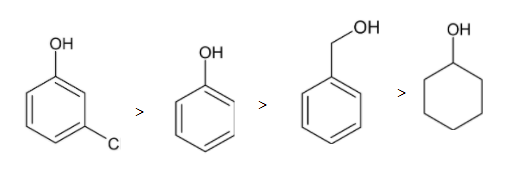
Thus meta-chlorophenol is more acidic
So, Option D is correct.
Note: Inductive effect and resonance effect are the major factors influencing the acidic character. The phenoxide ion is more stable because the negative charge is not confined to oxygen but delocalized into the benzene ring. The phenoxide ion is resonance stabilized by the benzene ring.
Complete step by step answer:
Alcohols are the organic compounds which have hydroxyl group $\left( { - {\text{OH}}} \right)$ connected to a saturated carbon $\left( {{\text{s}}{{\text{p}}^3}} \right)$. Phenols contain ${\text{OH}}$ group connected to a carbon of a benzene ring.
In ${\text{OH}}$ group, oxygen is more electronegative than hydrogen. So oxygen pulls shared electrons towards it. In aqueous solution, alcohol will donate its proton to water molecules to give an alkoxide ion. The acid-dissociation constant, ${{\text{K}}_{\text{a}}}$, of an alcohol is defined by the equilibrium.
${\text{ROH}} + {{\text{H}}_2}{\text{O}}\overset {{{\text{K}}_{\text{a}}}} \leftrightarrows {\text{R}}{{\text{O}}^ - } + {{\text{H}}_3}{{\text{O}}^ + }$
${{\text{K}}_{\text{a}}} = \dfrac{{\left[ {{{\text{H}}_3}{{\text{O}}^ + }} \right]\left[ {{\text{R}}{{\text{O}}^ - }} \right]}}{{\left[ {{\text{ROH}}} \right]}}$
${\text{p}}{{\text{K}}_{\text{a}}} = - \log \left( { - {{\text{K}}_{\text{a}}}} \right)$
The smaller the ${\text{p}}{{\text{K}}_{\text{a}}}$ value, the alcohol is more acidic.
Phenols are generally more acidic than alcohols by considering the resonance effect. A benzene ring is generally considered electron withdrawing (inductive effect) the benzene ring stabilizes the negative charge of phenoxide ion through resonance. Benzyl group stabilizes the negative charge on the oxygen atom.
The carbon-oxygen bond in benzyl alcohol is electron-deficient and is able to stabilize the negative charge on oxygen in alkoxide.
Electron withdrawing substituents make a phenol more acidic by stabilizing phenoxide ion through delocalization of negative charge and through inductive effects. Some electron withdrawing groups are ${\text{ - N}}{{\text{O}}_2}, - {\text{Cl}}, - {\text{CN}}$ etc.
Electron donating groups make a phenol less acidic by destabilizing the phenoxide ion (resonance effect).The location of the substituent relative to the phenol is important. Some electron donating groups are ${\text{ - N}}{{\text{H}}_2}, - {\text{NR}}, - {\text{OR}}, - {\text{R}}$ etc.
So the order of acidic character is given below:
Thus meta-chlorophenol is more acidic
So, Option D is correct.
Note: Inductive effect and resonance effect are the major factors influencing the acidic character. The phenoxide ion is more stable because the negative charge is not confined to oxygen but delocalized into the benzene ring. The phenoxide ion is resonance stabilized by the benzene ring.
Recently Updated Pages
Which will be the least stable resonating structure class 11 chemistry CBSE

How many 5 digit telephone numbers can be construc-class-11-maths-CBSE
How do you find the angle of the resultant vector class 11 physics CBSE
Draw labelled diagram of the following i Gram seed class 11 biology CBSE
1 Quintal is equal to a 110 kg b 10 kg c 100kg d 1000 class 11 physics CBSE
What is the need and importance of classification class 11 biology CBSE
Trending doubts
One Metric ton is equal to kg A 10000 B 1000 C 100 class 11 physics CBSE
Find the value of the expression given below sin 30circ class 11 maths CBSE
Draw a diagram of nephron and explain its structur class 11 biology CBSE
10 examples of friction in our daily life
Proton was discovered by A Thomson B Rutherford C Chadwick class 11 chemistry CBSE
How many kilometers are there in 100 meters class 11 maths CBSE