




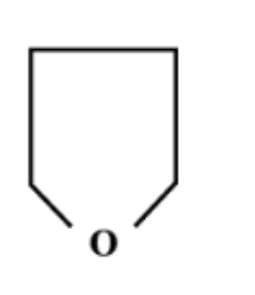
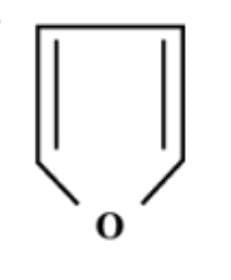
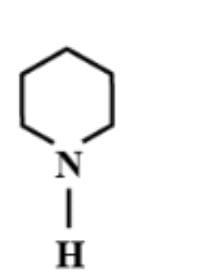
Which of the following is heterocyclic aromatic species?
A.
B.

C.
D.
Answer
 Verified
621k+ views
Hint: Basically, a heterocyclic compound is an organic compound where an atom other than carbon atom has substituted one or more of the carbon atoms in the molecule’s backbone. Some of the normal hereto atoms are nitrogen, Sulphur and oxygen.
Complete step by step answer:
Aromatic compounds are the chemical compounds that consist of conjugated planar ring systems accomplished by delocalized pi- electron clouds in place of individual alternating double and single bonds. These are also known as aromatics or arenes. Now, aromatic compounds are divided into two categories, the first one is benzenoid, one containing the benzene ring whereas the other one is non- benzenoid, that does not contain a benzene ring like furan.
Further, any hydrocarbon can be classified as an aromatic compound provided, they follow the Huckel rule. Now, according to this rule, for a ring to be aromatic, it should follow the following properties:
a)Planarity
b)Complete delocalization of pi electrons in the ring
c)Presence of $(4n + 2)\pi $ electrons in the ring where n is an integer.
Now, the heterocyclic aromatic compound is an organic compound where an atom other than carbon atom has substituted one or more of the carbon atoms in the molecule’s backbone. Nitrogen, oxygen, Sulphur are normal hetero atoms. So, option C i.e. furan is heterocyclic aromatic species as it is planar, cyclic, conjugated
$(4n + 2)\pi $ electron system.
Hence, option C is correct.
Note: Don’t get confused with aliphatic and aromatic compounds. In case of aliphatic compounds, there is a straight chain representation whereas in case of aromatic compounds, the carbon compounds are associated with conjugated pi electrons in the form of a ring structure.
Complete step by step answer:
Aromatic compounds are the chemical compounds that consist of conjugated planar ring systems accomplished by delocalized pi- electron clouds in place of individual alternating double and single bonds. These are also known as aromatics or arenes. Now, aromatic compounds are divided into two categories, the first one is benzenoid, one containing the benzene ring whereas the other one is non- benzenoid, that does not contain a benzene ring like furan.
Further, any hydrocarbon can be classified as an aromatic compound provided, they follow the Huckel rule. Now, according to this rule, for a ring to be aromatic, it should follow the following properties:
a)Planarity
b)Complete delocalization of pi electrons in the ring
c)Presence of $(4n + 2)\pi $ electrons in the ring where n is an integer.
Now, the heterocyclic aromatic compound is an organic compound where an atom other than carbon atom has substituted one or more of the carbon atoms in the molecule’s backbone. Nitrogen, oxygen, Sulphur are normal hetero atoms. So, option C i.e. furan is heterocyclic aromatic species as it is planar, cyclic, conjugated
$(4n + 2)\pi $ electron system.
Hence, option C is correct.
Note: Don’t get confused with aliphatic and aromatic compounds. In case of aliphatic compounds, there is a straight chain representation whereas in case of aromatic compounds, the carbon compounds are associated with conjugated pi electrons in the form of a ring structure.
Recently Updated Pages
Master Class 11 English: Engaging Questions & Answers for Success

Master Class 11 Social Science: Engaging Questions & Answers for Success
Master Class 11 Maths: Engaging Questions & Answers for Success
Master Class 11 Biology: Engaging Questions & Answers for Success
Master Class 11 Physics: Engaging Questions & Answers for Success
Master Class 11 Chemistry: Engaging Questions & Answers for Success
Trending doubts
One Metric ton is equal to kg A 10000 B 1000 C 100 class 11 physics CBSE
Difference Between Prokaryotic Cells and Eukaryotic Cells
Find the value of the expression given below sin 30circ class 11 maths CBSE
Difference between physical and chemical change class 11 chemistry CBSE
Two of the body parts which do not appear in MRI are class 11 biology CBSE
Draw a diagram of a plant cell and label at least eight class 11 biology CBSE