




Which of the following is capable of existing as a pair of enantiomers?
(A) $3 - {\text{Methylpentane}}$
(B) $3 - {\text{Methylhexane}}$
(C) $2 - {\text{Methylpentane}}$
(D) $2 - {\text{Methylpropane}}$
Answer
 Verified
591.6k+ views
Hint: Isomers are divided into two groups called structural isomers and stereoisomers. Again stereoisomers are further classified into diastereomers and enantiomers. The distinguishing property of these two groups is the reflective symmetry of that molecule. Both diastereomers and enantiomers have different spatial configurations.
Complete step by step answer:
Diastereomers are not mere images of one another. Enantiomers are mere images of one another. Enantiomers are mirror images. The geometrical centre is called the chiral center. As enantiomers have similar spatial configuration, they have identical physical and chemical properties. They bend light in the opposite direction. The attachment of atoms is identical in enantiomers. Enantiomers have identical formulas.
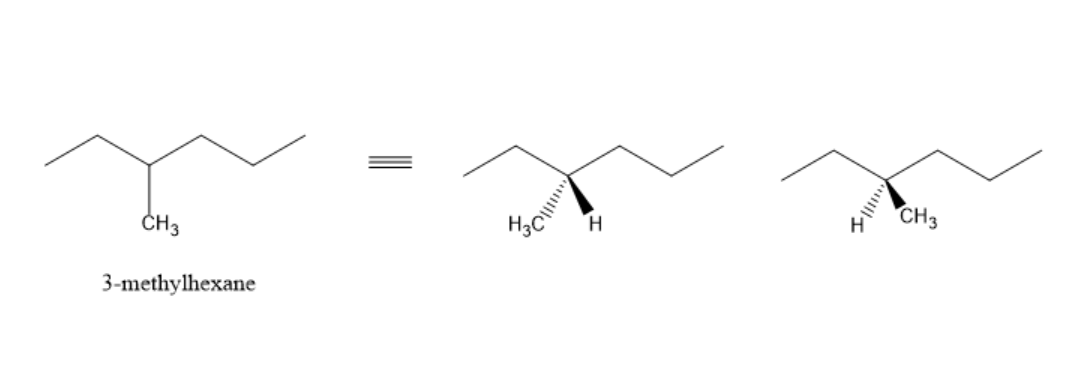
From the above diagram, we can observe that $3 - {\text{methylhexane}}$ exists as a pair of enantiomers. It is optically inactive due to molecular symmetry and chiral carbon.
Therefore, option B is correct.
Note: The compounds which are not superimposable with their mirror image are said to be chiral. Compounds which are superimposable with their mirror image are said to be achiral. An atom having four different substituents around it is called a stereocenter. Stereocenter is also called a stereogenic center. Properties like solubility and melting point are the same for enantiomers. If two enantiomers are present in equal proportions then the mixture is said to be a racemic mixture. Racemic mixture does not rotate polarized light because optical activity of each enantiomer is cancelled by another enantiomer.
Complete step by step answer:
Diastereomers are not mere images of one another. Enantiomers are mere images of one another. Enantiomers are mirror images. The geometrical centre is called the chiral center. As enantiomers have similar spatial configuration, they have identical physical and chemical properties. They bend light in the opposite direction. The attachment of atoms is identical in enantiomers. Enantiomers have identical formulas.
From the above diagram, we can observe that $3 - {\text{methylhexane}}$ exists as a pair of enantiomers. It is optically inactive due to molecular symmetry and chiral carbon.
Therefore, option B is correct.
Note: The compounds which are not superimposable with their mirror image are said to be chiral. Compounds which are superimposable with their mirror image are said to be achiral. An atom having four different substituents around it is called a stereocenter. Stereocenter is also called a stereogenic center. Properties like solubility and melting point are the same for enantiomers. If two enantiomers are present in equal proportions then the mixture is said to be a racemic mixture. Racemic mixture does not rotate polarized light because optical activity of each enantiomer is cancelled by another enantiomer.
Recently Updated Pages
If x a + bt + ct2 where x is in meters and t is in class 11 physics CBSE

A car covers the first half distance between two places class 11 physics CBSE
The resultant of two vectors overrightarrow P and overrightarrow class 11 physics CBSE
Find the value of cos 135 class 11 maths CBSE
A mass M is held in place by an applied force F and class 11 physics CBSE
A solution of glucose in water is labelled as 10 dfracwv class 11 chemistry CBSE
Trending doubts
Find the value of the expression given below sin 30circ class 11 maths CBSE
One Metric ton is equal to kg A 10000 B 1000 C 100 class 11 physics CBSE
Draw a diagram of nephron and explain its structur class 11 biology CBSE
10 examples of friction in our daily life
Proton was discovered by A Thomson B Rutherford C Chadwick class 11 chemistry CBSE
Bond order ofO2 O2+ O2 and O22 is in order A O2 langle class 11 chemistry CBSE