




Which of the following is called a sugar sink?
A. Roots
B. Developing seeds
C. Both A and B
D. Leaves
Answer
 Verified
661.8k+ views
Hint: Leaves are the sugar sources of the plant and roots are the sugar sinks of the plant. Sinks are those parts which store the sugar.
Complete Answer: Plant has xylem and phloem as conducting tissues which transport sugar molecules in the form of sucrose. The sugar molecules are transported from source end to sink end. Plant is divided into source and sink. Sinks are the sites where it is stored or used. Plants include both source and sink parts. Sources are the parts where net fixation of carbon dioxide occurs.
The correct answer is C. Both A and B.
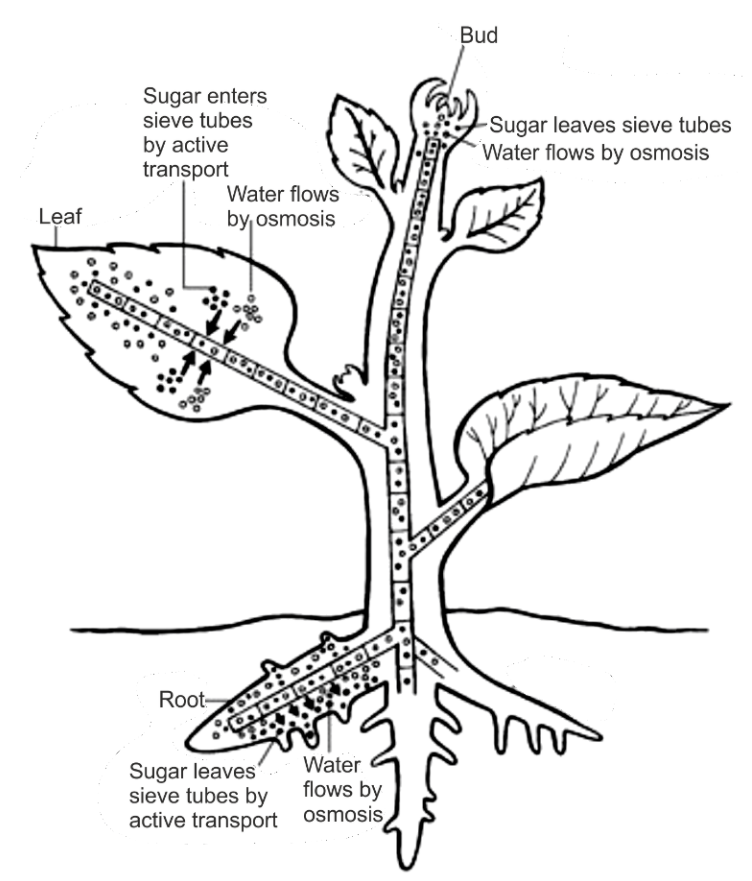
Additional Information: It is a longer distance movement of organic substances from the source or supply end to the region of utilization or sink. But the source and sink may be reversed depending on the season or need of the plant. Sugar stored in roots may be metabolized to become a source of food in the early spring when the buds of trees act as a sink and require energy for their growth and development. Since the source-sink relationship is variable, the direction of movement of organic solutes in phloem can be bidirectional that is upwards or downwards and in case of xylem, it is unidirectional. Translocation is directional movement of materials which occurs inside vascular tissues (Xylem and Phloem).
Note: Roots and developing seeds both act as sugar sink. The sugar is stored in the form of energy in roots which are acting as sinks.
Complete Answer: Plant has xylem and phloem as conducting tissues which transport sugar molecules in the form of sucrose. The sugar molecules are transported from source end to sink end. Plant is divided into source and sink. Sinks are the sites where it is stored or used. Plants include both source and sink parts. Sources are the parts where net fixation of carbon dioxide occurs.
The correct answer is C. Both A and B.
Additional Information: It is a longer distance movement of organic substances from the source or supply end to the region of utilization or sink. But the source and sink may be reversed depending on the season or need of the plant. Sugar stored in roots may be metabolized to become a source of food in the early spring when the buds of trees act as a sink and require energy for their growth and development. Since the source-sink relationship is variable, the direction of movement of organic solutes in phloem can be bidirectional that is upwards or downwards and in case of xylem, it is unidirectional. Translocation is directional movement of materials which occurs inside vascular tissues (Xylem and Phloem).
Note: Roots and developing seeds both act as sugar sink. The sugar is stored in the form of energy in roots which are acting as sinks.
Recently Updated Pages
If x a + bt + ct2 where x is in meters and t is in class 11 physics CBSE

A car covers the first half distance between two places class 11 physics CBSE
The resultant of two vectors overrightarrow P and overrightarrow class 11 physics CBSE
Find the value of cos 135 class 11 maths CBSE
A mass M is held in place by an applied force F and class 11 physics CBSE
A solution of glucose in water is labelled as 10 dfracwv class 11 chemistry CBSE
Trending doubts
One Metric ton is equal to kg A 10000 B 1000 C 100 class 11 physics CBSE
Find the value of the expression given below sin 30circ class 11 maths CBSE
What do you mean by retardation What is its SI uni class 11 physics CBSE
Draw a diagram of nephron and explain its structur class 11 biology CBSE
10 examples of friction in our daily life
Difference between physical and chemical change class 11 chemistry CBSE