




Which of the following is/ are not a graph of quadratic?
(a)
(b)
(c)
(d)
Answer
 Verified
611.7k+ views
Hint: For solving this problem, we consider all the options one by one and check whether they represent a quadratic graph or not. A quadratic graph can be intersecting the x-axis at two points (two distinct roots), intersecting the x-axis at one point (two equal roots) or not intersecting x axis (unreal roots). By using this methodology, we proceed to solve the problem.
Complete Step-by-Step solution:
According to the problem statement, we are given four graphs in four options and we are required to identify the graph which is not representing a quadratic polynomial.
By using the explanation provided in the hint, we proceed by:
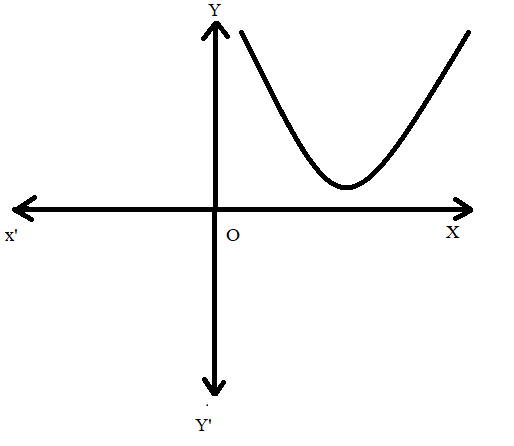
Considering option (a), the graph does not intersect the x-axis, so it could represent quadratic polynomials having unreal roots.
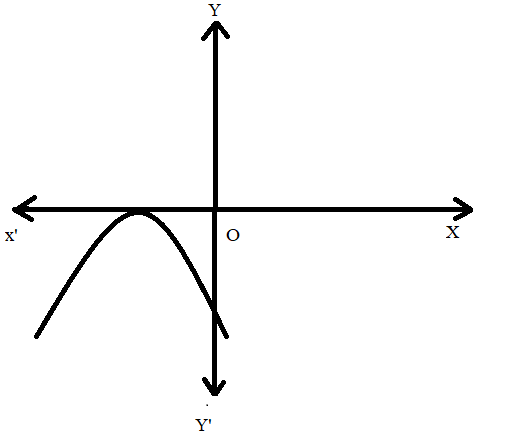
Considering option (b), the graph touches the x-axis at one point, so it could represent a quadratic polynomial having two equal roots.
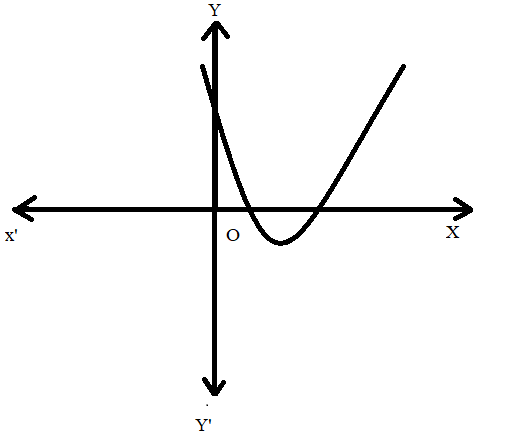
Considering option (c), the graph intersects the x-axis at two distinct points, so it could represent a quadratic polynomial having two distinct roots.
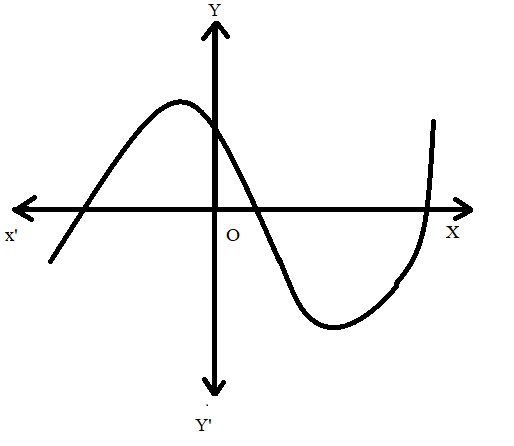
Considering option (d), the graph intersects the x axis at three points, so it is a cubic polynomial having three distinct roots.
Therefore, option (d) is correct.
Note: Students must be careful while observing all the graphs and must not tick mark option (a) as the graph does not intersect the x axis. They must consider all the cases possible for quadratic polynomials. Alternatively, by directly looking at the option (d), we can mark the answer without checking all the other options.
Complete Step-by-Step solution:
According to the problem statement, we are given four graphs in four options and we are required to identify the graph which is not representing a quadratic polynomial.
By using the explanation provided in the hint, we proceed by:
Considering option (a), the graph does not intersect the x-axis, so it could represent quadratic polynomials having unreal roots.
Considering option (b), the graph touches the x-axis at one point, so it could represent a quadratic polynomial having two equal roots.
Considering option (c), the graph intersects the x-axis at two distinct points, so it could represent a quadratic polynomial having two distinct roots.
Considering option (d), the graph intersects the x axis at three points, so it is a cubic polynomial having three distinct roots.
Therefore, option (d) is correct.
Note: Students must be careful while observing all the graphs and must not tick mark option (a) as the graph does not intersect the x axis. They must consider all the cases possible for quadratic polynomials. Alternatively, by directly looking at the option (d), we can mark the answer without checking all the other options.
Recently Updated Pages
Master Class 10 Computer Science: Engaging Questions & Answers for Success

Master Class 10 General Knowledge: Engaging Questions & Answers for Success
Master Class 10 English: Engaging Questions & Answers for Success
Master Class 10 Social Science: Engaging Questions & Answers for Success
Master Class 10 Maths: Engaging Questions & Answers for Success
Master Class 10 Science: Engaging Questions & Answers for Success
Trending doubts
What is the median of the first 10 natural numbers class 10 maths CBSE
Which women's tennis player has 24 Grand Slam singles titles?
Who is the Brand Ambassador of Incredible India?
Why is there a time difference of about 5 hours between class 10 social science CBSE
Write a letter to the principal requesting him to grant class 10 english CBSE
A moving boat is observed from the top of a 150 m high class 10 maths CBSE