



Which of the following is an open statement?
A) A trapezoid is four-sided polygon
B) Albany is a city in New York State
C) It was blue with white stripes
D) $5\left( {20} \right) + 3 = 113$
Answer
 Verified
579.3k+ views
Hint:
Here, we are asked to find an open statement from the given options.
An open statement is a mathematical statement that can either be true or false and depends on the values that are being used. So, an open statement cannot be one of true and false.
Thus, find the open statement from the given statements by the help of the above definition.
Complete step by step solution:
Here, we are asked to find an open statement from the given options.
For that, we must first know what an open statement is.
An open statement is defined as “An open statement is a mathematical statement that can either be true or false and depends on the values that are being used.” So, by definition it is clear that an open statement cannot be one of true and false.
So, now we will observe the options and find out whether they become true always, false always or either true or false.
In option (A) it is given that a trapezoid is a four-sided polygon. The shape of the trapezoid is as shown in the figure below.
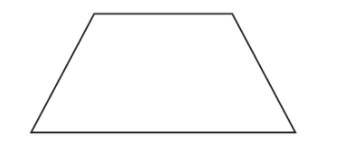
It is clear that it has 4 sides. So, the given statement is always true for any trapezoid. Thus, a trapezoid is a four-sided polygon is not an open statement.
Now, in option (B) it is given that Albany is a city in New York State. This is also always true as it is a fact. Thus, Albany is a city in New York State is also not an open statement.
In option (C) it is given that it was blue with white stripes. Here, in this statement, it can be anything and vary from person to person. So, it may be true for some while false for some. Thus, blue with white stripes can be an open statement.
In option (D) the expression given is $5\left( {20} \right) + 3 = 113$ . While $5\left( {20} \right) + 3 = 100 + 3 = 103$, it is given that $5\left( {20} \right) + 3 = 113$, which is false. So, the given expression $5\left( {20} \right) + 3 = 113$ is always false. So, $5\left( {20} \right) + 3 = 113$ cannot be an open statement.
Thus, option (C) is the correct answer.
Note:
The given question can be solved by the help of basic concepts of the chapter Mathematical Reasoning from class 11.
A simple definition of an open statement can be “When we cannot decide whether the given statement is true or false, then that statement can be called an open statement.”
For example, consider a statement $x - 6 \geqslant 9$.
Here, we are not given the value of x. So, we cannot decide that the statement will always be true or always be false. Thus, the given statement is an open statement.
Here, we are asked to find an open statement from the given options.
An open statement is a mathematical statement that can either be true or false and depends on the values that are being used. So, an open statement cannot be one of true and false.
Thus, find the open statement from the given statements by the help of the above definition.
Complete step by step solution:
Here, we are asked to find an open statement from the given options.
For that, we must first know what an open statement is.
An open statement is defined as “An open statement is a mathematical statement that can either be true or false and depends on the values that are being used.” So, by definition it is clear that an open statement cannot be one of true and false.
So, now we will observe the options and find out whether they become true always, false always or either true or false.
In option (A) it is given that a trapezoid is a four-sided polygon. The shape of the trapezoid is as shown in the figure below.
It is clear that it has 4 sides. So, the given statement is always true for any trapezoid. Thus, a trapezoid is a four-sided polygon is not an open statement.
Now, in option (B) it is given that Albany is a city in New York State. This is also always true as it is a fact. Thus, Albany is a city in New York State is also not an open statement.
In option (C) it is given that it was blue with white stripes. Here, in this statement, it can be anything and vary from person to person. So, it may be true for some while false for some. Thus, blue with white stripes can be an open statement.
In option (D) the expression given is $5\left( {20} \right) + 3 = 113$ . While $5\left( {20} \right) + 3 = 100 + 3 = 103$, it is given that $5\left( {20} \right) + 3 = 113$, which is false. So, the given expression $5\left( {20} \right) + 3 = 113$ is always false. So, $5\left( {20} \right) + 3 = 113$ cannot be an open statement.
Thus, option (C) is the correct answer.
Note:
The given question can be solved by the help of basic concepts of the chapter Mathematical Reasoning from class 11.
A simple definition of an open statement can be “When we cannot decide whether the given statement is true or false, then that statement can be called an open statement.”
For example, consider a statement $x - 6 \geqslant 9$.
Here, we are not given the value of x. So, we cannot decide that the statement will always be true or always be false. Thus, the given statement is an open statement.

Recently Updated Pages
Master Class 9 General Knowledge: Engaging Questions & Answers for Success

Master Class 9 Social Science: Engaging Questions & Answers for Success
Master Class 9 English: Engaging Questions & Answers for Success
Master Class 9 Maths: Engaging Questions & Answers for Success
Master Class 9 Science: Engaging Questions & Answers for Success
Class 9 Question and Answer - Your Ultimate Solutions Guide
Trending doubts
Difference Between Plant Cell and Animal Cell
Fill the blanks with the suitable prepositions 1 The class 9 english CBSE
Who is eligible for RTE class 9 social science CBSE
Which places in India experience sunrise first and class 9 social science CBSE
What is pollution? How many types of pollution? Define it
Name 10 Living and Non living things class 9 biology CBSE