




Which of the following is an example of leech?
(a) Hirudinaria
(b) Glossiphonia
(c) Haemadipsa
(d) All of the above
Answer
 Verified
632.4k+ views
Hint:These leeches are called as Indian cattle leech, jawed leech, and freshwater jawless leech. There are several different leeches species and are either parasites or predators.
Complete answer:
The Indian cattle leech is Hirudinaria. It lives on the freshwater and feeds on the blood of frogs, animals, and men. Glossiphonia complanata is a leech that occurs abundantly in the eastern United States and Canada. It feeds on the fluid of mollusks and invertebrates. The jawed land leeches are called Haemadipsa. In the tropical and subtropical regions around the Indian and the Pacific Ocean, these annelids are extensively observed.
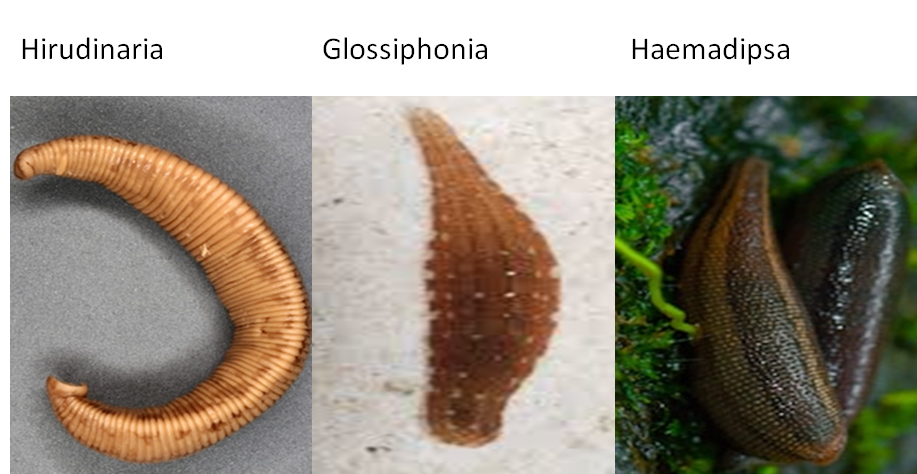
So, the correct answer is ‘All of the above’.
Additional Information:
Leeches are parasitic or predatory worms belonging to the phylum Annelida. The most common species, such as the medicinal leech, Hirudo medicinalis, are hematophagous, which binds to a host with a sucker and feeds on the blood. These leeches secrete a peptide called hirudine to keep blood from clotting. In other animals, the jaws used to pierce the skin are replaced by a proboscis that is forced into the skin. A small portion of leech species are predatory and they mostly feed on small invertebrates.
Note:From ancient times till the 19th century, leeches were used in medicine to extract blood from patients. In modern times, leeches find medicinal use in the treatment of joint diseases such as epicondylitis and osteoarthritis, severe vein diseases, and microsurgery, while hirudin is used as an anticoagulant medication in the treatment of blood clotting.
Complete answer:
The Indian cattle leech is Hirudinaria. It lives on the freshwater and feeds on the blood of frogs, animals, and men. Glossiphonia complanata is a leech that occurs abundantly in the eastern United States and Canada. It feeds on the fluid of mollusks and invertebrates. The jawed land leeches are called Haemadipsa. In the tropical and subtropical regions around the Indian and the Pacific Ocean, these annelids are extensively observed.
So, the correct answer is ‘All of the above’.
Additional Information:
Leeches are parasitic or predatory worms belonging to the phylum Annelida. The most common species, such as the medicinal leech, Hirudo medicinalis, are hematophagous, which binds to a host with a sucker and feeds on the blood. These leeches secrete a peptide called hirudine to keep blood from clotting. In other animals, the jaws used to pierce the skin are replaced by a proboscis that is forced into the skin. A small portion of leech species are predatory and they mostly feed on small invertebrates.
Note:From ancient times till the 19th century, leeches were used in medicine to extract blood from patients. In modern times, leeches find medicinal use in the treatment of joint diseases such as epicondylitis and osteoarthritis, severe vein diseases, and microsurgery, while hirudin is used as an anticoagulant medication in the treatment of blood clotting.
Recently Updated Pages
Master Class 11 English: Engaging Questions & Answers for Success

Master Class 11 Social Science: Engaging Questions & Answers for Success
Master Class 11 Maths: Engaging Questions & Answers for Success
Master Class 11 Biology: Engaging Questions & Answers for Success
Master Class 11 Physics: Engaging Questions & Answers for Success
Master Class 11 Chemistry: Engaging Questions & Answers for Success
Trending doubts
One Metric ton is equal to kg A 10000 B 1000 C 100 class 11 physics CBSE
Difference Between Prokaryotic Cells and Eukaryotic Cells
Find the value of the expression given below sin 30circ class 11 maths CBSE
Difference between physical and chemical change class 11 chemistry CBSE
Two of the body parts which do not appear in MRI are class 11 biology CBSE
Draw a diagram of a plant cell and label at least eight class 11 biology CBSE