




Which of the following is an electron-deficient compound?
\[
A.{\text{ N}}{{\text{H}}_{\text{3}}} \\
B.{\text{ ICl}} \\
{\text{C}}{\text{. BC}}{{\text{l}}_{\text{3}}} \\
D.{\text{ PC}}{{\text{l}}_{\text{3}}} \\
\]
Answer
 Verified
595.5k+ views
Hint: We must know that the electron deficient compound is the one in which there are not enough electrons to completely fill the outer shell (octet) of the central atom.
Complete step by step solution:
Let’s first discuss Electron deficient compounds. Electron deficient compound is the one in which there are not enough electrons to completely fill the outer shell (octet) of the central atom. These compounds contain less number of electrons i.e. they are electron deficient to form normal electron-pair bonds between each pair of atoms.
So, looking at the options provided in the question let’s check which compound’s central atom is not having its octet complete.
Case 1
In case of \[N{H_3}\]the electron dot structure will be
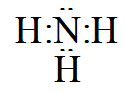
Clearly, the octet of nitrogen is completely filled. (Valence electron of nitrogen and hydrogen are 5 and 1 respectively)
Case 2
In case of \[ICl\] the electron dot structure will be like

Clearly, the octet of both the atoms is completely filled. (Valence electrons of Iodine and Chlorine are 7 each)
Case 3
In case of \[BC{l_3}\]the electron dot structure will be like
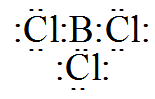
In this it is clearly visible that the central atom is not having a complete octet so it will be an electron deficient compound. (Valence electrons of Boron and Chlorine are 3 and 7 respectively)
Case 4
In case of $PCl_3$ the electron dot structure will be like
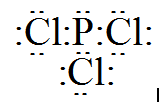
Clearly, the octet of the central atom is complete. (Valence electron of phosphate and chlorine is 5 and 7 respectively)
So, the answer to this question is C. \[BC{l_3}\].
Note: We must know that Lewis dot structure or we can say electron dot structures are diagrams that represent the valence electrons of an atom in a molecule. These structures help us visualize the valence electron of an atom in a molecule. Also tell us whether these valence electrons exist in bonds or lone pairs.
Complete step by step solution:
Let’s first discuss Electron deficient compounds. Electron deficient compound is the one in which there are not enough electrons to completely fill the outer shell (octet) of the central atom. These compounds contain less number of electrons i.e. they are electron deficient to form normal electron-pair bonds between each pair of atoms.
So, looking at the options provided in the question let’s check which compound’s central atom is not having its octet complete.
Case 1
In case of \[N{H_3}\]the electron dot structure will be
Clearly, the octet of nitrogen is completely filled. (Valence electron of nitrogen and hydrogen are 5 and 1 respectively)
Case 2
In case of \[ICl\] the electron dot structure will be like
Clearly, the octet of both the atoms is completely filled. (Valence electrons of Iodine and Chlorine are 7 each)
Case 3
In case of \[BC{l_3}\]the electron dot structure will be like
In this it is clearly visible that the central atom is not having a complete octet so it will be an electron deficient compound. (Valence electrons of Boron and Chlorine are 3 and 7 respectively)
Case 4
In case of $PCl_3$ the electron dot structure will be like
Clearly, the octet of the central atom is complete. (Valence electron of phosphate and chlorine is 5 and 7 respectively)
So, the answer to this question is C. \[BC{l_3}\].
Note: We must know that Lewis dot structure or we can say electron dot structures are diagrams that represent the valence electrons of an atom in a molecule. These structures help us visualize the valence electron of an atom in a molecule. Also tell us whether these valence electrons exist in bonds or lone pairs.
Recently Updated Pages
Master Class 11 Computer Science: Engaging Questions & Answers for Success

Master Class 11 Business Studies: Engaging Questions & Answers for Success
Master Class 11 Economics: Engaging Questions & Answers for Success
Master Class 11 English: Engaging Questions & Answers for Success
Master Class 11 Maths: Engaging Questions & Answers for Success
Master Class 11 Biology: Engaging Questions & Answers for Success
Trending doubts
One Metric ton is equal to kg A 10000 B 1000 C 100 class 11 physics CBSE
There are 720 permutations of the digits 1 2 3 4 5 class 11 maths CBSE
Discuss the various forms of bacteria class 11 biology CBSE
Draw a diagram of a plant cell and label at least eight class 11 biology CBSE
State the laws of reflection of light
Explain zero factorial class 11 maths CBSE