




Which of the following is a Pythagorean triplet?
(a) 3, 4, 5
(b) 5, 12, 14
(c) 6, 8, 11
(d) 8, 5, 17
Answer
 Verified
644.1k+ views
Hint: For solving this question we should know about the result of the Pythagoras Theorem in right-angled triangles. After that, we will examine every option separately and check whether it is a Pythagorean triplet or not.
Complete step-by-step answer:
Now, before we proceed just take a look at the result of the Pythagoras Theorem. The Pythagoras Theorem states that in a right-angled triangle as shown below $\Delta ABC$ , the square of the hypotenuse is equal to the sum of the squares of the other two sides.
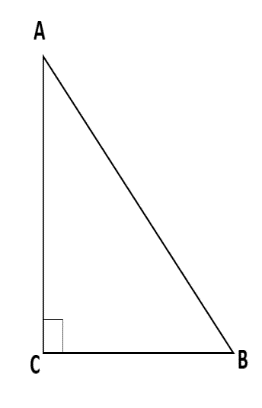
In the $\Delta ABC$ , $\angle ACB={{90}^{\circ}}$ and AB is the hypotenuse, BC is the base and AC is the perpendicular. From Pythagoras Theorem, we have:
$\begin{align}
& {{\left( BC \right)}^{2}}+{{\left( AC \right)}^{2}}={{\left( AB \right)}^{2}} \\
& \Rightarrow {{a}^{2}}+{{b}^{2}}={{c}^{2}} \\
\end{align}$
Then, we can write, ${{\left( base \right)}^{2}}+{{\left( perpendicular \right)}^{2}}={{\left( hypotenuse \right)}^{2}}$.
Now, we can easily understand the concept of the Pythagorean triplet.
Pythagorean Triplet: Pythagorean triplet are the values of hypotenuse, base and perpendicular which tend to represent a right-angled triangle. Integral solutions to the Pythagorean Theorem, ${{a}^{2}}+{{b}^{2}}={{c}^{2}}$ are called Pythagorean triplet which contains three positive integers $a,b,c$ where $a < b < c$.
Now, we check all of the given options:
1) $3, 4, 5$ : In this case $3 < 4 < 5$ so, $a=3, b=4$ and $c=5$. Then,
$\begin{align}
& {{a}^{2}}+{{b}^{2}}={{3}^{2}}+{{4}^{2}}=9+16=25 \\
& {{c}^{2}}={{5}^{2}}=25 \\
& \therefore LHS=RHS \\
\end{align}$
Thus, this is a Pythagorean triplet.
2) $5,12,14$ : In this case $5<12<14$ so, $a=5, b=12$ and $c=14$. Then,
$\begin{align}
& {{a}^{2}}+{{b}^{2}}={{5}^{2}}+{{12}^{2}}=25+144=169 \\
& {{c}^{2}}={{14}^{2}}=196 \\
& \therefore LHS\ne RHS \\
\end{align}$
Thus, this is not a Pythagorean triplet.
3. $6,8,11$ : In this case as $6<8<11$ so, $a=6,b=8$ and $c=11$ . Then,
$\begin{align}
& {{a}^{2}}+{{b}^{2}}={{6}^{2}}+{{8}^{2}}=36+64=100 \\
& {{c}^{2}}={{11}^{2}}=121 \\
& \therefore LHS\ne RHS \\
\end{align}$
Thus, this is not a Pythagorean triplet.
4. $8,5,17$ : In this case as $5<8<17$ so, $a=5,b=8$ and $c=17$ . Then,
$\begin{align}
& {{a}^{2}}+{{b}^{2}}={{5}^{2}}+{{8}^{2}}=25+64=89 \\
& {{c}^{2}}={{17}^{2}}=289 \\
& \therefore LHS\ne RHS \\
\end{align}$
Thus, this is not a Pythagorean triplet.
Now, from the above results we conclude, that $3,4,5$ is a Pythagorean triplet.
Hence, (a) is the correct option.
Note: Here, we should know the result of Pythagoras Theorem correctly and its use to find the Pythagorean triplets. And we should avoid calculation mistakes while solving.
Complete step-by-step answer:
Now, before we proceed just take a look at the result of the Pythagoras Theorem. The Pythagoras Theorem states that in a right-angled triangle as shown below $\Delta ABC$ , the square of the hypotenuse is equal to the sum of the squares of the other two sides.
In the $\Delta ABC$ , $\angle ACB={{90}^{\circ}}$ and AB is the hypotenuse, BC is the base and AC is the perpendicular. From Pythagoras Theorem, we have:
$\begin{align}
& {{\left( BC \right)}^{2}}+{{\left( AC \right)}^{2}}={{\left( AB \right)}^{2}} \\
& \Rightarrow {{a}^{2}}+{{b}^{2}}={{c}^{2}} \\
\end{align}$
Then, we can write, ${{\left( base \right)}^{2}}+{{\left( perpendicular \right)}^{2}}={{\left( hypotenuse \right)}^{2}}$.
Now, we can easily understand the concept of the Pythagorean triplet.
Pythagorean Triplet: Pythagorean triplet are the values of hypotenuse, base and perpendicular which tend to represent a right-angled triangle. Integral solutions to the Pythagorean Theorem, ${{a}^{2}}+{{b}^{2}}={{c}^{2}}$ are called Pythagorean triplet which contains three positive integers $a,b,c$ where $a < b < c$.
Now, we check all of the given options:
1) $3, 4, 5$ : In this case $3 < 4 < 5$ so, $a=3, b=4$ and $c=5$. Then,
$\begin{align}
& {{a}^{2}}+{{b}^{2}}={{3}^{2}}+{{4}^{2}}=9+16=25 \\
& {{c}^{2}}={{5}^{2}}=25 \\
& \therefore LHS=RHS \\
\end{align}$
Thus, this is a Pythagorean triplet.
2) $5,12,14$ : In this case $5<12<14$ so, $a=5, b=12$ and $c=14$. Then,
$\begin{align}
& {{a}^{2}}+{{b}^{2}}={{5}^{2}}+{{12}^{2}}=25+144=169 \\
& {{c}^{2}}={{14}^{2}}=196 \\
& \therefore LHS\ne RHS \\
\end{align}$
Thus, this is not a Pythagorean triplet.
3. $6,8,11$ : In this case as $6<8<11$ so, $a=6,b=8$ and $c=11$ . Then,
$\begin{align}
& {{a}^{2}}+{{b}^{2}}={{6}^{2}}+{{8}^{2}}=36+64=100 \\
& {{c}^{2}}={{11}^{2}}=121 \\
& \therefore LHS\ne RHS \\
\end{align}$
Thus, this is not a Pythagorean triplet.
4. $8,5,17$ : In this case as $5<8<17$ so, $a=5,b=8$ and $c=17$ . Then,
$\begin{align}
& {{a}^{2}}+{{b}^{2}}={{5}^{2}}+{{8}^{2}}=25+64=89 \\
& {{c}^{2}}={{17}^{2}}=289 \\
& \therefore LHS\ne RHS \\
\end{align}$
Thus, this is not a Pythagorean triplet.
Now, from the above results we conclude, that $3,4,5$ is a Pythagorean triplet.
Hence, (a) is the correct option.
Note: Here, we should know the result of Pythagoras Theorem correctly and its use to find the Pythagorean triplets. And we should avoid calculation mistakes while solving.
Recently Updated Pages
Master Class 12 Economics: Engaging Questions & Answers for Success

Master Class 12 English: Engaging Questions & Answers for Success
Master Class 12 Social Science: Engaging Questions & Answers for Success
Master Class 12 Maths: Engaging Questions & Answers for Success
Master Class 12 Physics: Engaging Questions & Answers for Success
Master Class 8 English: Engaging Questions & Answers for Success
Trending doubts
What is BLO What is the full form of BLO class 8 social science CBSE
Citizens of India can vote at the age of A 18 years class 8 social science CBSE
Right to vote is a AFundamental Right BFundamental class 8 social science CBSE
Full form of STD, ISD and PCO
What is the area formula of an obtuse triangle class 8 maths CBSE
Give me the opposite gender of Duck class 8 english CBSE