




Which of the following is a Pythagoras triplet?
(a) 3, 4, 5
(b) 5, 12, 14
(c) 6, 8, 11
(d) 8, 5, 17
Answer
 Verified
608.4k+ views
Hint: We solve this problem by using Pythagoras theorem.
We have the condition that the largest side is the hypotenuse and the remaining two sides are the other sides of the right-angled triangle.
The Pythagoras Theorem states that the square of the hypotenuse is equal to the sum of squares of the other two sides that is for the triangle shown below
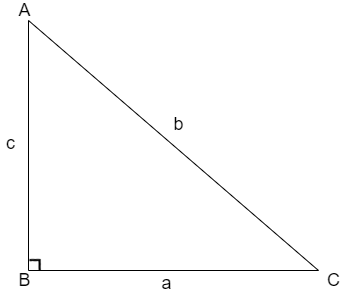
The Pythagoras theorem is given as\[{{b}^{2}}={{a}^{2}}+{{c}^{2}}\].
The triplet that follows the Pythagoras theorem is called the Pythagoras triplet.
Complete step by step answer:
We are asked to check whether the given triplet is Pythagoras triplet or not.
We know that the triplet that follows Pythagoras theorem in the Pythagoras triplet.
Let us take the first option
(a) 3, 4, 5
We know that the largest side is the hypotenuse and the remaining lengths are sides of right angles triangle
By using the above condition we get that 5 is hypotenuse and 3, 4 are the remaining sides of the triangle.
We know that the Pythagoras Theorem states that the square of the hypotenuse is equal to sum of squares of the other two sides that is for the triangle shown below
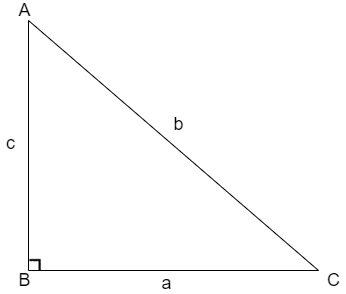
The Pythagoras theorem is given as\[{{b}^{2}}={{a}^{2}}+{{c}^{2}}\].
By using the above theorem to given triplet we get
\[\begin{align}
& \Rightarrow {{5}^{2}}={{3}^{2}}+{{4}^{2}} \\
& \Rightarrow 25=9+16 \\
& \Rightarrow 25=25 \\
\end{align}\]
Here, we can see that LHS is equal to RHS
Therefore, we can conclude that the triplet 3, 4, 5 is a Pythagoras triplet.
(b) 5, 12, 14
Here, we can see that 14 is hypotenuse and 5, 12 are the remaining sides.
By using the Pythagoras theorem then we get
\[\begin{align}
& \Rightarrow {{14}^{2}}={{5}^{2}}+{{12}^{2}} \\
& \Rightarrow 196=25+144 \\
& \Rightarrow 196=169 \\
\end{align}\]
Here, we can see that LHS is not equal to RHS
Therefore, we can conclude that the triplet 5, 12, 14 is not a Pythagoras triplet.
(c) 6, 8, 11
Here, we can see that 11 is hypotenuse and 6, 8 are the remaining sides.
By using the Pythagoras theorem then we get
\[\begin{align}
& \Rightarrow {{11}^{2}}={{6}^{2}}+{{8}^{2}} \\
& \Rightarrow 121=36+64 \\
& \Rightarrow 121=100 \\
\end{align}\]
Here, we can see that LHS is not equal to RHS
Therefore, we can conclude that the triplet 6, 8, 11 is not a Pythagoras triplet.
(d) 8, 5, 17
Here, we can see that 17 is hypotenuse and 5, 8 are the remaining sides.
By using the Pythagoras theorem then we get
\[\begin{align}
& \Rightarrow {{17}^{2}}={{5}^{2}}+{{8}^{2}} \\
& \Rightarrow 289=25+64 \\
& \Rightarrow 289=89 \\
\end{align}\]
Here, we can see that LHS is not equal to RHS
Therefore, we can conclude that the triplet 5, 8, 17 is not a Pythagoras triplet.
So, we can say that 3, 4, 5 is the only Pythagoras triplet given
Therefore, option (a) is correct answer.
Note:
We need to note that the largest of all the given lengths will be always hypotenuse. This is because in the Pythagoras theorem we can see that square of the hypotenuse is the sum of squares of the other two sides. This indicates that hypotenuse is obtained by adding two other terms which place it as the largest of all sides because we know that side length can never be negative.
Sometimes students may do mistake and take one of the remaining sides as the hypotenuse.
We have the condition that the largest side is the hypotenuse and the remaining two sides are the other sides of the right-angled triangle.
The Pythagoras Theorem states that the square of the hypotenuse is equal to the sum of squares of the other two sides that is for the triangle shown below
The Pythagoras theorem is given as\[{{b}^{2}}={{a}^{2}}+{{c}^{2}}\].
The triplet that follows the Pythagoras theorem is called the Pythagoras triplet.
Complete step by step answer:
We are asked to check whether the given triplet is Pythagoras triplet or not.
We know that the triplet that follows Pythagoras theorem in the Pythagoras triplet.
Let us take the first option
(a) 3, 4, 5
We know that the largest side is the hypotenuse and the remaining lengths are sides of right angles triangle
By using the above condition we get that 5 is hypotenuse and 3, 4 are the remaining sides of the triangle.
We know that the Pythagoras Theorem states that the square of the hypotenuse is equal to sum of squares of the other two sides that is for the triangle shown below
The Pythagoras theorem is given as\[{{b}^{2}}={{a}^{2}}+{{c}^{2}}\].
By using the above theorem to given triplet we get
\[\begin{align}
& \Rightarrow {{5}^{2}}={{3}^{2}}+{{4}^{2}} \\
& \Rightarrow 25=9+16 \\
& \Rightarrow 25=25 \\
\end{align}\]
Here, we can see that LHS is equal to RHS
Therefore, we can conclude that the triplet 3, 4, 5 is a Pythagoras triplet.
(b) 5, 12, 14
Here, we can see that 14 is hypotenuse and 5, 12 are the remaining sides.
By using the Pythagoras theorem then we get
\[\begin{align}
& \Rightarrow {{14}^{2}}={{5}^{2}}+{{12}^{2}} \\
& \Rightarrow 196=25+144 \\
& \Rightarrow 196=169 \\
\end{align}\]
Here, we can see that LHS is not equal to RHS
Therefore, we can conclude that the triplet 5, 12, 14 is not a Pythagoras triplet.
(c) 6, 8, 11
Here, we can see that 11 is hypotenuse and 6, 8 are the remaining sides.
By using the Pythagoras theorem then we get
\[\begin{align}
& \Rightarrow {{11}^{2}}={{6}^{2}}+{{8}^{2}} \\
& \Rightarrow 121=36+64 \\
& \Rightarrow 121=100 \\
\end{align}\]
Here, we can see that LHS is not equal to RHS
Therefore, we can conclude that the triplet 6, 8, 11 is not a Pythagoras triplet.
(d) 8, 5, 17
Here, we can see that 17 is hypotenuse and 5, 8 are the remaining sides.
By using the Pythagoras theorem then we get
\[\begin{align}
& \Rightarrow {{17}^{2}}={{5}^{2}}+{{8}^{2}} \\
& \Rightarrow 289=25+64 \\
& \Rightarrow 289=89 \\
\end{align}\]
Here, we can see that LHS is not equal to RHS
Therefore, we can conclude that the triplet 5, 8, 17 is not a Pythagoras triplet.
So, we can say that 3, 4, 5 is the only Pythagoras triplet given
Therefore, option (a) is correct answer.
Note:
We need to note that the largest of all the given lengths will be always hypotenuse. This is because in the Pythagoras theorem we can see that square of the hypotenuse is the sum of squares of the other two sides. This indicates that hypotenuse is obtained by adding two other terms which place it as the largest of all sides because we know that side length can never be negative.
Sometimes students may do mistake and take one of the remaining sides as the hypotenuse.
Recently Updated Pages
Master Class 11 English: Engaging Questions & Answers for Success

Master Class 11 Social Science: Engaging Questions & Answers for Success
Master Class 11 Maths: Engaging Questions & Answers for Success
Master Class 11 Biology: Engaging Questions & Answers for Success
Master Class 11 Physics: Engaging Questions & Answers for Success
Master Class 11 Chemistry: Engaging Questions & Answers for Success