




Which of the following is a freshwater indicator organism?
A. Tubifex
B. Daphnia
C. Sludge worm
D. All of the above
Answer
 Verified
648.3k+ views
Hint: They are the small aquatic crustaceans which are commonly called water fleas and are found mostly in various aquatic environments.
Complete answer:
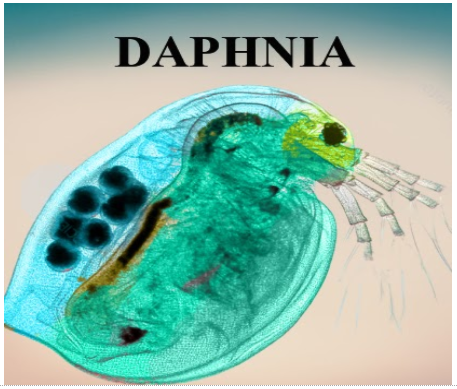
Daphnia is the freshwater indicator organism as it is used in certain environments to check the effects of toxicity on an ecosystem. It is the indicator genus having a short life span and is highly reproductive.
Additional Information:
-Daphnia lives in various habitats from acidic swamps to freshwater lakes and ponds.
-They are named in resemblance to the movement of fleas and show terrestrial locomotion adaptation.
-The body of daphnia has segments that are not visible and are very small in size.
-They have compound eyes, antennae, and a pair of abdominal seats.
-They do early reproduction and thus have a short life span depending upon the temperature.
-They are transparent so it is easy to study their internal organs and the effect of temperature on it.
-It is used as live food in tropical and marine fish keeping.
-They are also used commonly for testing climate change that damages the small animal species.
-They are used to monitor the effectiveness of certain drugs but absorbing the drugs through their thin cell membrane.
-The eggs of the daphnia are covered in a thick chitinous shell which helps in its protection.
So, the correct answer is ‘Daphnia'.
Note: Tubifex is also known as the sludge worm. They care for annelids that live in sediments, lakes, and rivers, and sometimes even in skewer lines. They are used as live food for fish. They live in skewers so they may have serious health diseases. They sometimes act as water pollution indicators.
Complete answer:
Daphnia is the freshwater indicator organism as it is used in certain environments to check the effects of toxicity on an ecosystem. It is the indicator genus having a short life span and is highly reproductive.
Additional Information:
-Daphnia lives in various habitats from acidic swamps to freshwater lakes and ponds.
-They are named in resemblance to the movement of fleas and show terrestrial locomotion adaptation.
-The body of daphnia has segments that are not visible and are very small in size.
-They have compound eyes, antennae, and a pair of abdominal seats.
-They do early reproduction and thus have a short life span depending upon the temperature.
-They are transparent so it is easy to study their internal organs and the effect of temperature on it.
-It is used as live food in tropical and marine fish keeping.
-They are also used commonly for testing climate change that damages the small animal species.
-They are used to monitor the effectiveness of certain drugs but absorbing the drugs through their thin cell membrane.
-The eggs of the daphnia are covered in a thick chitinous shell which helps in its protection.
So, the correct answer is ‘Daphnia'.
Note: Tubifex is also known as the sludge worm. They care for annelids that live in sediments, lakes, and rivers, and sometimes even in skewer lines. They are used as live food for fish. They live in skewers so they may have serious health diseases. They sometimes act as water pollution indicators.
Recently Updated Pages
Class 10 Question and Answer - Your Ultimate Solutions Guide

Master Class 10 Computer Science: Engaging Questions & Answers for Success
Master Class 10 General Knowledge: Engaging Questions & Answers for Success
Master Class 12 Economics: Engaging Questions & Answers for Success
Master Class 12 Social Science: Engaging Questions & Answers for Success
Master Class 12 English: Engaging Questions & Answers for Success
Trending doubts
Explain the Treaty of Vienna of 1815 class 10 social science CBSE
The slogan Jai Hind was given by A Lal Bahadur Shastri class 10 social science CBSE
10 examples of evaporation in daily life with explanations
What is the full form of POSCO class 10 social science CBSE
Five things I will do to build a great India class 10 english CBSE
Identify the feminine form of noun nephew a shenephew class 10 english CBSE