




Which of the following irrigation procedures is/are followed when the land of cultivation is huge and the availability of water is scarce?
A. Drip irrigation
B. Furrow irrigation
C. Basin irrigation
D. All of these
Answer
 Verified
608.1k+ views
Hint: Irrigation is one of the most important practices done in agriculture. It refers to the watering of crops. Water is the basic requirement in fields. Some farmers provide water to fields by nearby rivers or lakes whereas some used other conventional methods. The type of irrigation is decided based on the availability of water sources near the field.
Complete answer: Agriculture is the main and primary source of food supply to the whole world. Irrigation is one of the key practices done in the cultivation of crops. Irrigation is the process of watering the crops artificially to meet their survival and growth requirements. Water is the most essential component of the maintenance of life. Thus, crops need proper irrigation to give healthy and quality yield. The various common sources of irrigation are wells, lakes, canals, tube-wells, dams, etc.
The amount and rate of irrigation to crops depends on various environmental factors. These factors include season, types of soil, types of crops, water availability, etc. Summer crops require more water as compared to other crops. There are different types of irrigation available based on ease of access to water sources and pattern of cropping.
Let us understand each type of given irrigation-
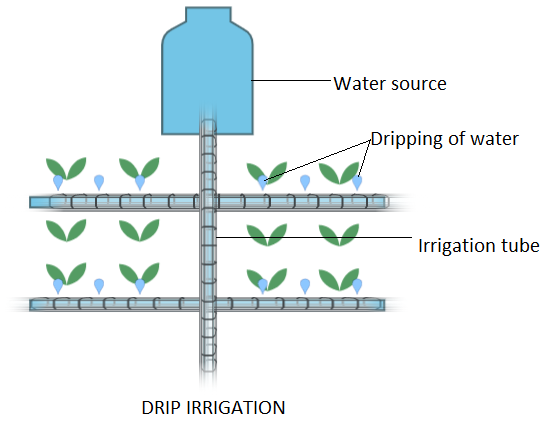
1. Drip irrigation- It is referred to that type of irrigation which involves watering the crops drip by drip. Drops of water are delivered to the roots of the plants. Water is supplied to the crops with the help of types of equipment like emitters, tubes, valves, etc. This type of irrigation stores water and also fertilizer as it gradually provides water in the form of drops. The water equipment is easy to install in large cultivation areas and also it prevents evaporation.
2. Furrow irrigation- It is a ridge and furrow type of irrigation. It is a method in which water channels are laid out providing enough water for suitable pants. It is a type of surface irrigation and requires large water quantities. It is not applicable in water-scarce regions.
3. Basin irrigation- It is also a type of surface irrigation and thus requires a large amount of water. Streams can be used as water sources. Gravity plays an important role in this method. Water is applied uniformly to the whole cultivation area. Thus, it cannot be applied to huge cultivation areas and in water-scarce regions.
Hence, Option A, i.e.,Drip irrigation is the right answer.
Note: Irrigating the fields requires large amounts of water. The most common sources of this water are streams, ponds, wells, etc. due to water pollution the water is becoming unfit for the proper growth and development of the crops. This is leading to a decline in yield and quality. Thus, certain measures should be taken to reduce water pollution as well as wastage of water.
Complete answer: Agriculture is the main and primary source of food supply to the whole world. Irrigation is one of the key practices done in the cultivation of crops. Irrigation is the process of watering the crops artificially to meet their survival and growth requirements. Water is the most essential component of the maintenance of life. Thus, crops need proper irrigation to give healthy and quality yield. The various common sources of irrigation are wells, lakes, canals, tube-wells, dams, etc.
The amount and rate of irrigation to crops depends on various environmental factors. These factors include season, types of soil, types of crops, water availability, etc. Summer crops require more water as compared to other crops. There are different types of irrigation available based on ease of access to water sources and pattern of cropping.
Let us understand each type of given irrigation-
1. Drip irrigation- It is referred to that type of irrigation which involves watering the crops drip by drip. Drops of water are delivered to the roots of the plants. Water is supplied to the crops with the help of types of equipment like emitters, tubes, valves, etc. This type of irrigation stores water and also fertilizer as it gradually provides water in the form of drops. The water equipment is easy to install in large cultivation areas and also it prevents evaporation.
2. Furrow irrigation- It is a ridge and furrow type of irrigation. It is a method in which water channels are laid out providing enough water for suitable pants. It is a type of surface irrigation and requires large water quantities. It is not applicable in water-scarce regions.
3. Basin irrigation- It is also a type of surface irrigation and thus requires a large amount of water. Streams can be used as water sources. Gravity plays an important role in this method. Water is applied uniformly to the whole cultivation area. Thus, it cannot be applied to huge cultivation areas and in water-scarce regions.
Hence, Option A, i.e.,Drip irrigation is the right answer.
Note: Irrigating the fields requires large amounts of water. The most common sources of this water are streams, ponds, wells, etc. due to water pollution the water is becoming unfit for the proper growth and development of the crops. This is leading to a decline in yield and quality. Thus, certain measures should be taken to reduce water pollution as well as wastage of water.

Recently Updated Pages
Master Class 8 English: Engaging Questions & Answers for Success

Master Class 8 Science: Engaging Questions & Answers for Success
Master Class 8 Maths: Engaging Questions & Answers for Success
Class 8 Question and Answer - Your Ultimate Solutions Guide
Master Class 8 Social Science: Engaging Questions & Answers for Success
Master Class 12 Economics: Engaging Questions & Answers for Success
Trending doubts
What is BLO What is the full form of BLO class 8 social science CBSE
Which Indian state shares the longest international class 8 social science CBSE
Citizens of India can vote at the age of A 18 years class 8 social science CBSE
Right to vote is a AFundamental Right BFundamental class 8 social science CBSE
Full form of STD, ISD and PCO
What is the area formula of an obtuse triangle class 8 maths CBSE