




Which of the following has zero dipole moment ?
A. $B{F_3}$
B. $BeClBr$
C. $C{H_2}C{l_2}$
D. $COS$
Answer
 Verified
653.7k+ views
Hint: Dipole moment is defined as the product of the magnitude of the charge and the distance between the centre of positive and negative charges. Dipole moment is a measure of the polarity of a molecule .
Complete step by step answer:
Dipole moments arise from electronegativity differences .
it is denoted by $\mu $
$\mu = q \times r$
where , q=magnitude of charge
and r= distance between charges
In the case of polyatomic molecules, $\mu $ not only depends upon the individual dipole moments of the bonds but also on the spatial arrangement of various bonds in the molecule.
When all the bonds in a molecule are oriented in such a way that they totally cancel each other's effects then the dipole moment is said to be zero.
In case of BF3,
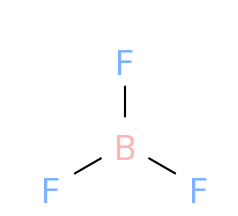
As we can see , the molecule has a trigonal planar shape
That is, the bonds are oriented at an angle of ${120^ \circ }$ such that the resultant dipole due to two $B - F$ bonds cancel the third bond dipole and so the net dipole moment becomes zero.
In all the other molecules given in the options , the bonds are so arranged that the net dipole moment is not equal to zero
So, the correct answer is Option A .
Note:
Dipole moment is used to calculate the polarity of the bonds . The dipole moment of a molecule depends on two things: the individual dipole moment of each bond and the arrangement of the molecules .
Complete step by step answer:
Dipole moments arise from electronegativity differences .
it is denoted by $\mu $
$\mu = q \times r$
where , q=magnitude of charge
and r= distance between charges
In the case of polyatomic molecules, $\mu $ not only depends upon the individual dipole moments of the bonds but also on the spatial arrangement of various bonds in the molecule.
When all the bonds in a molecule are oriented in such a way that they totally cancel each other's effects then the dipole moment is said to be zero.
In case of BF3,
As we can see , the molecule has a trigonal planar shape
That is, the bonds are oriented at an angle of ${120^ \circ }$ such that the resultant dipole due to two $B - F$ bonds cancel the third bond dipole and so the net dipole moment becomes zero.
In all the other molecules given in the options , the bonds are so arranged that the net dipole moment is not equal to zero
So, the correct answer is Option A .
Note:
Dipole moment is used to calculate the polarity of the bonds . The dipole moment of a molecule depends on two things: the individual dipole moment of each bond and the arrangement of the molecules .
Recently Updated Pages
If x a + bt + ct2 where x is in meters and t is in class 11 physics CBSE

A car covers the first half distance between two places class 11 physics CBSE
The resultant of two vectors overrightarrow P and overrightarrow class 11 physics CBSE
Find the value of cos 135 class 11 maths CBSE
A mass M is held in place by an applied force F and class 11 physics CBSE
A solution of glucose in water is labelled as 10 dfracwv class 11 chemistry CBSE
Trending doubts
One Metric ton is equal to kg A 10000 B 1000 C 100 class 11 physics CBSE
Find the value of the expression given below sin 30circ class 11 maths CBSE
What do you mean by retardation What is its SI uni class 11 physics CBSE
Draw a diagram of nephron and explain its structur class 11 biology CBSE
10 examples of friction in our daily life
Difference between physical and chemical change class 11 chemistry CBSE