




Which of the following has the greatest number of atoms?
A. ${\text{1}}\,{\text{g}}$ of butane $\left( {{{\text{C}}_{\text{4}}}{{\text{H}}_{{\text{10}}}}} \right)$
B. ${\text{1}}\,{\text{g}}$ of nitrogen $\left( {{{\text{N}}_2}} \right)$
C. ${\text{1}}\,{\text{g}}$ of silver $\left( {{\text{Ag}}} \right)$
D. ${\text{1}}\,{\text{g}}$ of water $\left( {{{\text{H}}_2}{\text{O}}} \right)$
Answer
 Verified
598.8k+ views
Hint: According to the Avogadro, one mole of any substance have $\,6.02 \times {10^{23}}$ atoms, ions, or molecules. This number $\,6.02 \times {10^{23}}$ is known as Avogadro number. The total number of atoms can be determined by multiplying the moles of a substance with Avogadro number.
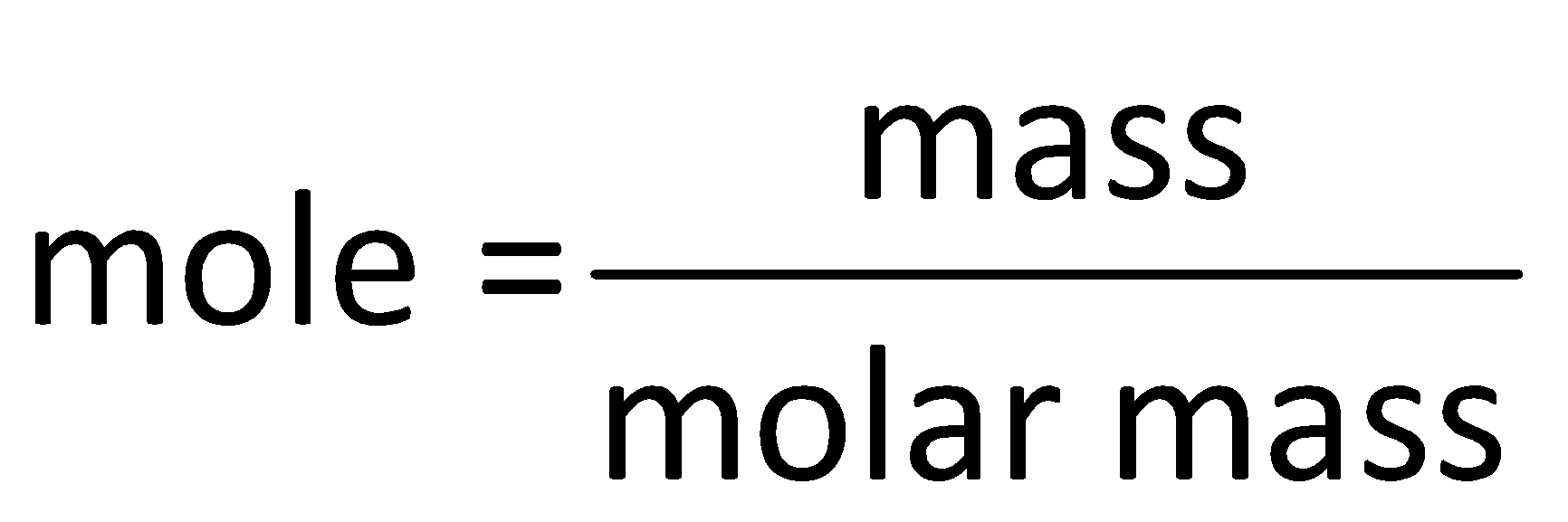
Step by step answer: The number of moles in a substance is determined by using the mole formula which is as follows:
Determine the mole in ${\text{1}}\,{\text{g}}$ of butane as follows:
Substitute ${\text{1}}\,{\text{g}}$ for mass and $58\,{\text{g/mol}}$ for molar mass.
${\text{mole}}\,\,{\text{of }}{{\text{C}}_4}{{\text{H}}_{10}}{\text{ = }}\,\dfrac{{{\text{1 g}}}}{{{\text{58 g/mol}}}}$
${\text{mole}}\,\,{\text{of }}{{\text{C}}_4}{{\text{H}}_{10}}{\text{ = }}\,{\text{0}}{\text{.017}}\,{\text{mol}}$
Multiply the mole of butane with Avogadro number to determine the total number of molecules.
${\text{Molecules}}\,{\text{of }}{{\text{C}}_4}{{\text{H}}_{10}}{\text{ = }}\,{\text{0}}{\text{.017}}\,{\text{mol}} \times {\text{6}}{\text{.02}} \times {\text{1}}{{\text{0}}^{23}}{\text{molecules/mol}}$
${\text{Molecules}}\,\,{\text{of }}{{\text{C}}_4}{{\text{H}}_{10}}{\text{ = }}\,1.04 \times {\text{1}}{{\text{0}}^{22}}$
So, the number of molecules in ${\text{1}}\,{\text{g}}$of butane is $1.04 \times {\text{1}}{{\text{0}}^{22}}$.
One molecule of butane has $14$atoms. So, the total number atoms are as follows:
\[1.04 \times {\text{1}}{{\text{0}}^{22}} \times {\text{1}}4\]
\[14.6 \times {\text{1}}{{\text{0}}^{22}}{\text{atoms}}\]
So, the number of atoms in ${\text{1}}\,{\text{g}}$ of butane is\[14.6 \times {\text{1}}{{\text{0}}^{22}}\].
Determine the mole in ${\text{1}}\,{\text{g}}$ of nitrogen as follows:
Substitute ${\text{1}}\,{\text{g}}$ for mass and $14\,{\text{g/mol}}$ for molar mass.
${\text{mole}}\,\,{\text{of }}{{\text{N}}_2}{\text{ = }}\,\dfrac{{{\text{1 g}}}}{{{\text{14 g/mol}}}}$
${\text{mole}}\,\,{\text{of }}{{\text{N}}_2}{\text{ = }}\,{\text{0}}{\text{.071}}\,{\text{mol}}$
Multiply the mole of nitrogen with Avogadro number to determine the total number of molecules.
${\text{molecules}}\,\,{\text{of }}{{\text{N}}_2}{\text{ = }}\,{\text{0}}{\text{.071}}\,{\text{mol}} \times {\text{6}}{\text{.02}} \times {\text{1}}{{\text{0}}^{23}}{\text{molecules/mol}}$
${\text{molecules}}\,\,{\text{of }}{{\text{N}}_2}{\text{ = }}\,4.{\text{3}} \times {\text{1}}{{\text{0}}^{22}}$
So, the number of molecules in ${\text{1}}\,{\text{g}}$ of nitrogen is $4.3 \times {\text{1}}{{\text{0}}^{22}}$.
One molecule of nitrogen has $2$atoms.
$ = 4.3 \times {\text{1}}{{\text{0}}^{22}} \times 2$
$ = 8.6 \times {\text{1}}{{\text{0}}^{22}}$
So, the number of atoms in ${\text{1}}\,{\text{g}}$ of nitrogen is $8.6 \times {\text{1}}{{\text{0}}^{22}}$.
Determine the mole in ${\text{1}}\,{\text{g}}$ of silver as follows:
Substitute ${\text{1}}\,{\text{g}}$ for mass and $108\,{\text{g/mol}}$ for molar mass.
${\text{mole}}\,\,{\text{of Ag}}\,{\text{ = }}\,\,\dfrac{{{\text{1 g}}}}{{108\,{\text{g/mol}}}}$
${\text{mole}}\,\,{\text{of Ag}}\,{\text{ = }}\,\,{\text{9}}{\text{.259}} \times {\text{1}}{{\text{0}}^{ - 3}}\,{\text{mol}}$
Multiply the mole of silver with Avogadro number to determine the total number of molecules.
${\text{molecules}}\,\,{\text{of Ag}}\,{\text{ = }}\,\,{\text{9}}{\text{.259}} \times {\text{1}}{{\text{0}}^{ - 3}}\,{\text{mol}} \times {\text{6}}{\text{.02}} \times {\text{1}}{{\text{0}}^{23}}{\text{molecules/mol}}$
${\text{molecules}}\,{\text{of Ag}}\,{\text{ = }}\,\,0.55 \times {\text{1}}{{\text{0}}^{22}}$
One molecule of silver has one atom.
${\text{Atoms}}\,{\text{of Ag}}\,{\text{ = }}\,\,1\, \times 0.55 \times {\text{1}}{{\text{0}}^{22}}$
${\text{Atoms}}\,{\text{of Ag}}\,{\text{ = }}\,0.55 \times {\text{1}}{{\text{0}}^{22}}$
So, the number of atoms in ${\text{1}}\,{\text{g}}$ of silver is $0.55 \times {\text{1}}{{\text{0}}^{22}}$.
Determine the mole in ${\text{1}}\,{\text{g}}$ of water as follows:
Substitute ${\text{1}}\,{\text{g}}$ for mass and $18\,{\text{g/mol}}$ for molar mass.
${\text{mole}}\,\,{\text{of }}{{\text{H}}_2}{\text{O}}\,{\text{ = }}\,\,\dfrac{{{\text{1 g}}}}{{18\,{\text{g/mol}}}}$
${\text{mole}}\,\,{\text{of }}{{\text{H}}_2}{\text{O}}\,{\text{ = }}\,\,0.055\,{\text{mol}}$
Multiply the mole of water with Avogadro number to determine the total number of molecules.
\[{\text{molecules}}\,\,{\text{of }}{{\text{H}}_2}{\text{O}}\,{\text{ = }}\,\,0.055\,{\text{mol}} \times {\text{6}}{\text{.02}} \times {\text{1}}{{\text{0}}^{23}}{\text{molecules/mol}}\]
${\text{molecules}}\,\,{\text{of }}{{\text{H}}_2}{\text{O}}\,\,{\text{ = }}\,\,3.3 \times {\text{1}}{{\text{0}}^{22}}$
So, the number of molecules in ${\text{1}}\,{\text{g}}$ of water is $3.3 \times {\text{1}}{{\text{0}}^{22}}$.
One molecule of water has $3$atoms.
No. of atoms $ = 3 \times 3.3 \times {\text{1}}{{\text{0}}^{22}}$
No. of atoms $ = 9.9 \times {\text{1}}{{\text{0}}^{22}}{\text{atoms}}$
So, the number of atoms in ${\text{1}}\,{\text{g}}$ of water is$9.9 \times {\text{1}}{{\text{0}}^{22}}$.
${\text{1}}\,{\text{g}}$ of butane has the highest number of moles so, option (B), (C), (D) are incorrect.
Therefore, option (A) ${\text{1}}\,{\text{g}}$ of butane$\left( {{{\text{C}}_{\text{4}}}{{\text{H}}_{{\text{10}}}}} \right)$, is correct.
Note: Atomicity also denotes the number of atoms in a substance. Here, the gram amount of each substance is given so, the total number of atoms is determined by multiplying the moles with Avogadro's number and number of atoms in one molecule. If the gram amount is not given the total number of atoms can be determined by adding the number of atoms of a substance.
Step by step answer: The number of moles in a substance is determined by using the mole formula which is as follows:
Determine the mole in ${\text{1}}\,{\text{g}}$ of butane as follows:
Substitute ${\text{1}}\,{\text{g}}$ for mass and $58\,{\text{g/mol}}$ for molar mass.
${\text{mole}}\,\,{\text{of }}{{\text{C}}_4}{{\text{H}}_{10}}{\text{ = }}\,\dfrac{{{\text{1 g}}}}{{{\text{58 g/mol}}}}$
${\text{mole}}\,\,{\text{of }}{{\text{C}}_4}{{\text{H}}_{10}}{\text{ = }}\,{\text{0}}{\text{.017}}\,{\text{mol}}$
Multiply the mole of butane with Avogadro number to determine the total number of molecules.
${\text{Molecules}}\,{\text{of }}{{\text{C}}_4}{{\text{H}}_{10}}{\text{ = }}\,{\text{0}}{\text{.017}}\,{\text{mol}} \times {\text{6}}{\text{.02}} \times {\text{1}}{{\text{0}}^{23}}{\text{molecules/mol}}$
${\text{Molecules}}\,\,{\text{of }}{{\text{C}}_4}{{\text{H}}_{10}}{\text{ = }}\,1.04 \times {\text{1}}{{\text{0}}^{22}}$
So, the number of molecules in ${\text{1}}\,{\text{g}}$of butane is $1.04 \times {\text{1}}{{\text{0}}^{22}}$.
One molecule of butane has $14$atoms. So, the total number atoms are as follows:
\[1.04 \times {\text{1}}{{\text{0}}^{22}} \times {\text{1}}4\]
\[14.6 \times {\text{1}}{{\text{0}}^{22}}{\text{atoms}}\]
So, the number of atoms in ${\text{1}}\,{\text{g}}$ of butane is\[14.6 \times {\text{1}}{{\text{0}}^{22}}\].
Determine the mole in ${\text{1}}\,{\text{g}}$ of nitrogen as follows:
Substitute ${\text{1}}\,{\text{g}}$ for mass and $14\,{\text{g/mol}}$ for molar mass.
${\text{mole}}\,\,{\text{of }}{{\text{N}}_2}{\text{ = }}\,\dfrac{{{\text{1 g}}}}{{{\text{14 g/mol}}}}$
${\text{mole}}\,\,{\text{of }}{{\text{N}}_2}{\text{ = }}\,{\text{0}}{\text{.071}}\,{\text{mol}}$
Multiply the mole of nitrogen with Avogadro number to determine the total number of molecules.
${\text{molecules}}\,\,{\text{of }}{{\text{N}}_2}{\text{ = }}\,{\text{0}}{\text{.071}}\,{\text{mol}} \times {\text{6}}{\text{.02}} \times {\text{1}}{{\text{0}}^{23}}{\text{molecules/mol}}$
${\text{molecules}}\,\,{\text{of }}{{\text{N}}_2}{\text{ = }}\,4.{\text{3}} \times {\text{1}}{{\text{0}}^{22}}$
So, the number of molecules in ${\text{1}}\,{\text{g}}$ of nitrogen is $4.3 \times {\text{1}}{{\text{0}}^{22}}$.
One molecule of nitrogen has $2$atoms.
$ = 4.3 \times {\text{1}}{{\text{0}}^{22}} \times 2$
$ = 8.6 \times {\text{1}}{{\text{0}}^{22}}$
So, the number of atoms in ${\text{1}}\,{\text{g}}$ of nitrogen is $8.6 \times {\text{1}}{{\text{0}}^{22}}$.
Determine the mole in ${\text{1}}\,{\text{g}}$ of silver as follows:
Substitute ${\text{1}}\,{\text{g}}$ for mass and $108\,{\text{g/mol}}$ for molar mass.
${\text{mole}}\,\,{\text{of Ag}}\,{\text{ = }}\,\,\dfrac{{{\text{1 g}}}}{{108\,{\text{g/mol}}}}$
${\text{mole}}\,\,{\text{of Ag}}\,{\text{ = }}\,\,{\text{9}}{\text{.259}} \times {\text{1}}{{\text{0}}^{ - 3}}\,{\text{mol}}$
Multiply the mole of silver with Avogadro number to determine the total number of molecules.
${\text{molecules}}\,\,{\text{of Ag}}\,{\text{ = }}\,\,{\text{9}}{\text{.259}} \times {\text{1}}{{\text{0}}^{ - 3}}\,{\text{mol}} \times {\text{6}}{\text{.02}} \times {\text{1}}{{\text{0}}^{23}}{\text{molecules/mol}}$
${\text{molecules}}\,{\text{of Ag}}\,{\text{ = }}\,\,0.55 \times {\text{1}}{{\text{0}}^{22}}$
One molecule of silver has one atom.
${\text{Atoms}}\,{\text{of Ag}}\,{\text{ = }}\,\,1\, \times 0.55 \times {\text{1}}{{\text{0}}^{22}}$
${\text{Atoms}}\,{\text{of Ag}}\,{\text{ = }}\,0.55 \times {\text{1}}{{\text{0}}^{22}}$
So, the number of atoms in ${\text{1}}\,{\text{g}}$ of silver is $0.55 \times {\text{1}}{{\text{0}}^{22}}$.
Determine the mole in ${\text{1}}\,{\text{g}}$ of water as follows:
Substitute ${\text{1}}\,{\text{g}}$ for mass and $18\,{\text{g/mol}}$ for molar mass.
${\text{mole}}\,\,{\text{of }}{{\text{H}}_2}{\text{O}}\,{\text{ = }}\,\,\dfrac{{{\text{1 g}}}}{{18\,{\text{g/mol}}}}$
${\text{mole}}\,\,{\text{of }}{{\text{H}}_2}{\text{O}}\,{\text{ = }}\,\,0.055\,{\text{mol}}$
Multiply the mole of water with Avogadro number to determine the total number of molecules.
\[{\text{molecules}}\,\,{\text{of }}{{\text{H}}_2}{\text{O}}\,{\text{ = }}\,\,0.055\,{\text{mol}} \times {\text{6}}{\text{.02}} \times {\text{1}}{{\text{0}}^{23}}{\text{molecules/mol}}\]
${\text{molecules}}\,\,{\text{of }}{{\text{H}}_2}{\text{O}}\,\,{\text{ = }}\,\,3.3 \times {\text{1}}{{\text{0}}^{22}}$
So, the number of molecules in ${\text{1}}\,{\text{g}}$ of water is $3.3 \times {\text{1}}{{\text{0}}^{22}}$.
One molecule of water has $3$atoms.
No. of atoms $ = 3 \times 3.3 \times {\text{1}}{{\text{0}}^{22}}$
No. of atoms $ = 9.9 \times {\text{1}}{{\text{0}}^{22}}{\text{atoms}}$
So, the number of atoms in ${\text{1}}\,{\text{g}}$ of water is$9.9 \times {\text{1}}{{\text{0}}^{22}}$.
${\text{1}}\,{\text{g}}$ of butane has the highest number of moles so, option (B), (C), (D) are incorrect.
Therefore, option (A) ${\text{1}}\,{\text{g}}$ of butane$\left( {{{\text{C}}_{\text{4}}}{{\text{H}}_{{\text{10}}}}} \right)$, is correct.
Note: Atomicity also denotes the number of atoms in a substance. Here, the gram amount of each substance is given so, the total number of atoms is determined by multiplying the moles with Avogadro's number and number of atoms in one molecule. If the gram amount is not given the total number of atoms can be determined by adding the number of atoms of a substance.
Recently Updated Pages
Master Class 11 Social Science: Engaging Questions & Answers for Success

Master Class 11 Physics: Engaging Questions & Answers for Success
Master Class 11 Maths: Engaging Questions & Answers for Success
Master Class 11 Economics: Engaging Questions & Answers for Success
Master Class 11 Computer Science: Engaging Questions & Answers for Success
Master Class 11 Chemistry: Engaging Questions & Answers for Success
Trending doubts
One Metric ton is equal to kg A 10000 B 1000 C 100 class 11 physics CBSE
There are 720 permutations of the digits 1 2 3 4 5 class 11 maths CBSE
1 Quintal is equal to a 110 kg b 10 kg c 100kg d 1000 class 11 physics CBSE
State and prove Bernoullis theorem class 11 physics CBSE
Difference Between Prokaryotic Cells and Eukaryotic Cells
Which among the following are examples of coming together class 11 social science CBSE