




Which of the following has intramolecular H-bonding?
A. Ortho-nitrophenol
B. Ortho-boric acid
C. Both (A) and (B)
D. None of these
Answer
 Verified
600k+ views
Hint: Before solving this question, we should first know about Hydrogen-bonding, its types and then we can look at the options and find out which of them has intramolecular H-bonding. The formation of the hydrogen bond is Hydrogen bonding. They are of two types: Intermolecular and Intramolecular.
Complete answer:
Hydrogen- Bonding occurs because of the dipole-dipole interaction between the Hydrogen atom and a strongly electronegative element and another electronegative atom lies in the region of the Hydrogen atom having a lone pair of electrons. Let us now discuss Intramolecular Hydrogen Bonding.
Intramolecular H- Bonding: It is the bonding that occurs between the same molecule. It occurs in compounds which have two groups in which one group has a hydrogen atom joined to an electronegative atom and the other group has a strongly electronegative atom joined to a weak electronegative atom of another group.
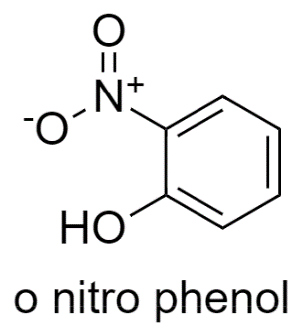
Let us see the first option, In ortho-nitrophenol structure, the donor and the acceptor both are in the same molecule, so Intramolecular Hydrogen bonding is possible in this.
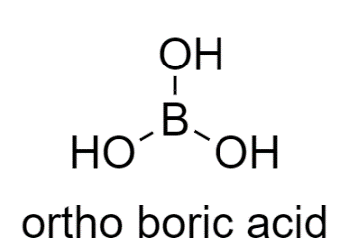
Now moving on to the second option, In ortho-boric acid structure, the donor and the acceptor are not within the same molecule, therefore it shows Intermolecular Hydrogen bonding.
So, the correct answer is “Option A”.
Note:
There is another type of hydrogen bonding i.e. Intermolecular H- Bonding. It is the bonding that occurs between different molecules of the same or different compounds. Some examples of it are Hydrogen bonding in water, alcohol, etc.
Complete answer:
Hydrogen- Bonding occurs because of the dipole-dipole interaction between the Hydrogen atom and a strongly electronegative element and another electronegative atom lies in the region of the Hydrogen atom having a lone pair of electrons. Let us now discuss Intramolecular Hydrogen Bonding.
Intramolecular H- Bonding: It is the bonding that occurs between the same molecule. It occurs in compounds which have two groups in which one group has a hydrogen atom joined to an electronegative atom and the other group has a strongly electronegative atom joined to a weak electronegative atom of another group.
Let us see the first option, In ortho-nitrophenol structure, the donor and the acceptor both are in the same molecule, so Intramolecular Hydrogen bonding is possible in this.
Now moving on to the second option, In ortho-boric acid structure, the donor and the acceptor are not within the same molecule, therefore it shows Intermolecular Hydrogen bonding.
So, the correct answer is “Option A”.
Note:
There is another type of hydrogen bonding i.e. Intermolecular H- Bonding. It is the bonding that occurs between different molecules of the same or different compounds. Some examples of it are Hydrogen bonding in water, alcohol, etc.
Recently Updated Pages
If x a + bt + ct2 where x is in meters and t is in class 11 physics CBSE

A car covers the first half distance between two places class 11 physics CBSE
The resultant of two vectors overrightarrow P and overrightarrow class 11 physics CBSE
Find the value of cos 135 class 11 maths CBSE
A mass M is held in place by an applied force F and class 11 physics CBSE
A solution of glucose in water is labelled as 10 dfracwv class 11 chemistry CBSE
Trending doubts
Find the value of the expression given below sin 30circ class 11 maths CBSE
One Metric ton is equal to kg A 10000 B 1000 C 100 class 11 physics CBSE
What is the maximum height of a projectile class 11 physics CBSE
Describe various types of epithelial tissues with the class 11 biology CBSE
Lysosomes are known as suicidal bags of cell why class 11 biology CBSE
State the laws of reflection of light