




Which of the following has a plane of symmetry?
(A) 1,4-dimethylcyclohexene
(B) 1,3-dimethylcyclohexene
(C) trans-1,3-dimethylcyclohexane
(D) cis-1,2-dimethylcyclohexane
Answer
 Verified
599.1k+ views
Hint: To solve this question we first need to know what is the plane of symmetry. An imaginary plane which bisects the molecule into two to give halves which are mirror images of each other is known as the plane of symmetry.
Complete answer:
Now, to determine which molecule has a plane of symmetry, we first need to draw the structure of each molecule.
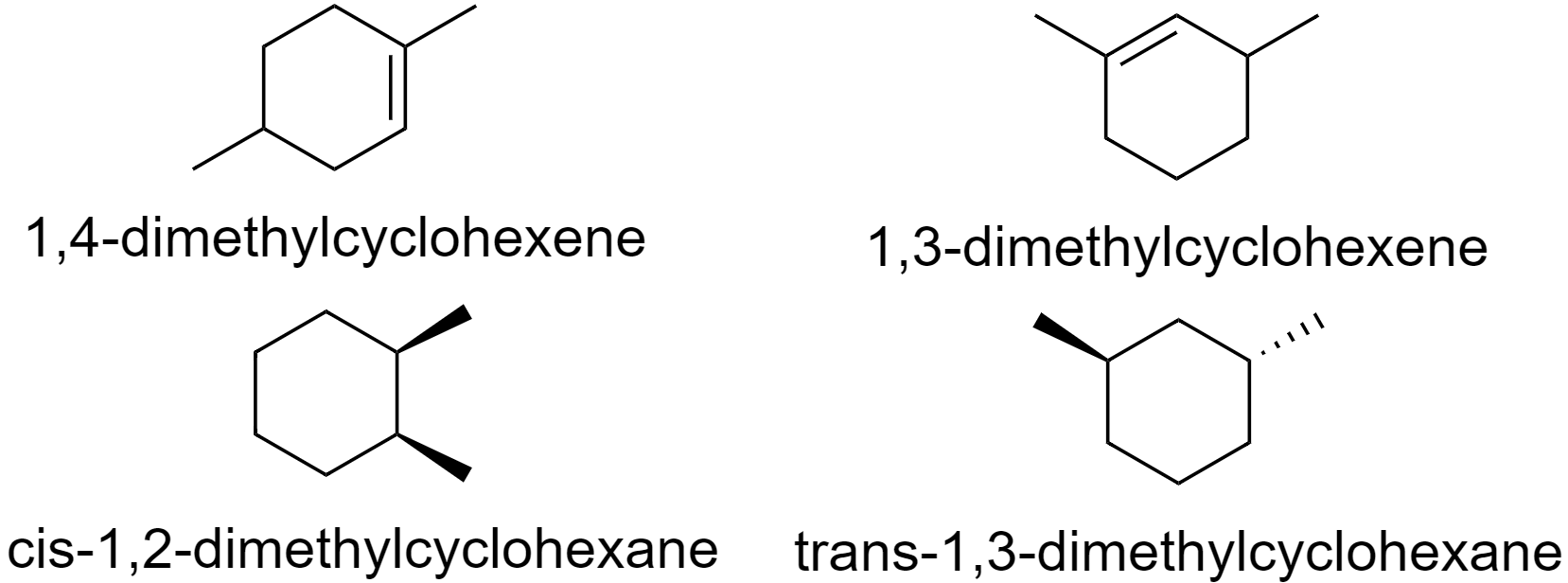
Now, from the structures above we can see that in 1,4-dimethylcyclohexene, 1,3-dimethylcyclohexene, and trans-1,3-dimethylcyclohexane, we cannot draw any axis that will bisect the molecule in such a way that it produces mirror images.
This is because, in 1,4-dimethylcyclohexene and 1,3-dimethylcyclohexene, the methyl groups are substituted at only one of the carbon atoms which is double bonded and hence does not have a plane of symmetry.
In trans-1,3-dimethylcyclohexane, the substituted methyl groups are on the opposite sides of the carbon atom plane hence they do not produce mirror images.
Whereas, in cis-1,2-dimethylcyclohexane, when the molecule is bisected horizontally, it divides into two mirror images.
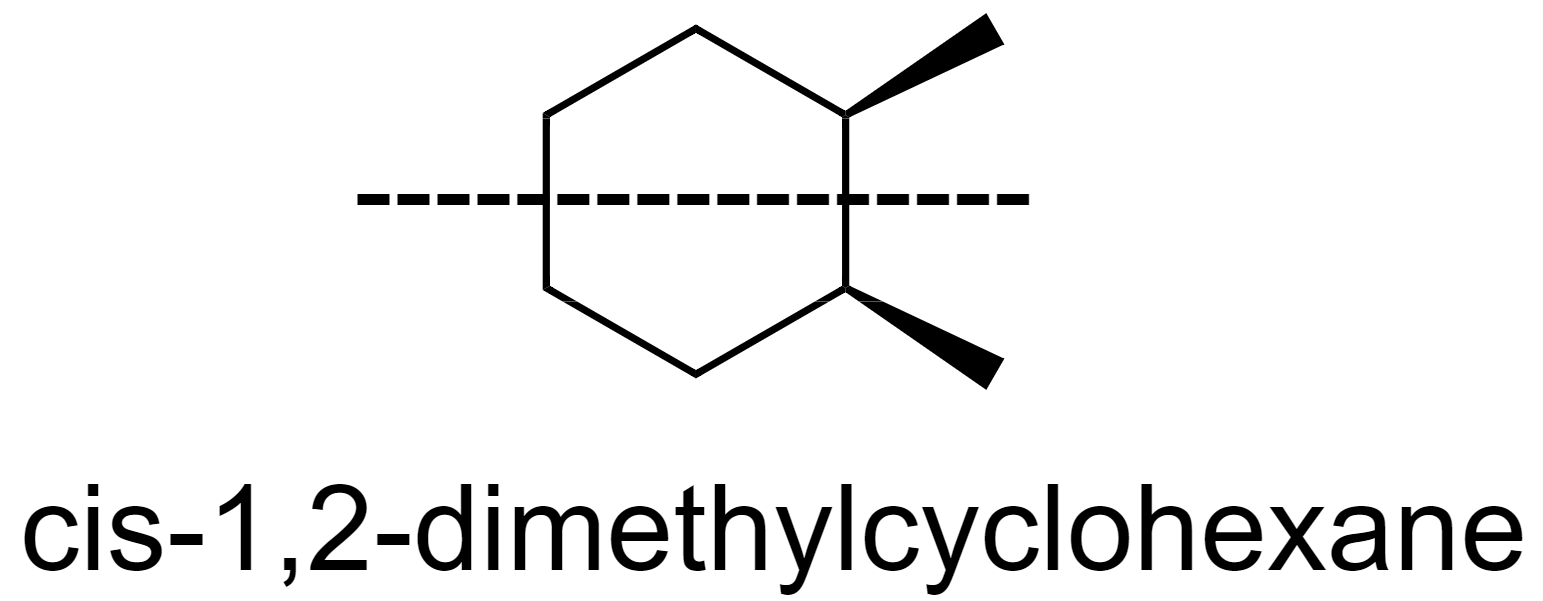
Hence the correct answer is option (D) cis-1,2-dimethylcyclohexane has a plane of symmetry.
Additional Information:
It should be noted that if a molecule has a plane of symmetry, it can be said that the molecule is achiral. An achiral molecule is superimposable on its mirror image.
Note:
It is easy to confuse the plane of symmetry of trans isomer and a cis isomer of a molecule.
One could assume that simply 1,2-dimethylcyclohexane has a plane of symmetry without knowing the cis-trans orientation of the molecule. Hence to determine the plane of symmetry of any molecule, one must know about the orientation of the molecule.
Complete answer:
Now, to determine which molecule has a plane of symmetry, we first need to draw the structure of each molecule.
Now, from the structures above we can see that in 1,4-dimethylcyclohexene, 1,3-dimethylcyclohexene, and trans-1,3-dimethylcyclohexane, we cannot draw any axis that will bisect the molecule in such a way that it produces mirror images.
This is because, in 1,4-dimethylcyclohexene and 1,3-dimethylcyclohexene, the methyl groups are substituted at only one of the carbon atoms which is double bonded and hence does not have a plane of symmetry.
In trans-1,3-dimethylcyclohexane, the substituted methyl groups are on the opposite sides of the carbon atom plane hence they do not produce mirror images.
Whereas, in cis-1,2-dimethylcyclohexane, when the molecule is bisected horizontally, it divides into two mirror images.
Hence the correct answer is option (D) cis-1,2-dimethylcyclohexane has a plane of symmetry.
Additional Information:
It should be noted that if a molecule has a plane of symmetry, it can be said that the molecule is achiral. An achiral molecule is superimposable on its mirror image.
Note:
It is easy to confuse the plane of symmetry of trans isomer and a cis isomer of a molecule.
One could assume that simply 1,2-dimethylcyclohexane has a plane of symmetry without knowing the cis-trans orientation of the molecule. Hence to determine the plane of symmetry of any molecule, one must know about the orientation of the molecule.
Recently Updated Pages
If x a + bt + ct2 where x is in meters and t is in class 11 physics CBSE

A car covers the first half distance between two places class 11 physics CBSE
The resultant of two vectors overrightarrow P and overrightarrow class 11 physics CBSE
Find the value of cos 135 class 11 maths CBSE
A mass M is held in place by an applied force F and class 11 physics CBSE
A solution of glucose in water is labelled as 10 dfracwv class 11 chemistry CBSE
Trending doubts
Find the value of the expression given below sin 30circ class 11 maths CBSE
One Metric ton is equal to kg A 10000 B 1000 C 100 class 11 physics CBSE
Draw a diagram of nephron and explain its structur class 11 biology CBSE
10 examples of friction in our daily life
Proton was discovered by A Thomson B Rutherford C Chadwick class 11 chemistry CBSE
Bond order ofO2 O2+ O2 and O22 is in order A O2 langle class 11 chemistry CBSE