




Which of the following graphs do not represent function?
This question has multiple correct choices
A)
B)
C)
D)
Answer
 Verified
620.4k+ views
Hint:
We will draw a line parallel to y-axes on all the curve and then move that line across the x-axis (vertical line test), if at any place we find that there is more than one point of intersection of the curve for a given value of x, that cannot be a function. Because a function has a unique preimage for all images in a relation.
Complete step by step solution:
We know that in a function, the set of images have a unique preimage, to find that, we have to draw a line parallel to the y-axis on all the curve and then move that line across the x-axis, if at any place we find that there is more than one point of intersection of the curve for a given value of x, That cannot be a function.
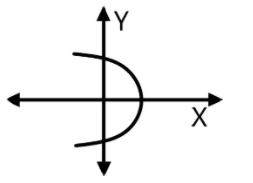
For curve A, we can see that at the right side of the origin, if we draw a line parallel to the y-axis, the drawn line would intersect the curve at two places. That is, it would have two satisfactory solutions for a single value of x. Hence it cannot be a function.
Since the question is multiple correct, we have to check for all the other curves.
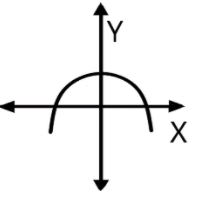
For curve B, we can find no place where a line is drawn parallel to the y-axis will have two intersections at the curve, Hence B is a function.
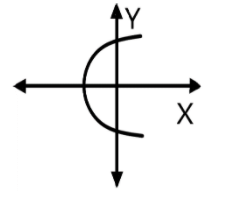
For curve C, we can see that at the right side of the origin, if we draw a line parallel to the y-axis, the drawn line would intersect the curve at two places. That is, it would have two satisfactory solutions for a single value of x. Hence it cannot be a function.
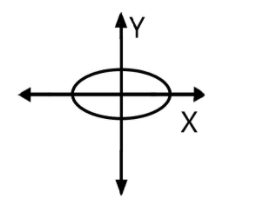
For curve D, we can see that at the right side of the origin, if we draw a line parallel to the y-axis, The drawn line would intersect the curve at two places. That is it would have two satisfactory solutions for a single value of x. Hence it cannot be a function.
Now according to the observations made, we can say that
A, C and D are not the functions, and hence these are the required answers.
Note:
In these types of questions, where the question requires us to check all the MCQs one by one, it is advisable to stop after finding out our first answer and then check if the question is saying single correct or multiple correct. If the question is a single correct type then we can stop then and there to assume that our first answer is the final one. But if it is multiple correct, then we need to observe all the MCQs to get our final answer.
We will draw a line parallel to y-axes on all the curve and then move that line across the x-axis (vertical line test), if at any place we find that there is more than one point of intersection of the curve for a given value of x, that cannot be a function. Because a function has a unique preimage for all images in a relation.
Complete step by step solution:
We know that in a function, the set of images have a unique preimage, to find that, we have to draw a line parallel to the y-axis on all the curve and then move that line across the x-axis, if at any place we find that there is more than one point of intersection of the curve for a given value of x, That cannot be a function.
For curve A, we can see that at the right side of the origin, if we draw a line parallel to the y-axis, the drawn line would intersect the curve at two places. That is, it would have two satisfactory solutions for a single value of x. Hence it cannot be a function.
Since the question is multiple correct, we have to check for all the other curves.
For curve B, we can find no place where a line is drawn parallel to the y-axis will have two intersections at the curve, Hence B is a function.
For curve C, we can see that at the right side of the origin, if we draw a line parallel to the y-axis, the drawn line would intersect the curve at two places. That is, it would have two satisfactory solutions for a single value of x. Hence it cannot be a function.
For curve D, we can see that at the right side of the origin, if we draw a line parallel to the y-axis, The drawn line would intersect the curve at two places. That is it would have two satisfactory solutions for a single value of x. Hence it cannot be a function.
Now according to the observations made, we can say that
A, C and D are not the functions, and hence these are the required answers.
Note:
In these types of questions, where the question requires us to check all the MCQs one by one, it is advisable to stop after finding out our first answer and then check if the question is saying single correct or multiple correct. If the question is a single correct type then we can stop then and there to assume that our first answer is the final one. But if it is multiple correct, then we need to observe all the MCQs to get our final answer.
Recently Updated Pages
Master Class 11 English: Engaging Questions & Answers for Success

Master Class 11 Social Science: Engaging Questions & Answers for Success
Master Class 11 Maths: Engaging Questions & Answers for Success
Master Class 11 Biology: Engaging Questions & Answers for Success
Master Class 11 Physics: Engaging Questions & Answers for Success
Master Class 11 Chemistry: Engaging Questions & Answers for Success
Trending doubts
One Metric ton is equal to kg A 10000 B 1000 C 100 class 11 physics CBSE
Difference Between Prokaryotic Cells and Eukaryotic Cells
Find the value of the expression given below sin 30circ class 11 maths CBSE
Difference between physical and chemical change class 11 chemistry CBSE
Two of the body parts which do not appear in MRI are class 11 biology CBSE
Draw a diagram of a plant cell and label at least eight class 11 biology CBSE